When Kenya adopted its new Constitution on August 27, 2010, many believed the provincial administration—long criticised for its colonial legacy and centralised control—had come to an end.
The expectation was that its functions would be restructured to align with devolution, shifting authority closer to the people.
But 15 years since the promulgation of the Constitution, what looked like a subdued provincial administration has grown even bigger with enhanced roles amid fears that it is undermining devolution.
Under the current constitution, the National Government Coordination Act was enacted by Parliament to provide for service delivery coordination units, which have since seen the number of National Government Administration Officers (NGAO) soar.
The 2019 Kenya Population and Housing Census shows that there are 2,427 locations manned by Chiefs and 6,612 sub-locations headed by Assistant Chiefs.
However, the locations have since increased to 2,735, with sub-locations also increasing to about 7,000.
Chiefs and assistant chiefs from Ndhiwa, Rangwe and Homa Bay Sub-counties during a training session at Kabunde Social Hall in Homa Bay town on January 7, 2023.
Photo credit: George Odiwour | Nation Media Group
This has given rise to 106,072 village elders, 9,144 assistant chiefs and 4,008 chiefs across the country, reporting directly to the national government.
Determined to bolster NGAO, the government has since published a policy document that seeks to recognise and onboard village elders into the national government administration structure and facilitate them for efficient streamlining of service delivery down at the villages ahead of the 2027 general election.
The Draft National Government Village Administration Policy seeks to integrate the village elders, to be renamed Village Administration Elders, into the national government administrative units, effectively granting them legal authority, clear responsibilities and financial clout.
However, immediate former Attorney-General Justin Muturi who also served as Speaker of the National Assembly in the 11th and 12th parliaments, claims that the policy is a clear indication that the government is keen to give chiefs, their assistants and village elders “enhanced and sweeping powers over the operations of the police service.”
While making reference to the failed attempts to enhance the NGAO powers through changes to the law, Mr Muturi, also the immediate former Public Service Cabinet Secretary, revealed that the government wants to give NGAO officers the powers to command and deploy the police officers.
Former Cabinet Secretary for Public Service Justin Muturi makes his remarks during the second Mwai Kibaki Memorial Lecture and Luncheon at the Serena Hotel on April 11, 2025.
Photo credit: Francis Nderitu | Nation Media Group
This is notwithstanding that the command and deployment of the police is reserved for the Inspector-General of Police.
“Command over the police service, under the constitution, is a preserve of the authority of the Inspector-General of Police. It is not shared. Anything that gives somebody else command over the police is unconstitutional,” said Mr Muturi.
Command is defined as an order, imperative direction, or behest to direct with authority, power to dominate and control.
The police service, just like any other national security organ, is subordinate to civilian authority.
“The constitution prescribes instances in which civilian authority can exercise power over the police,” says Mr Muturi, adding; “civilian authority is exercised in the appointment of the Inspector-General of Police and in the issuance of lawful directions.”
Article 245 (2) provides that the IG shall exercise independent command over the police and perform any other functions prescribed by national legislation.
The 2010 constitution mandated the national government to restructure the provincial administration to focus on service provision, downward accountability and advance public interest rather than self or regime interests.
In doing so, the national government was required to ensure that it stays above inter and intra-governmental conflicts so as to protect the interests of devolution.
Article 189 of the Constitution states how the national and county governments shall relate in terms of cooperative governance.
“A government at either level shall perform its functions, and exercise its powers in a manner that respects the functional and institutional integrity of government at the other level and respects the constitutional status and institutions of government at the other level,” the article states.
But the increased numbers of NGAOs from the locational level downwards show a government determined to ensure its presence is felt, a policy direction that has been blamed by legal and governance experts for duplication of roles and wastage of public resources.
City lawyers David Ochami and Lempaa Suyianka cautioned that the policy and the entire setup of NGAO undermine devolution.
“Abolition and reformation of the provincial administration in particular and implementation of devolution in general have been met with attempts to defeat the letter and spirit of the constitution by subsequent regimes,” says Mr Ochami while pointing an accusing finger at parliament.
According to Mr Suyianka, “I would have supported a system that seeks to integrate the NGAOs into the devolution system.”
“What we are witnessing is abuse of public resources and funds,” said Mr Suyianka.
With the repeal of the Chiefs Act that allowed the Chiefs and their assistants to be appointed by the Public Service Commission (PSC), the power to issue orders and to maintain order in their respective areas came with the National Government Coordination (NGC) Act.
The NGC Act established an administrative and institutional framework for the coordination of national government functions at the national and county levels of governance.
The law assigns the Chief the power to head a location and an assistant chief, a sub-location.
The PSC also has the power to recruit “any other national government administrative officer in respect of a service delivery unit,” as outlined in the Act.
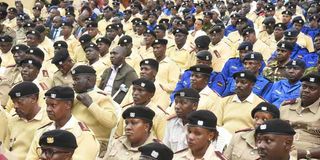
Members of the provincial administration at a past public function. PHOTO/ FILE
“A national government administrative officer appointed under this Act shall have all the powers necessary for the proper performance of the functions under this Act or any other written law,” reads section 16 of the NGC Act.
Their functions, as outlined in section 17 of the NGC Act, state, “a national government administrative officer shall be responsible for the co-ordination of national government functions as set out in the constitution, this Act and any other written law at the county level and other decentralised units as far as may be necessary.”
In 2023, an attempt by former Malava MP, the late Malulu Injendi, to have the national government recognise village elders and have them on the payroll as national government administrative officers in charge of service delivery units at the lower level failed.
This is after the National Assembly failed to enact the National Government Coordination (Amendment) Bill 2022.
The Bill sought to establish village councils headed by a village administrator and the appointment of village elders to the village council “for the coordination of national government functions at the village level.”
The policy has provisions for training, oversight and logistical support for the Village Administration Elders.
To qualify for appointment as village elder, the policy states, one must be a citizen of Kenya of sound mind, have knowledge about the village, culture and residents, have integrity, be in good standing in the community and must be a resident of their respective village for at least five years.
It also seeks to have formal mapping and gazettement of villages undertaken, as well as the introduction of eligibility requirements for the elders and the assignment of defined responsibilities that include maintaining local incident registers, promoting peace and coordinating with government institutions.