Ask Consolata Wanjiku, a 52-year-old vegetable vendor in Kiambu, what she thinks of police officers and she will tell you: "If you see them coming, you hide your things or your money.”
Her voice is weary and not angry. And for as old as she is, she has never known a different kind of policing. She has been stopped for “inspection” more times than she can count. Each time, the negotiation is the same: cash in exchange for being left alone.
It’s a story Nicholas Omondi, a mason in Nairobi, knows well. Most evenings, he walks home carrying his tools of trade including a hammer, trowel, and other paraphernalia. More often than not, police stop him to “inspect” his belongings. Each stop comes at a price between Sh500 and Sh1,000 to “buy” his freedom. Sometimes, exhausted and demoralised, he hands over all he has earned. If he hesitates, they threaten him with charges such as loitering or disorderly conduct or whatever suits the moment.
"They have become very brutal. Their presence around me has always sent chills down my spine," Mr Omondi said.
Had the spirit of the 2010 Constitution been fully realised, the Kenya Police would have transformed from a force to a service. But 15 years later, that transformation remains a pipedream.
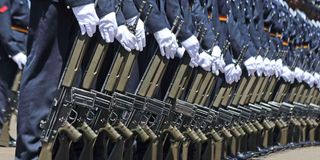
Police officers during a past pass-out parade at the National Police College Main Campus Kiganjo in Nyeri County.
Photo credit: File | Nation Media Group
The new constitution promised a police service grounded in human dignity, rights, and freedoms. The name change — from “force” to “service” — was meant to signal the end of colonial-era policing, where the uniform symbolised fear rather than trust. But on the ground today, the uniform still carries that old weight.
That constitution envisioned a National Police Service bound by a code of conduct, trained in community policing, with the National Police Service Commission (NPSC) insulating recruitment and promotions from politics. It also birthed the Independent Policing Oversight Authority (IPOA) that was given the mandate to investigate misconduct.
Policing in Kenya was built to protect the state and not the citizens, argues Ernest Cornel of the Kenya Human Rights Commission (KHRC). That is the root of the problem of policing in the country, he says.
"Number one is, it is the history of how the police came to being in Kenya," he says. "The police force was created by the British colony to protect their interests… the culture… [is] nearly to protect those in authority.”
That culture survived independence. "Even when the British left… the police assumed the same role, to protect those in power… It became their number one objective." Whether the leader was a democrat or a dictator made little difference — orders from the top were “judiciously followed.”
The 2010 Constitution sought to break that chain by making the service independent of the executive. But a turning point came in 2015.
"The Security Laws Amendment Act… removed the independence of selecting the Inspector General of Police… and gave that power to the head of state," Cornel says, adding that the result is "successive Inspector General of Police… taking instructions from the executive."
Administration Police officers during a pass-out parade at the National Police College in Embakasi,Nairobi, on November 29,2021.
Photo credit: File | Nation Media Group
Accountability, Cornel argues, is key. "One of the ways to achieve a police service that respects human rights is… courts are very, very important… [They] are setting good precedents."
Surveys have consistently ranked the Kenya Police as the country’s most corrupt institution — a fact reaffirmed by the Ethics and Anti-Corruption Commission (EACC) in August. Nearly half of respondents (48.2%) named the police as most prone to graft, over nine times higher than the second-ranking department.
Dubbed the National Ethics and Corruption Survey (NECS) 2024, the report singled out the Traffic Police (3.6%) among the offenders.
The NPSC and Ipoa — once hailed as reform game-changers — have struggled under budget cuts, political hostility, and intimidation.
In August, a consortium of civil society organisations called for strengthening the NPSC and a sweeping overhaul of the police. Vocal Africa and six other groups warned Kenya is "on the brink" and pushed for abolishing the current system, arguing that "as long as this police force exists in its current form," the country will remain trapped in "violence, corruption and fear."
Inspector-General of Police Douglas Kanja.
Photo credit: File | Nation Media Group
Their statement demanded: "The NPSC must be independent, well-funded and empowered to vet, discipline, and oversee police officers without political interference… including overseeing promotions."
The National Assembly’s Public Accounts Committee in July directed Mr Kanja to surrender payroll management , but the dispute remains unresolved.
Civil society groups also proposed raising the KCSE entry grade for recruits to C plain. "Policing must not be a dumping ground for desperation," they said. "Kenyans deserve… competent, educated, ethical officers."
President William Ruto inspects a guard of honour during the Administration Police pass-out parade at the National Police College Embakasi A Campus in Nairobi on January 11, 2023.
Photo credit: PCS
A Missing Voices report by a consortium of Civil Society Organisations observed that 2024 alone saw an increase of 24 per cent of cases of enforced disappearances and police killings compared to 2023. Enforced disappearances increased by 450 per cent from 10 cases in 2023 to 55 in 2024. However, cases of police related killings saw a drop of 12 per cent from 118 in 2023 to 104 in 2024.
Most cases of extrajudicial killings took place during the Gen Z demos between June and August, with June recording the highest number of cases at 38, 11 July cases and 9 August. Bringing police killings cases to 58 during the protest period, the report said. And it kept getting grimmer by the day.
Some reforms have emerged, like Policare which is a one-stop centre for gender-based violence survivors offering medical, legal, and psychosocial support. But such initiatives remain small islands in a vast sea of systemic problems.
The desire for Kenya to achieve a people centred police service has been long and onerous, reads a communique on the Ministry of Interior and National Coordination website.
The Ministry of Interior admits the journey to a people-centred police service has had “many hits and misses” since the force was formed in 1906. Multiple commissions from Waki to Ransley have diagnosed the same problems: impunity, political interference, and lack of accountability. Salaries and equipment have improved, but training and mindset reforms lag.
In 2022, President William Ruto appointed a taskforce led by former Chief Justice David Maraga to reform the police. Its 2023 report recommended sweeping changes to the police, prisons, and the National Youth Service. But, like past reports, it remains largely on paper.
"It also became clear that the reform recommendations stand little chance of being implemented if the leadership issues are not addressed," Mr Maraga said while presenting the report to President Ruto.
Interior Principal Secretary Raymond Omollo said reforms will be implemented from 2024 to 2028. “The success of these reforms will hinge on their effective implementation and continued support and collaboration of all stakeholders,” he said then.
For now, Kenyans like Wanjiku and Omondi keep paying their way out of trouble and the police remain, for many, the force that refused to become a service.