Before 2015, if you bumped into one Dr Ezekiel Mutua Nyithya, the former Kenya Films Classification Board (KFCB) and Music Copyright Society of Kenya (MCSK) CEO, on the streets of Nairobi, you'd likely have mistaken him for just another sharply dressed government officer navigating the labyrinth that is Kenya’s public service.
And you wouldn’t be wrong.
Up until December 9 that year, Dr Mutua was quietly tucked away in the Ministry of Information, drawing a decent bureaucratic salary somewhere between Sh133,870 and Sh197,800—as per Salaries Remuneration Commission scales—while carrying the title of Information Secretary. Fancy, yes, but still far from front-page material.
Dr Ezekiel Mutua. He has been ordered to pay Sh27 million.
Photo credit: Wilfred Nyangaresi | Nation Media Group
A man so invisible, then, that even his own social media pages looked like ghost towns. No fire tweets, no hashtags, no lectures on morality.
That was before the Public Service Commission (PSC) stepped in and handed him a script rewrite fit for a blockbuster.
In a December 9, 2015, letter to the Ministry of Information, signed by the then PSC Secretary and CEO Alice Otwala, one Mutua was seconded to head the Kenya Film Classification Board (KFCB) as CEO.
And just like that, Dr Mutua went from the shadows of government office corridors to the full glare of national spotlight.
Kenya was about to witness a transformation the likes of which only daytime telenovelas dare attempt.
Overnight, this man became what Kenyans would later nickname “self-appointed moral cop”: policing films, regulating music videos, and issuing parental advisories with all the energy of a deejay on a 12-hour set.
KFCB was suddenly hot! Not because of films—no one remembers what they actually rated—but because Dr Mutua had become the country’s newest headline generator.
He didn’t just enter the KFCB office. He marched into the CEO's corner office like the Biblical Moses, with a freshly printed copy of the Ten Commandments and armed with one mission: to protect the moral fabric of Kenya at all costs, whether we liked it or not.
Under him, the colonial-era Film and Stage Plays Act of 1962 found new life, resurrected and weaponised like a zombie law out to devour modern artistic expression. If Mutua didn’t like it, you didn’t get to see it. Period! He sparred with artistes, threatened to ban global streaming services, and once even tried to out-regulate the internet.
He barred kiss scenes on a Coca-Cola TV advert and labelled cartoons as ‘satanic’ when he banned DSTV cartoon programs for allegedly promoting homosexuality.
From there on, Dr Mutua went full-blown “moral Avenger”. When the group Sauti Sol released “Melanin” in 2017, he branded it “pure pornography.”
He moved on to ban Diamond Platnumz’s “Kwangwaru” and Rayvanny’s “Tetema” branding the Tanzanian records “pure filth”.
Mutua’s moral mission was on steroids, gaining maximum velocity as days went by.
But perhaps his most high-profile moment came when he banned Rafiki in 2019, the lesbian-themed film by Wanuri Kahiu. The backlash was fierce, global even. But when a court backed the ban in 2020, Mutua was over the moon. He gave thanks not just to God but to all the lecturers who taught him law. Never mind that nobody can quite confirm which law school he went to.
“We’ve won against beer ads, betting companies, and now against gay sympathisers,” he vaunted.
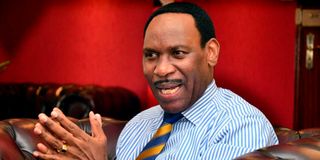
Dr Ezekiel Mutua gestures during a past interview.
Photo credit: File | Nation Media Group
Behind Curtains, the mess
As the country watched his morality crusade, as he preached righteousness in front of cameras, behind the scenes, his morals were beginning to stain. Dr Mutua and the KFCB board were quietly reworking his “salary script”.
It turns out that he’d been “blessed” with an illegal salary hike from Sh348,840 to a “heavenly” Sh1.1 million plus a Sh100,000 monthly ‘entertainment allowance’. All of this was without the SRC and the Cabinet Secretary for ICT approvals.
By 2019, in his second term, Mutua was already earning Sh1.1 million per month, way above the SRC cap of Sh480,000 for the role. The moral police were knowingly living large off irregular pay.
When the Inspector General of State Corporations demanded he refund the illegal pay, which had accumulated to Sh27 million in overpaid perks, Dr Mutua lawyered up. He resisted with the passion of a televangelist defending his jet. He sued.
He claimed it was board-approved, not his fault, and that no one proved it was ‘overpayment’.
In its ruling on July 9, the State Corporations Appeal Tribunal termed the salary ‘irregular and unlawful’. The entertainment allowance? Equally shady. The man who told us what was right and wrong on screen was now facing allegations of being financially unholy.
After overstaying his two-term welcome at KFCB, Dr Mutua clung to his CEO chair like it was an inheritance. When word went out he had been kicked out of the board, Dr Mutua still, in full Mutua-mode, declared to cameras and on X that he was still the CEO.
"My attention has been drawn to reports on social media to the effect that I have been fired as CEO of KFCB. Please ignore such malicious rumours. I am not aware of such developments and there can be no grain of truth in them as there's no vacancy in the office of the CEO KFCB."
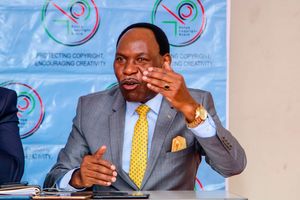
Music Copyright Society of Kenya CEO Ezekiel Mutua addressing participants during distribution of royalties to their members at Safari Park Hotel in Nairobi on January 25, 2024.
Photo credit: Bonface Bogita | Nation
He was eventually kicked out with a whimper and a court order. The High Court ruled that his attempted third term as KFCB CEO was illegal, as he had already maxed out (maximum possible) the limit of two terms of three years each. From 2015-2018, and then from October 2018- October 2020.
He left the moral pulpit with his ego dented, but not destroyed.
Then came March 2022. Like a reboot of a bad movie franchise, Mutua returned, this time as MCSK CEO with a salary of Sh742,500 and a black shiny Sh10 million Toyota Prado TX, complete with a chauffeur paid for by the society.
On his first media interview (with Nation), he promised to “make Kenyan artistes billionaires.” His new mantra? “Pesa mfukoni” (Money in your pocket).
What did the musicians get instead? Sh2,500 in royalties and another round of hollow speeches on X and media interviews. Soon, the MCSK board had had enough of the man and his gospel of empty promises to turn the society’s fortune around and fired him for insubordination and gross misconduct.
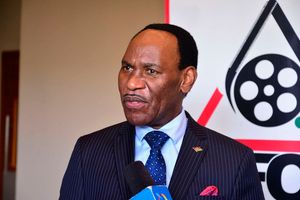
Kenya Film Classification Board CEO Ezekiel Mutua speaks to journalists in Mombasa on February 1, 2016. He announced that the board would soon launch a nationwide crackdown on all unregistered video distributors and exhibitors and those distributing pornographic material. PHOTO | WACHIRA MWANGI | NATION MEDIA GROUP
But like an unskippable irritating ad, Dr Mutua refused to go away. He claimed he was still the CEO. He posted, he protested, and even threatened to sue the Nation for publishing his termination notice.
Once again, the High Court ruled in May 2025 that he had no authority to transact any business on behalf of MCSK as he had long been fired as the society's CEO. The moral cop had attempted to pull a dirty trick when he opened a new MCSK bank account months after being sacked, but it was immediately frozen. Irked, he rushed to court to sue Kenya Revenue Authority for freezing the new account, only for Justice Aburili Roselyn to leave him egg-faced. You are not the boss, she ordered.
Even though disgraced, the moral cop remains active on X—talking about God, football and dropping doses of life quotes. To this very day, his X bio still reads, 'CEO - MCSK', complete with a link to the MCSK website—which hilariously opens with the public notice of his firing.