When a boy is circumcised in many Kenyan communities, the days that follow come with a cultural demand: his parents must abstain from sex until his wound heals, usually after seven days.
For generations, this was accepted as part of the circumcision ritual. However, this ritual obligation is increasingly becoming a fault line between tradition and modern Kenya. While elders insist that the abstinence rule preserves cultural purity and protects the initiate, critics see an unverifiable belief that can be exploited for financial gain.
At the heart of the debate are bigger questions about the place of tradition in contemporary society, the changing structure of Kenyan families and whether circumcision has retained the deeper lessons that once gave it meaning.
According to cultural researcher Mwaura wa Koigi, the belief that parents of a circumcised boy must abstain from sex for seven days is common across almost all circumcising communities in Kenya.
“The logic has three steps: First, a fresh circumcision wound is hot, open and sacred. Second, sex is hot and worldly. Third, mixing the two transfers heat and impurity to the boy, causing bleeding, swelling, infection and spiritual vulnerability, and the circumcision wound won't heal,” he said.
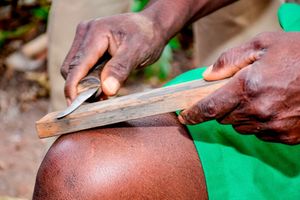
A Ngariba (traditional circumciser) sharpens a Lukembe, the ceremonial circumcision knife, ahead of the Bukusu male circumcision in Bungoma on August 1, 2026.
Photo credit: Alex Odhiambo| Nation Media Group
“For those seven days (in some communities, the period is not limited to seven days but extends throughout the time the wound remains unhealed), the parents must live in a state of ritual cleanliness: no sex, no quarrels, no drinking of alcohol or narcotics, and no attending funerals,” he said.
According to Mr Koigi, culture presents the restriction as both a sacrifice and a lesson in discipline. The underlying question, he says, is whether parents who cannot exercise self-control for seven days can teach their sons how to conduct themselves as men.
But medical professionals see no connection between a parent's sexual activity and a child's recovery.
According to Dr Leonald Gikera of Murang'a Level Five Hospital, there is no medical basis for the belief.
“A parent's sex life does not affect a child's wound healing. Cleanliness, antibiotics and rest do. But culturally, the rule survived because it was never really about medicine. It was about demonstrating that the family took the transition seriously. That consensus is now breaking,” he said.
In the Mt Kenya region, the demand is already facing resistance. New Gikuyu, Embu, Meru and Akamba Association youth leader Dr Martin Njenga describes the sexual abstinence requirement as a misguided belief riddled with grey areas.
“Who confirmed that it is observed? Where is the data that there are boys who did not heal because their parents broke the cultural demand on intimacy? Do we have boys who have spent their lifetime trying to heal the wound because their parents broke the demand?” he poses.
He argues that a taboo that cannot be verified cannot become a moral law, but can only operate as a law of fear.
“No one can walk into a bedroom to confirm. So who benefits from the fear? Here among the Agikuyu, we have cultural purists who insist on all this chaos so that they can demand money and goats for purification. But for those who don't care, we treat the circumcision wound just like any other wound. I know what I am saying because I recently had my firstborn circumcised, and I did not abstain. The boy healed normally,” he claims.
Dr Njenga also questions how the rule can be enforced in modern family arrangements, particularly where single mothers, absent fathers and blended families are involved.
“The traditional rule assumed a stable, co-resident, monogamous homestead: one father, one mother, under one elder's authority. Modern Kenya does not look like that. Single mothers wouldn't know where the father of the child is, and if he is married to another woman, you can't walk there and demand that he abstains,” Mr Njenga says.
He gives the example of a boy raised by a single mother in Eldoret while his biological father lives with another wife in Nairobi. Another boy may be raised by his grandmother, while a third may live with a stepfather.
“Who must abstain? The mother alone? The absent father? The stepfather? The rule has no answer because the family structure it was designed for no longer exists for millions of Kenyans,” he says.
But cultural elders insist that the abstinence requirement should not be dismissed simply because modern society has become more permissive.
Kiama Kia Ma Council of Elders patron Mr Kung'u Muigai says circumcision is facing a legitimacy crisis, partly because some of the elders enforcing cultural obligations have themselves not undergone the rite.
“One elder recently got circumcised at the age of 72. The very same elders enforcing that abstinence,” he said.
Lost cultural significance
Nevertheless, Mr Muigai maintains that the abstinence requirement applies to whoever has immediate responsibility for the boy, regardless of their biological relationship.
“It is not about theories. It is about the one under whose care the boy is, even if it is a total stranger who has taken custody of the boy. This is about making the ritual reign supreme in that homestead. Sex is also a ritual. I won't advise you to dare it, for it might withhold its anger on that boy but come back in a more devastating way,” he said.
He argues that circumcision has gradually lost its cultural significance, pointing to the growing practice of having boys circumcised in hospitals and churches, with some mothers taking their sons for the procedure without following the traditional initiation process.
“This was supposed to be a cultural rite of passage where the boy first sought permission from his eldest maternal uncle, then got a mentor, as well as remained in seclusion while getting counsel from elders,” he said.
Mr Muigai says the rite commanded respect when it was held in high esteem and parents willingly observed the restrictions imposed on them during the initiation period.
He further argues that many boys are now circumcised primarily for HIV prevention rather than as part of the traditional transition into manhood.
“They have a wound, but no teaching. Their parents borrow fragments from other tribes, other churches, other YouTube videos to fill the vacuum. The seven-day abstinence survives, but the months of teaching that gave it meaning do not,” he said.
Former Education Chief Administrative Secretary Zack Kinuthia, who is also a cultural researcher, says circumcision remains a powerful political and social marker in Kenya.
“It determines who is considered a man, who can speak in elders' councils, who can lead. If the rite is hollowed out, its political power does not disappear — it becomes more dangerous. It becomes a gatekeeping tool without the ethical training that was supposed to accompany it,” he said.
Mr Kinuthia acknowledges that modernity is challenging many aspects of traditional culture, but argues that cultural obligations should not necessarily be abandoned.
“...but since in law nothing can be forceful, we leave it at the juncture of dare your gods if you can, for me I won't, and the seven days of sexual purity applies,” he said.
He maintains that the seven-day abstinence rule was never primarily about the physical healing of a boy's circumcision wound.
“It was about a family proving it could subordinate pleasure to purpose. And mind you, the family is universal, hence why it applies in all compounds with a freshly circumcised boy in the whole world,” he said.
For Mr Kinuthia, the debate should go beyond whether parents can manage to abstain from sex for seven days. It should address whether the cultural values and lessons behind the practice are still understood and respected.
“The question for the next generation is not whether parents will abstain for seven days. It is whether anyone can still explain why in a way that makes sense to all,” he said.