While studying at Sony Sugar Primary School in Migori County, Juma Alexander had so much passion for journalism. He dreamed of becoming a senior journalist. That passion inspired him to put more effort into his studies, aiming for nothing below a C-plus – the minimum university entry requirement.
When he received his Kenya Certificate of Secondary Education (KCSE) exam results in January this year, he was happy with his C-plus grade. However, his father convinced him to pursue a course that would guarantee him a job after graduation.
“My dad advised me to take a diploma in electrical engineering, saying that even if I failed to get employed, I could start my own business,” Alexander says.
After choosing the course, Alexander spent a lot of his time around his uncle, who is currently working with Kenya Power.
“My uncle is an electronic engineer and he told me there is a huge demand for engineers like him,” says Alexander.
Unlike a degree in journalism, which takes four years, Alexander will graduate in two years.
“I decided to start at diploma level so I could acquire skills and knowledge faster than the theories they teach in degree versions of the same course, which take five years. At home I have been fixing showers. I plan to advance to degree level while already employed or running my business,” he adds.
For Kelvin Kimurgor of Nandi County, who also scored a C+ in the 2025 KCSE examinations, pursuing a diploma in electrical engineering is an opportunity to turn a childhood dream into a career.
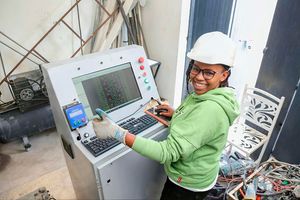
“I’ve always had a passion for this course. By the time I was in Form One, I was already connecting batteries to light bulbs at home and repairing radios. I used to break my own phone and try to fix it myself. I went for a diploma instead of a degree because I wanted to study in a TVET (Technical, Vocational Education and Training) institution,” Kimurgor says.
Kimurgor will graduate after three years, two years earlier than if he had taken a degree course.
“My family, especially my parents, say I made the right choice and are supporting me. I look forward to being self-employed and creating jobs for others once I graduate.”
Daniel Muthoka, who qualified for a degree course, says that he is taking a Diploma in Mechatronics Engineering instead of a degree because it takes less time and is more practical than the degree classes, which have a lot of theory lessons.
Photo credit: Pool
After Daniel Muthoka completed high school last year in Makueni County and scored C-plus in KCSE, he was excited to have qualified for a degree course. However, he decided to enrol for a diploma in mechatronics engineering that will take him two years.
“I was actually aiming for a degree in engineering but then I started to see the advantages of the diploma, including it being more or practical work. While studying, I would be dealing with machines and spending time in the workshop, which I find more interesting than the degree classes which have a lot of theory,” Muthoka says.
His passion for engineering was inspired by his father, who is a plant operator.
“When I visited my dad’s workplace, I saw how huge machines were cleaning avocados, which made the job easier instead of people having to wash the fruits one by one. That made me appreciate the role of automation.”
Muthoka hopes to take a degree course, but only after working and enjoying the fruits of his studies for a while. When he revealed his plan to his parents, they did not object.
“My dad told me not to think about what people will say. I am glad I have a supportive dad because my elder sister also qualified for a degree but she went for a diploma in nursing.”
Alexander, Kimurgor and Muthoka are among the 270,715 candidates who sat the 2025 KCSE examination and qualified for direct university entry after scoring a mean grade of C+ and above.
A total of 993,226 candidates sat the 2025 KCSE examination.
Meru University of Science and Technology Vice Chancellor Romanus Odhiambo during an interview at Nation Centre in Nairobi on November 11, 2026.
Photo credit: Evans Habil | Nation
According to the Vice Chancellor at Meru University of Science and Technology, Prof Romanus Odhiambo, qualifying for a degree course is one thing; meeting the cluster points for electrical and electronic engineering is another.
“For all engineering courses, there are specific subjects that are considered, including mathematics, physics, chemistry, as well as English and Kiswahili languages,” Prof Odhiambo tells Parenting.
Before attaining university status, Meru University of Science and Technology was a TVET institution.
It continues to offer diploma programmes in engineering, accredited by the TVET Authority. In recent years, enrolment in these programmes has been on the rise, with more students opting for diplomas over degrees in the same fields. For instance, 32 students enrolled for the Diploma in Electrical Engineering in 2022. This number rose to 45 in 2023 and 53 in 2024.
“Some students are coming straight to the university to pursue a diploma in electrical and electronic engineering because they initially wanted to study the course at Bachelor’s level but realised they could not. Progressing from a diploma to a degree then becomes easier, and they complete the degree a year earlier because they have already covered most of the units taught in the first and part of the second year of the diploma programme,” Prof Odhiambo says.
While degrees are often associated with theory and diplomas with practical skills, this distinction does not apply to all degree programmes. The Bachelor of Technology, for instance, places as much emphasis on hands-on learning as it does on scientific knowledge.
“Students can dismantle an electrical appliance, troubleshoot it, identify the problem and fix it. These are technologists, so their training is competency-based. They acquire knowledge, such as understanding what a circuit is, develop practical skills by working with their hands and, importantly, learn the value of understanding why a component must be installed in a particular way and not another. Their training focuses on building abilities, skills and knowledge,” explains Prof Odhiambo.
The availability of TVET institutions in nearly every constituency, coupled with government support through scholarships, loans and upkeep allowances, are among the factors Prof Odhiambo attributes to the rise in enrolment in certificate and diploma programmes in engineering. Asked whether TVET institutions are more responsive to market demands than universities, Prof Odhiambo says there is no neat answer.
“Well, when you have a plumbing or electrical problem in your house, it is TVET graduates you call because they are hands-on. But they are technologists, not engineers. The world cannot have technologists without the people who guide them. They need engineers, who have to go to university for five years. In fact, the conventional rule is that you require at least one engineer for every three technologists,” adds Prof Odhiambo.
He avers that there are many job opportunities for students graduating with electrical and electronic engineering.
“I’ll start with TVET students. There is currently high demand for their skills in homes, hotels and industries, where many are needed. Another advantage is the Competency-Based Education approach, which equips students with practical skills to start their own businesses. Once properly trained, they can get equipment from their parents or sponsors and set up enterprises such as car repair garages. Some of these young people earn between Sh10,000 and Sh50,000 a day, tax-free.”
There are also opportunities abroad, where the majority of the population is ageing.
“In Europe and America, one can earn 30 times more for the same job that would earn him Sh10,000 in Kenya,” says Prof Odhiambo. But skills alone are not enough. “I really encourage our young students to consider learning languages such as Italian and German.”
Shadrack Waithaka from the State Department of TVET believes that changing job trends within and outside the country are fueling the preference for diplomas over degrees.
“More people have seen that the “juakali” sector is booming and they want to be their own employers in future. They are seeing unemployed people all around them.
Factors like lack of enough money to support degree education also make some parents send their children to diplomas courses even if they have qualified for degrees. But life coach Wanyonyi Wafula says none of this erases the value of degrees.
“We are in a competitive field and things are very hard. If you feel that a diploma can open more opportunities for your child, let them go for that. They can continue to degree level later in life,” he says.