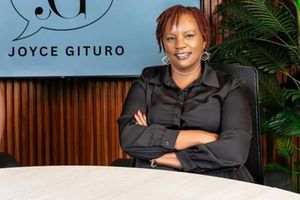
Fanice Andeso, Mercy Mulwa and Wendy Mbuki Gachuki.
As single motherhood grows in Kenya, finding a dependable father figure remains an elusive goal for many women and their children.
Some boys, too, grapple with the absence of a father, searching for role models to fill the void. Wendy Gachuki, Mercy Mulwa, Fanice Andeso and Sammy Lenawalchingei recount their experiences in interviews with Nation Lifestyle.
Mercy Mulwa is a mother of two sons.
Wendy had hopes that her children would grow up as she did. Both her parents were present in her life.
“My parents never failed me. But I feel like I failed, not as a mother, but in choosing my daughter’s father. Our relationship fell apart after I became pregnant. The first time he saw our daughter was when she was about six years old, in Grade Two,” she says.
When the relationship ended, Wendy suddenly found herself raising a child on her own while trying to build a career. It was not easy, she says, but she chose to leave the hurt behind and focus on raising her daughter, with the support of her parents.
Read: Dear Dad, this is how your absence affected me
“I got my baby when I was a bit advanced in age. I was 31. When my baby daddy left, I was so confused because I was in between jobs. But I chose not to blame him. I moved on; I didn’t even take him to court,” she says.
Wendy says there are moments when her daughter, now 10 years old, misses her father.
She remembers during an online class at the height of the Covid-19 pandemic. Her daughter, then aged four, asked one of her classmates who he was spending the day with. “My mum and dad,” the child replied. Then came the question that filled Wendy with sadness. “Where is your dad?,” the other child asked. “I don’t have a dad,” her daughter answered.
It was that moment she realised that her daughter was beginning to notice her father’s absence.
“After that, I called him and told him I had accepted that our relationship was over. I asked him to be part of our daughter’s life. I also told him that if he had any doubts about whether she was his child, I was willing and ready to drop our daughter at a place of his choice for a DNA test at my cost,” she says.
One of the hardest parts, Wendy says, has been trying to keep the bond between her daughter and her father alive—a draining effort that too often ends in heartbreak.
She says it took two years before the dad showed up to see the daughter, and his visits were inconsistent.
“He is trying, but their conversations are mostly over the phone,” she says.
For now, her brothers and her dad continue to play the role of father figure. Her greatest disappointment, she adds, comes from watching her daughter repeatedly let down.
“Twice he promised her he would send a birthday cake, but nothing came. When she was younger, I would secretly buy her gifts and tell her they were from her dad because I didn’t want her to feel forgotten. Eventually, I realised I was only creating a false image of him. I stopped. Now, if he promises her something and doesn’t follow through, I tell her the truth. I encourage her to remind him the next time they speak—either to bring the gift or send the money so I can buy it for her.”
Through it all, Wendy is grateful to her parents’ continuous support.
“When I gave birth, my mother was with me in the delivery room, and after that, I stayed with her for a year before I got my own house. My father has been the best grandfather to my daughter, and he has made parenting so easy. Not once have I reached out to him to pay for my daughter’s school fees, and he unconditionally does it.”
Colleague as father figure
Wendy Mbuki Gachuki is a single mother of one whose baby daddy first saw their daughter when she was about six years old
Like Wendy, Mercy Mulwa, 28, also has her struggles. Her child’s father left.
Mercy later found a colleague who started playing the father figure role to her son.
“He loved my son, organised his fifth birthday party and even allowed him to call him dad. It was such a nice relationship.”
Their friendship blossomed into a romantic relationship, and they later had a son together.
“Two years after I gave birth to his son, he started telling our friends that my firstborn was not his. I did not want my sons to be separated, so I parted ways with him and started taking care of my two sons alone.”
Mercy’s sons are now eight and five years old. They stay with her parents; her father plays the father figure role.
“My father has shown them so much love. If he’s running late, my sons refuse to go to bed until he comes. That has made parenting easier because raising sons is not easy. Sometimes they don’t take me seriously, and I have to tell my father to discipline them,” she says.
Mercy says her requests for parental support have hit dead ends.
“Last year, I was jobless, and my first-born son was sent home for school fees. When I sent a message to his dad, he didn’t send even a single cent. There was another time his son was sick, but when I told him said he did not have money. I just sat down and cried,” she says.
Does she hope to remarry and give her children a father figure?
“I can only get married to a man who loves my two sons. If that does not happen, then I am fine raising them alone, however difficult it is. I have to work extra hard, but now I feel less burdened since they live with my parents.”
Widows and father figures
Widows, too, struggle with finding someone who can fill the void left by a husband’s death and become a positive father figure for their children.
Fanice Andeso is a widow and a mother of four.
When her husband died, Fanice Andeso suddenly found herself carrying the full weight of parenthood alone.
Alongside the financial and emotional burden of raising four children, she was confronted with another daunting challenge—finding a positive father figure.
One option, according to her community’s traditions, was to be inherited by one of her late husband’s male relatives. But for Fanice, that was never an option.
“My husband died when our children were very young. The lastborn was nine months old. Coping as a single mother was not easy because my husband was the breadwinner. He used to provide for everything while I was a stay-at-home mother,” she tells Nation Lifestyle.
While her husband was alive, visiting her in-laws was a regular family tradition. But after his death, her female relatives began falsely accusing her.
“They started seeing me as a threat to their marriages,” she says.
Five years after the death of her husband, she reached out to a relative who agreed to play the father figure role in her children’s lives.
“He was our neighbour back in the village and a church elder. He loved my children, and they loved him too. And because he had no wife, I knew I would not have any drama,” she says.
He would even represent her during parent meetings in schools. But things changed.
“One day he told me he wanted us to take our relationship further, that he wanted me to marry me and have a child with me. I couldn’t give him what he wanted. To me, he was only a father figure to my children.”
Later on, Fanice reached out to her best friend whose husband agreed to the role.
“As my children grew into teenagers, I would reach out to him. He was very good at discipline. He did not come to my house; my children would spend time at his house.” That arrangement worked well.
“He was a good person. His wife was also understanding, and he played the role of father figure to my children until he died.”
Impact in adulthood
Sammy Lenawalchingei says that life without a father figure was challenging for him and his siblings after the death of their dad
Also, adults who grow up without father figures often carry the effects well into adulthood.
Sammy Lenawalchingei, whose father died 10 years ago when he had just joined university, says that life without a father was very challenging for him and his siblings. “After my father died, my confidence took a hit. I felt his absence most when my younger brothers and I were getting circumcised. We missed having our father there to guide us and reassure us that we were becoming men.
“I felt that void again on my wedding day. Society often views a man without a father differently, and I wished he had been there to stand by my side. From the day he died, my mother became everything to us, but there are some roles only a father can fill. A father’s presence creates a sense of security in the family and gives children the confidence to express themselves freely. A present father leaves his footprint in his children even if they die, unlike a father who has been absent after conception,” he says.
Now a counselling psychologist, Lenawalchingei says that many children are growing up without dads for many reasons.
“Because of the psychological pressures of raising children, single mums try to bring a man to provide that father figure role to their children. In the end, they get into unhealthy relationships where they are exploited and abused. This man ends up abusing you because at the back of his mind, he knows his presence is only tied to the needs of children who are not his own.
Lover but not father
Dr Elizabeth Waithanji, a sociologist, points out a common trend in society.
“There are so many men I have interacted with who say they have impregnated a woman, but they are not ready to be fathers. But I ask, why were you engaging in intimate relationships if you are not ready to be a father? A child is a consequence of that, so what are you talking about? But they just say they are not ready,” she says. This trend, she says, is disturbing.
What makes a good father
In his Father’s Day message themed “What Fatherhood Teaches Us About Security,” SGA Security chairman and CEO Jules Delahaije described fatherhood as a lifelong commitment to creating an environment where others feel safe, supported and empowered to thrive.

“A father teaches a child to look both ways before crossing the road not because danger is imminent, but because preparation matters,” he said.
“He ensures emergency contacts are available, encourages responsible behaviour and imparts values that help children make sound decisions long after they have left home. These actions may seem ordinary, yet they reflect a mindset centred on protection and preparedness. Ultimately, fatherhood teaches a quieter but equally important lesson: that leadership is not about visibility, but consistency.”
Follow our WhatsApp channel for breaking news updates and more stories like this.