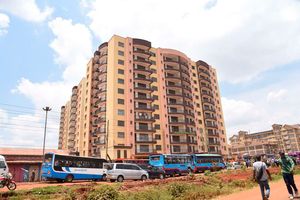
The Central Bank of Kenya (CBK) has embarked on one of its most aggressive monetary easing cycles in recent years, cutting its benchmark Central Bank Rate (CBR) from 13 per cent in August 2024 to 8.75 per cent.
The cuts were expected to reduce the cost of borrowing, encourage banks to lend more and make mortgages and construction finance more affordable. While the cost of money has fallen, lending to the real estate sector has barely moved.
Between April 2025 and April 2026, outstanding banking-sector credit to real estate increased marginally from Sh452.8 billion to Sh453.4 billion, a rise of just Sh600 million, or 0.13 per cent. This was despite total net domestic credit expanding by Sh386.3 billion, or 6.34 per cent, during the same period.
Credit to building and construction rose by 32.06 per cent from Sh151.9 billion to Sh200.6 billion. Credit to private households rose by 6.86 per cent, from Sh558.3 billion to Sh596.6 billion. But real estate lending remained virtually flat.
The figures suggest that the CBK rate cuts have not yet produced a broad-based surge in credit to the property sector, even as the economy begins to benefit from lower interest rates. This means that the price of money is falling, but access to property finance remains difficult.
The CBK has continued its easing cycle in an effort to support economic activity and private-sector credit. Average commercial lending rates have also declined, although they remain significantly above the policy rate. This gap is important for property buyers and developers.
A reduction in the CBR does not mean that a borrower automatically receives a mortgage at the same rate. Commercial banks continue to price loans based on the cost of deposits, operating expenses, capital requirements, the borrower’s creditworthiness and the risk of default.
For a homebuyer, the difference between a mortgage priced at 10 per cent and one priced at 15 per cent can translate into millions of shillings over a 20- or 25-year repayment period. For developers borrowing hundreds of millions of shillings, even a small reduction in the interest rate can significantly affect the cost of construction. Yet the near-stagnation in real estate credit indicates that cheaper money alone has not been enough to unlock large-scale lending.
The clearest evidence that the rate-cut environment is beginning to reach the mortgage market can be seen in the products now being offered by commercial lenders.
Kenya Commercial Bank (KCB) for example is currently offering a limited-period affordable home loan at a fixed rate starting from 8.9 per cent per year, with financing of up to 105 per cent and a repayment period of up to 25 years.
The facility can be used to purchase a ready home, buy land and construct, or construct on property already owned by the borrower. The offer is significant because the financing amount is higher than the traditional 90 per cent loan-to-value threshold used by many lenders.
In theory, a buyer may therefore require less cash upfront for the purchase and associated costs, although eligibility requirements, fees and other charges still apply.
KCB’s broader home loan product provides financing of up to 90 per cent for owner-occupied homes, 80 per cent for income-generating properties and 70 per cent for plot purchases, with repayment periods of up to 25 years.
The products are available to different categories of borrowers, including salaried and self-employed customers. For a Sh10 million home, a 90 per cent mortgage would provide financing of up to Sh9 million, leaving the buyer to raise approximately Sh1 million as a deposit, before other transaction costs.
The higher financing available under selected products could reduce this initial hurdle. But the cost of a mortgage is not limited to the advertised interest rate. Borrowers must also consider legal fees, valuation charges, stamp duty, insurance and other applicable costs. Where financing exceeds certain loan-to-value thresholds, additional charges may also apply.
The terms demonstrate the central issue facing Kenya’s mortgage market. Banks may now be offering more competitive interest rates and higher financing levels, but borrowers still need sufficient income to qualify for the loans. Housing Finance, also remains an important player in the mortgage market.
Its property financing product provides loans of up to 90 per cent of the purchase price or valuation, whichever is lower, with repayment periods of up to 20 years.
The lender also provides mortgage protection features, although borrowers must factor in a commitment fee of 1.5 per cent of the loan amount, as well as other costs such as stamp duty, valuation and legal fees.
A borrower will save interest running into millions of shillings over the life of the mortgage if one decides to make early repayments.
Photo credit: Shutterstock
The institution has also offered concessional mortgage financing at 9.5 per cent for selected housing projects, with repayment periods of up to 20 years.
These products illustrate how lenders and developers are increasingly attempting to make home ownership more accessible through lower rates and partnerships linked to specific housing projects. However, they also show why lower interest rates alone have not solved Kenya’s housing affordability crisis.
Even where a buyer can obtain financing of 90 per cent or more of a property’s value, the borrower must still demonstrate sufficient income to service the debt.
A 25-year loan may reduce the monthly instalment by spreading repayment over a longer period, but the borrower remains indebted for a longer period and may pay more interest over the life of the loan.
The cost of borrowing is falling. Banks are offering more competitive rates, longer repayment periods and, in some cases, financing above the property’s purchase price, yet the majority of Kenyans still cannot afford the homes being financed.
Obviously, affordability remains the biggest obstacle. This is because lower interest rates can reduce the monthly repayment on a loan, but they cannot by themselves solve the problem of insufficient household incomes. A borrower who cannot afford the deposit, legal fees, valuation charges and monthly instalments will remain locked out of home ownership even when interest rates decline. This is why the impact of the CBK rate-cuts on mortgage uptake is likely to be gradual rather than immediate.
For existing borrowers with variable-rate loans, a reduction in lending rates may provide immediate relief. For new borrowers, however, the process is more complicated, they must still meet the lender’s income requirements, provide evidence of stable earnings, pass credit checks and raise the required deposit. The cost of the property itself remains a major obstacle and the same challenge applies to developers. The fall in interest rates improves the financial arithmetic of a project, but it does not eliminate the risks associated with construction. Land prices remain high in many urban and peri-urban locations. Construction projects require large amounts of upfront capital, while delays in approvals, rising material costs and slow sales can increase the time before a project begins generating income.
For a developer using debt, every month of delay can increase the cost of the project. This may explain why real estate credit has not risen at the same pace as credit to building and construction. This is where the Kenya Mortgage Refinance Company (KMRC) has attempted to address one of the structural weaknesses in Kenya’s housing finance system.
Many Kenyans are balancing paying mortgages and paying monthly rent.
Photo credit: Shutterstock
The company provides long-term funding to participating banks and Savings and Credit Cooperative Societies, enabling them to offer longer-tenor and more affordable mortgages.
In 2025, banks and SACCOs borrowed an additional Sh7.7 billion from KMRC, taking cumulative borrowing to Sh19.6 billion. The refinancing has supported more than 5,000 mortgages, with women accounting for nearly half of the financed loans. SACCOs have also become increasingly important in expanding access to housing finance because they serve large numbers of salaried workers and middle-income households. The KMRC model is significant because banks traditionally rely heavily on short-term deposits to finance long-term loans.
This creates a mismatch. A bank may receive deposits that can be withdrawn within a relatively short period but lend money to a homeowner over 20 or 25 years. Long-term refinancing helps reduce that pressure and gives lenders greater certainty when offering mortgages. However, refinancing alone cannot solve the affordability problem. The potential borrower still needs sufficient income.
The CBK has lowered the cost of money. Commercial banks are responding with more competitive mortgage products, but for millions of Kenyans, the biggest barrier to home ownership is having enough income to qualify for the loan in the first place.