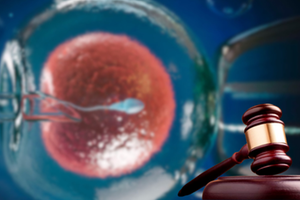
A Kenyan couple spends years trying to conceive. They drain their savings of up to Sh1 million for In -Vitro Fertilisation (IVF). A donor egg is used. A surrogate mother carries the pregnancy. Months later, they welcome the child they had long prayed for.
However, the celebrations fade quickly. What begins as recurring bouts of the baby’s illness ends with a devastating diagnosis: their long-awaited child has a severe congenital disorder.
Questions quickly follow. Could it have been detected earlier? Did the fertility clinic miss some signs? Was the sperm or egg donor properly screened? Did something happen during the implantation or pregnancy? And if negligence played a role, who should be held responsible?
Currently, Kenya has no clear answers since there is no comprehensive legal framework defining who should be held accountable when a donor-conceived child is born with a serious deformity.
As assisted reproduction gains ground in Nairobi, the country is entering an uncharted legal territory. Fertility clinics now offer donor sperm, donor eggs, and surrogacy to couples struggling with infertility. Yet when things go wrong, there is no comprehensive law spelling out who bears legal responsibility.
The result is a legal vacuum with profound consequences for parents, children, surrogate mothers and medical practitioners.
As assisted reproduction gains ground in Nairobi, the country is entering an uncharted legal territory.
Photo credit: Pool
For instance, a woman identified in court papers as Ms JW is locked in a legal battle with a fertility clinic over her child’s poor health condition. She conceived through assisted reproduction and alleges that the clinic used donor sperm different from the one she had selected and consented to during treatment.
The absence of a dedicated legal framework is not new. More than a decade ago, the High Court acknowledged that Kenya lacked laws regulating surrogacy arrangements.
In a landmark decision involving intended parents seeking recognition of children born through surrogacy, the court in June 2014 observed that assisted reproductive technologies had outpaced legislation and left judges to resolve disputes without statutory guidance.
The Assisted Reproductive Technology Bill, 2022, which seeks to regulate fertility treatment, donor arrangements and surrogacy, is yet to become law.
Until then, lawyers say, accountability largely depends on the written contracts, medical evidence and broad legal principles that were never designed for the complexities of assisted reproduction.
Martina Swiga, an advocate of the High Court, says the legal uncertainty makes it difficult to determine responsibility when donor-conceived children are born with serious disorders.
“As of today, there is no surrogacy law established in Kenya. However, there is a Bill named the Assisted Reproductive Technology Bill, 2022, that is currently before the Senate,” she said, “therefore, any surrogacy before the Bill is enacted as law is unenforceable and accountability is far-fetched.”
“We are not sure what they may modify in the Bill, but according to the Bill that is in the Senate, prior screening is required to be done by a medical expert, who is to screen the donor for all diseases and conditions that may endanger the child,” she said. “Such defects are screenable before birth.”
“The intended parties are required to sign a surrogacy agreement, which is likely to be a prescribed form, and defects are highly likely to be anticipated if necessary,” she said.
“With an Act of Parliament, such rights ensue, and one can go before a court of law for a court to determine who bears liability depending on the circumstances of each case,” she adds.
Currently, Kenya has no clear answers since there is no comprehensive legal framework defining who should be held accountable when a donor-conceived child is born with a serious deformity.
Photo credit: Pool
Though the first instinct for many people is to blame the surrogate mother or the fertility clinic, lawyers have cautioned against that assumption.
A surrogate mother, they say, is often only the gestational carrier. In many arrangements, she contributes no genetic material.
Morara Omoke, a Nairobi-based constitutional lawyer, says liability cannot be determined without first understanding the medical cause of the condition and the contract signed by the parties.
“A surrogate mother can hardly be sued in case of any disorder in the child because her duty was to carry the pregnancy. She is not the biological mother,” he said.
“Before knowing who to sue, you must have a clear medical theory and evidence. Otherwise, the court case will collapse.”
“We must also ask what the doctors are saying about the disorder. The primary cause of deformity in a human is genetic, but a child can also gain deformity based on how the pregnancy was carried up to birth,” Mr Omoke said.
“We must trace the deformity to something. The commissioning parent and the clinic must also do due diligence on the sperm and egg before the pregnancy," he said.
According to Mr Omoke, fertility clinics may face scrutiny where donor screening obligations were not adequately discharged.
“In case of sperm donation, the clinic has a responsibility to ensure that sperm donors are healthy and the sperm are perfect,” he said.
“From a scientific standpoint, disorder would also arise from genetic makeup of the child and that would go down to the sperm donor and egg donor. In terms of liability or blameworthiness, the clinic would be blamed if they were to ensure the sperm or eggs are perfect.”
“We also have to check what agreements were in place between the parties, the fertility clinic and the commissioning parents. Also, whether there were disclaimers on the part of the clinic,” he said.
For Samantha Mokaya, another advocate of the High Court, the legal position is even more complicated. She argues that the occurrence of a disorder alone may not automatically create liability.
“Nobody is to be sued because when you are drafting a contract or getting into a surrogacy agreement, there are terms,” she said. “IVF is not a normal pregnancy. That means the risk of these things happening is higher than those that would happen in a natural pregnancy. On the default of it, nobody is liable.”
Ms Mokaya said that for a surrogate mother to be held liable for a child’s disorder, the intended parents would have to prove that her conduct directly contributed to the child's condition.
“The commissioning parents would not have a case unless they go ahead and prove there is something the surrogate mother did during the pregnancy period that contributed to the deformity,” she said.
“It needs a lot of medical evidence and documentation to show what could have probably led to the disorder… At the end of the day, it is difficult.”
Can a commissioning parent then request or legally coerce the surrogate to terminate the pregnancy in case the foetus has deformities?
For many, donor conception and surrogacy offer hope after years of failed treatments and miscarriages. However, legal experts say hope must be matched with caution. The lawyers of said parents must understand the terms of agreements they sign. Clinics must maintain rigorous screening standards. Medical records must be comprehensive. Consent processes must be robust.
Until Parliament enacts a comprehensive framework, courts will continue confronting deeply personal disputes using legal tools developed for a different era.