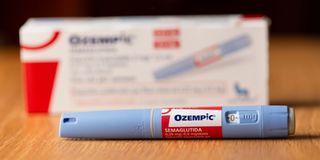
For many Kenyans taking weight-loss injections, Ozempic, Wegovy and Mounjaro, the results can feel almost transformative. Cravings ease, portions shrink, appetite declines, and the number on the scale begins to fall.
But what happens when you stop getting the injections?
Dr Rilwan Adan, the head of Lions Diabetes and Care Centre, says some weight regain is expected when a person stops these GLP-1 (glucagon-like peptide-1) medications.
A study known as the STEP 1 extension trial, which looked at semaglutide, one of the GLP-1 analogues, found that within one year, participants regained about two-thirds of the weight they had lost, roughly 11.6 per cent.
"Another study (SURMOUNT-4) done with Tirzapetide, another GLP-1 analogue, showed that participants who were initially put on the drug then stopped, regained 14 per cent of the weight they had lost."
A weight loss drug injected on a man's belly.
Photo credit: Pool
Dr Adan adds that beyond weight loss, these drugs also improve a person’s metabolic profile, including blood sugar, cholesterol, and blood pressure.
"So, their sugar management or glycemia improves, their blood pressure and cholesterol improve. Similarly, when you stop, you not only regain the weight but also these metabolic profiles [blood sugar, cholesterol and blood sugar] start to get out of hand again," she explains.
One reason people regain weight after stopping GLP-1 injections, Dr Adan says, is that the medication suppresses appetite and increases feelings of fullness, reducing "food noise"- the constant thoughts about eating.
When you stop the medication, that food noise returns. To manage this, Dr Adan says, patients need to work around their appetite.
"So, eating food that increases satiety, like increasing their protein and fibre, so you tend to feel full for longer, which sort of mimics what the drug is doing. And then exercising, which will not only help burn calories but also boost the metabolism of the patient."
She adds that a patient’s emotional resilience and underlying eating habits also influence what happens after they stop the medication.
Can you regain more than your initial weight?
"It depends. I may have patient A who will maintain what they were doing while they were on the drug, and also probably take the tips of the diet, exercise, and mental health, and then you have patient B who doesn't consider all this. So obviously, the weight to regain for the two is different. Looking at the science, the drug does not drive you to gain weight after stopping it."
Dr Rilwan Adan, the Head of Lions Diabetes Care Centre.
Photo credit: Lions SightFirst Eye Hospital
Since it is a once-weekly injection, Dr Adan says the drug is out of the system after about a week. GLP-1 drugs, she explains, are not depot drugs that stay in the body for the long term after injection.
For those who take the injections on and off, they may not get the desired effect because they are not using them consistently.
The first physical sign a person may notice after stopping the injections is increased appetite. Dr Adan says they may feel hungrier than usual and begin craving carbohydrates they were not eating before.
"They now start eating larger portions than they were eating before, or more frequently. With this, obviously, you start getting the mild increase in weight, and those with diabetes, blood sugar symptoms start coming back; they feel fatigued, energy fluctuations, among others," she adds.
Wealthy Kenyans are stocking up on Ozempic, Wegovy and Mounjaro; injectable drugs promising dramatic slimming results
Photo credit: Shutterstock
For this reason, Dr Adan says patients should see their doctor before stopping the medication, to determine whether they should stop, how they should stop, and what measures they need to put in place.
While some people may need to stay on these weight management drugs indefinitely, Dr Adan says obesity is also a disease, and some patients may require ongoing treatment.
However, a patient may stop taking these drugs because of cost, side effects, reaching their target weight, or plans to get pregnant, since these medications are not considered safe during pregnancy.