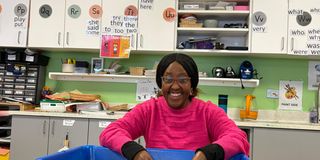
I teach First Grade in New York City, at one of America’s most progressive schools. Progressive education here means child-centered learning, where students are encouraged to question, think critically, and make sense of the world on their own terms.
For a long time, I didn’t think being Kenyan in this predominantly white teaching space would be my superpower. I thought it was something to manage, to minimize, to keep small.
My name is Njeri. It’s unmistakably African. Easy to mispronounce. My Africanness is announced on paper before I’m announced in person — on resumes, on school rosters, in parent emails. Before anyone meets me, they know I’m “other”.
I’ve heard it all: Nuhjery. Ninjeri — as though I’m a ninja. New-Jerry. The mispronunciations are endless, and after a while, you develop a strategy. Sometimes I correct gently. Sometimes I let it go because it’s easier. Sometimes I make them practice until they get it right. It depends on the day, the person, and the context.
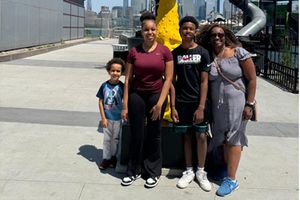
Njeri Gachathi, a First Grade teacher in New York.
Photo credit: Pool
And don’t get me wrong; I love my name. It’s dope. It means “someone who likes to travel,” and I was named after my grandmother. It carries my character, my lineage, my everything. But in predominantly white American teaching spaces, it also marks me. It signals a difference before I even walk into the room.
Being African in American schools sometimes feels other, other. Not Black enough for some conversations. Not the right kind of Black for others. There are expectations of my Blackness that I don’t always meet. And in my current workspace, I’m often the only teacher with an African affinity, which means navigating a particular kind of isolation—holding an identity that doesn’t quite fit the boxes people expect.
I have the same credentials as my American peers: a master’s degree in progressive education plus years of teaching experience. But there’s always this undercurrent of something. It shows up in subtle ways.
In teacher meetings, when we’re planning social studies units, I don’t have the same American historical touchpoints that others assume everyone shares. Thanksgiving isn’t my childhood.
The Fourth of July wasn’t my framework for understanding freedom. Halloween wasn’t a tradition I grew up with.
And while it used to make me feel behind, I’ve realised it’s actually a strength. That’s because I’m the one who says: “We need to be clear and explicit about this background knowledge. We can’t assume everyone has the same reference points.”
I push my American colleagues to think about what we take for granted—what cultural knowledge we assume is universal when it’s actually very specific.
Here’s the thing about not belonging fully to the dominant culture of a space: you learn to observe and listen.
I don’t indulge in the schmoozing and small talk that often fills American teacher lounges and parent events. And because I’m not trying to perform belonging in that way, I can watch more carefully. I notice things others miss.
Once, my co-teacher said they couldn’t read a parent, thinking the parent was aloof, distant, and uninterested. But I saw something different. That parent wasn’t aloof. They were culturally reserved. They were navigating a predominantly white school space where effusiveness and over-sharing are rewarded, and quieter, more formal engagement is read as coldness.
I told my co-teacher, “That’s not aloofness. That’s culture. Not everyone shows care the same way.”
Njeri Gachathi, a First Grade teacher in New York.
Photo credit: Pool
My otherness let me see that, because I know what it’s like to have your quiet mistaken for disinterest. I know what it’s like to be read wrong because you don’t perform warmth the way white American culture expects.
I can question language structures and the power embedded in them — even as I teach kids to read and write in English. When we’re teaching first graders place value, English creates unnecessary confusion. A child hears “eleven” and “twelve” and has to think about why they’re not “one-teen” or “two-teen.”
But in Kiswahili, we say kumi na moja — ten and one. Kumi na mbili — ten and two. The structure is transparent. You can hear the place value. Research shows that children who speak languages with transparent number systems often develop place value understanding earlier — not because they’re better at math, but because their language isn’t working against them.
So, when I teach math, I don’t just teach English number words. I teach kids that language shapes how we think about numbers. That some languages make math easier and some make it harder. That English isn’t the default or the “right” way — it’s just one way, and sometimes not even the best way. I tell them: in Kiswahili, we do this better.
I can say: “In Kenya, we value rest. We value just being. Kids don’t need every minute structured.” And when I say that, it’s not just a teacher’s belief; it’s cultural knowledge.
Harambee, our Kenyan principle of collective work and responsibility, isn’t something I learned in an American professional development session. It’s something I grew up with. And it shapes how I structure morning meetings, how I teach conflict resolution, how I frame our classroom as a collective, not a collection of individuals.
Being so far from my family in Kenya — oceans away, time zones apart — has given me a particular kind of empathy with my students as they navigate separation and independence.
When a six-year-old struggles with drop-off, I don’t just see a kid who can’t separate from their parent. I see someone learning what it means to be far from the people you love. I know that ache. And so I can hold space for that grief in a way that feels authentic. I can say: “It’s hard to say goodbye. I know.” And I mean it. Not in a distant, teacher-y way. But in a real, human way. It’s because I’m living it too, thousands of miles from my own family.
One of the most powerful things my otherness allows me to do is bring language into the classroom, not as a special addition, but as part of our everyday rhythm.
I bring in British English (lift, not elevator; torch, not flashlight) because that’s the English I grew up speaking in Kenya. I bring in Kiswahili (kumi na moja, not eleven) because it’s my first language and sometimes it teaches concepts better than English does.
And when I do that — when I don’t apologise for my language, when I don’t frame it as “exotic” or “diverse” but just as how I speak — other kids feel permission to bring their languages too.
The Cantonese speaker doesn’t wait to be invited. The Tamil speaker offers a word. The kid whose family speaks German at home starts code-switching more freely. Because I’ve modelled that our languages aren’t things we leave at the door. They’re tools. They’re gifts. They help us all think better.
Njeri Gachathi, a First Grade teacher in New York.
Photo credit: Pool
Last year, one of my students, a child from Rwanda, didn’t celebrate Halloween. When her parents told me, I knew exactly how to handle it. Because I didn’t grow up with Halloween either.
So, when we talked about fall celebrations in class, I told the kids: “I didn’t celebrate Halloween growing up. In Kenya, we eat pumpkins; we don’t carve them. We cook them, like vegetables, because that’s food.”
The girl from Rwanda looked at me. And in that moment, something shifted. Because the person in the room with the most power — the teacher — had just shared something with her. I had validated her experience not by making it a big teachable moment, but by saying: I know what this feels like. You’re not alone.
I got it because I’ve lived it. Because I’m African too. Because I know what it’s like to navigate American culture that assumes everyone celebrates the same holidays, values the same things, speaks the same way.
Just like the meaning of my name, I have been lucky to travel. Not just physically — though I’ve crossed oceans from Kenya to America — but intellectually. Culturally. Emotionally.
I’ve travelled between worlds. Between languages. Between cultures. Between being other and being seen.
And maybe those mispronunciations were onto something. Ninjeri. Maybe I am a ninja — someone who’s learned to move through spaces that weren’t built for me. Someone who’s learned to be nimble, to observe carefully, to adapt without losing myself.
That constant navigation between identities, languages, expectations — that’s made me a better teacher.
Because I know what it’s like to not fit. I know what it’s like to have to translate yourself constantly. I know what it’s like to carry multiple worlds in one body.
And so when my students show up carrying their own multiplicity — their languages, their cultures, their ways of knowing — I don’t ask them to shrink. I don’t ask them to choose. I say: bring all of it. We’re better when you do.
For a long time, I thought my otherness — my Kenyanness — was something to manage in American teaching spaces. Something to minimise. Something to navigate carefully so I didn’t take up too much space, didn’t make people uncomfortable, didn’t challenge the dominant culture too directly.
It lets me see what my American colleagues miss. It lets me challenge what they accept. It lets me build community in ways that feel authentic. It lets me hold space for kids who don’t fit the American mould. It lets me bring richness into the classroom that wouldn’t be there without me.
Njeri Gachathi, a First Grade teacher in New York.
Photo credit: Pool
My Kenyanness, my Africanness, my otherness isn’t a liability. It’s an asset. It’s a gift.
And when I bring my whole self into the classroom — my name, my language, my culture, my Kenyan perspective — everyone learns better. Not in spite of my otherness. Because of it.
Being Kenyan, being other, is my superpower.