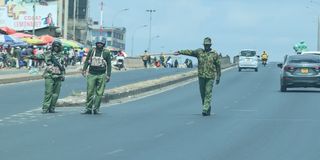
On Wednesday morning, major roads leading into the city centre were barricaded, restricting access to parts of the Central Business District and significantly disrupting commuter movement as security agencies sought to prevent Saba Saba demonstrations.
These events have raised an important constitutional question: Can a day legally be considered a normal working day when the State's own security measures make it difficult for people to access their workplaces?
According to Mary Audi and Fridah Muriithi of MMTK Law (Muri Mwaniki Thige & Kageni LLP Advocates), the answer depends less on what the government declares and more on the practical reality experienced by citizens.
Police on standby outside Parliament buildings on July 7, 2026, during Saba Saba commemoration.
Photo credit: Lucy Wanjiru | Nation Media Group
"A declaration that a day is a normal working day does not, by itself, make it so. A normal working day presupposes that people can reasonably access their places of work, businesses, schools, and public services. Where the State declares that normal activities should continue, but its own security measures significantly impede access, legitimate constitutional questions arise."
They noted that several constitutional rights may be affected when citizens are unable to access workplaces, businesses, or public services due to security measures. These include freedom of movement, the right to assemble and demonstrate peacefully, access to healthcare and other essential services, and the right to work.
"None of these rights is absolute, but any limitation must comply with Article 24 of the Constitution."
Under Kenyan law, the National Police Service is mandated to maintain law and order, protect life and property, and prevent crime. These powers include regulating traffic, setting up security barricades, and temporarily restricting movement where reasonably necessary.
"However, these powers are not unlimited. Every restriction must be lawful, necessary, reasonable, proportionate and must respect the Bill of Rights."
Police on horseback patrol Harambee avenue in Nairobi during Saba Saba commemoration.
Photo credit: Lucy Wanjiru | Nation Media Group
While the lawyers acknowledged that the State does not have to wait until violence erupts before taking preventive action, they also cautioned that pre-emptive restrictions carry a higher constitutional burden because they affect citizens before any unlawful conduct has occurred.
They added that blanket restrictions affecting the general public, imposed without sufficient justification, are unlikely to satisfy the constitutional threshold.
The advocates said that the Constitution seeks to strike a balance between individual rights and public security. Article 24 permits the limitation of rights only where the limitation is reasonable, justifiable, and proportionate in an open and democratic society.
According to the lawyers, the state must demonstrate that any restriction serves a legitimate purpose, is necessary, and does not go further than is required to address the identified security concern.
They said that whether security measures become unconstitutional largely depends on the principle of proportionality.
"Courts would consider factors such as the geographical scope of the restrictions, their duration, the number of people affected and whether less restrictive alternatives were available."
They added that measures such as blocking access to entire districts instead of specific risk areas, shutting down businesses, schools and hospitals, or preventing peaceful protesters from reaching lawful assembly points could amount to an unjustifiable limitation of constitutional rights if they are not adequately justified.
Police on standby at Free Area along the Nakuru–Nairobi Highway on July 7, 2026. As Kenyans marked the annual Saba Saba commemoration, traffic along the Northern Corridor and activities across Nakuru remained largely uninterrupted.
Photo credit: Boniface Mwangi | Nation
"Where security measures effectively prevent large sections of the public from exercising their constitutional rights without adequate justification, a court may conclude that they amount to an unjustifiable limitation of rights under Article 24, rather than a lawful exercise of police powers."
The advocates also argued that, although there may not be an explicit statutory obligation arising from the government's declaration that a day is a normal working day, Article 21(1) of the Constitution imposes a broader duty on the State to uphold, respect, protect, promote and fulfil the rights and fundamental freedoms set out in the Bill of Rights.
They added that, when the state publicly declares a day to be a normal working day, it arguably assumes a positive duty not to make access to work impossible through its own security measures.
They also noted that restrictions on movement that prevent workers, students and business owners from accessing the city inevitably raise constitutional questions.
"The issue is not simply one of inconvenience, but whether the restrictions are justified, proportionate, and consistent with Article 24 of the Constitution."
The advocates said that citizens are entitled, under Article 22 of the Constitution, to challenge government action where they believe a constitutional right has been denied, violated or threatened.
"Security considerations do not place government action beyond judicial review. The Constitution allows courts to examine whether restrictions on rights were lawful, necessary, and proportionate."
The lawyers also cited the High Court's decision in Katiba Institute v Inspector General of Police (Constitutional Petition E349 of 2024), which found that suspending assembly-related rights across Nairobi's Central Business District (CBD) was unconstitutional as it was too broad and did not meet the requirements of Article 24.
According to the advocates, this decision reinforces the principle that, while the police have broad powers to maintain public order, these powers must always be exercised within the framework of the Constitution. Security measures must be targeted and evidence-based, rather than imposing broad restrictions on the general public.
"A court would likely examine whether the restrictions were lawful, necessary and proportionate; whether less restrictive measures could have achieved the same objective; and whether the impact on citizens' constitutional rights was justified."
While maintaining public security is a legitimate State objective, the advocates maintained that any limitation of rights must comply with the principles of legality, necessity and proportionality under Article 24. The final determination rests with the courts, which will base their decision on the evidence presented.