The court ruled that the explosive claims must be tested at a full trial rather than dismissed at a preliminary stage.
The court dismissed separate applications by Treasury Principal Secretary Chris Kiptoo, Head of Public Service Felix Koskei, Attorney General Dorcas Oduor and businessman Jayesh Saini seeking to be struck out of a Sh291 million compensation suit filed by software developer Mary Wachuka and her company, Jipe Inc.
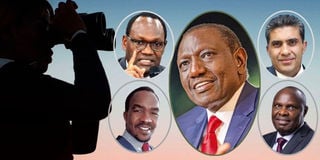
President William Ruto (centre), PS Chris Kiptoo, (top left), President's speech writer Eric Ng'eno (bottom left), Health sector entrepreneur Jayesh Saini (top right) and Head of Public Service Felix Koskei.
Photo credit: Nation Media Group
The court ruling keeps alive the commercial dispute, which centres on allegations that senior State officials sought a confidential digital communications platform before abandoning the project, leaving Ms Wachuka facing substantial losses. The defendants deny the allegations and argue no lawful contract ever existed.
The substantive dispute stems from Ms Wachuka's claim that she was approached in late 2023 to develop a confidential digital communications platform for the government after discussions with Eric Ng'eno, President William Ruto's speechwriter at the time.
She alleges she subsequently contracted an American technology company, Tesxo, to build the platform under a project codenamed "Numera 2023". She says the government later failed to honour its commitments, leaving her unable to pay the subcontractor and exposing her to contractual penalties in the United States.
According to her pleadings, she was told the project would be financed through the National Treasury's confidential vote and that Mr Saini would oversee funding because of the project's sensitive nature. Those allegations remain disputed.
“The presence of the 1st and 2nd defendants (PS Kiptoo and Mr Koskei), as senior government officials whose alleged actions or inactions are central to the plaintiffs' claim, would enable this Court to effectually determine whether the Government of Kenya, through its officers, made representations that induced the Plaintiffs to act to their detriment,” the court said.
In the ruling, the court stressed that the court was not determining whether the allegations were true but whether the plaintiffs had raised issues deserving a full hearing.
"It is a cardinal principle of our legal system that parties should be accorded the opportunity to have their disputes resolved on merit through a full trial," the court said, after considering Ms Wachuka’s claims and the extensive exhibits attached to the affidavits, including the WhatsApp conversations.
The judge added that the court's role at this stage was limited. "At this preliminary stage, this court is not required to determine the merits of the claim. It is sufficient that the plaintiffs have pleaded sufficient facts which, if proved, could establish a cause of action against the applicants," ruled the court.
Ms Wachuka, a Canada-based businesswoman, moved to court in November 2024 alleging breach of contract. She alleges she was engaged to develop specialized government software after discussions involving State House officials and later subcontracted an American technology company to undertake the work.
According to her, she was approached to develop software that would improve the public image of the President and his deputy while monitoring former opposition leader Raila Odinga, suppressing social media criticism of the Kenya Kwanza administration and targeting journalists critical of the government.
She says the project collapsed after repeated assurances of payment, forcing her to settle substantial liabilities in the United States before filing suit in Kenya.
Her claim seeks about $2.25 million (Sh291 million) against Mr Kiptoo, Mr Koskei, the Attorney-General, Mr Saini and President Ruto's speechwriter Eric Ng'eno. She alleges the defendants jointly induced her to undertake the project before failing to honour the agreement. All the defendants who have responded deny liability.
In asking the court to strike them out of the proceedings, the AG, Mr Kiptoo, Mr Koskei and Mr Saini argued that the plaint contains no direct allegations against them.
They contended that all factual allegations relate to Mr Ng’eno and that the plaint contains generic references that he acted "on behalf of the Government" without any specific pleading of authority, mandate, or direct participation by them.
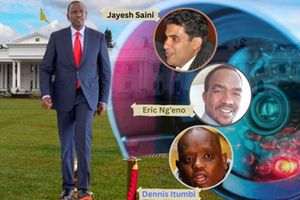
Mr Eric Ng'eno, President William Ruto's speech writer.
Photo credit: File | Nation Media Group
But the court said this argument was “unpersuasive” and that the pleadings contained specific allegations linking senior government officials to the disputed project through the actions of Mr Ng'eno.
“A careful reading of the plaint reveals that while the primary actor appears to be the 5th defendant (Ng’eno), the plaintiffs have pleaded that the 5th defendant was acting as an agent of the Government and that the alleged representations and assurances were made with the knowledge and approval of senior government officials, including the 1st and 2nd Defendants (PS Kiptoo and Mr Koskei),” the court noted.
It noted that Ms Wachuka and her company specifically pleaded that Mr Ng’eno “made false misrepresentations” "with the knowledge and approval and on behalf of the other defendants."
The ruling notes that the plaintiffs specifically pleaded that Ng'eno represented funding would come from the National Treasury's confidential vote and allegedly arranged meetings involving Wachuka, Kiptoo and Koskei to discuss financing. The court said those allegations could not be rejected without hearing evidence.
“The question whether these allegations are true is a matter for trial. At this preliminary stage, this Court is not required to determine the merits of the claim. It is sufficient that the Plaintiffs have pleaded sufficient facts which, if proved, could establish a cause of action against the Applicants.
The judge also rejected arguments that the case should be dismissed because the alleged software project may have been unlawful.
"The illegality of the alleged contract, if any, is a triable issue of mixed fact and law," the court said, adding that whether the project "was illegal or unconstitutional is a matter for the trial court to determine after a full hearing."
“The plaintiffs have pleaded that the software was intended for legitimate purposes such as managing government communications and public engagement. Whether the project was illegal or unconstitutional is a matter for the trial court to determine after a full hearing.”
The court also rejected separate attempts by Mr Saini to exit the proceedings, finding that Ms Wachuka had pleaded specific allegations against the businessman beyond merely describing him as the project's financier.
It said the plaintiffs alleged that Mr Saini had been introduced as "the regime's financier" and "oligarch" tasked with funding the project, later confirming that role during a meeting at his office while participating in discussions about implementation.
"The Plaintiffs have pleaded that the 4th Defendant (Saini) was a central actor in the events giving rise to the dispute," the judge said, adding that the claims included allegations that Mr Saini attended meetings, made representations about his role and coordinated the withholding of payment after the plaintiffs relied on the alleged assurances.
It concluded that those issues could only be resolved after witnesses testify and are cross-examined.
"It is sufficient that the Plaintiffs have pleaded a prima facie case against the 4th defendant," the court ruled.
Mr Saini had argued that the case discloses no reasonable cause of action against him because there was no direct communication or contractual relationship between himself and the plaintiffs. He contended that he was merely referenced in conversations between the plaintiffs and Mr Ng’eno, and that such references constitute hearsay.
He further argued that he was not an employee or officer of the government and could not, therefore, procure a contract on behalf of the government.
Another contention was that being described as a "regime-financier" was not legally possible because all government financing processes are regulated by the Constitution and the Public Finance Management Act.
But the court ruled that his joinder in the suit was proper and consistent with the Civil Procedure Rules.