It has happened again. I‘ve had another visitor from the After-life Kenyan Ghost Club. I was enjoying my after-breakfast cup of coffee, when this woman suddenly appeared.
‘Good morning, John Fox,’ she said. ‘I hope I am not disturbing you.’
At first, I didn’t recognise her. Then, with her long brown hair tied back in a bun, she reminded me of Meryl Streep playing Karen Blixen in the film Out of Africa.
Of course, it was not Meryl Streep but the ghost of Karen Blixen herself.
‘I know you have enjoyed speaking with a number of our Kenyan Ghost Club members, and I thought it was time to have my turn.’
‘You are very welcome,’ I said. ‘And I am very happy to meet you.’
‘I’m not surprised,’ she said with a laugh. ‘She did a wonderful job playing me in the film didn’t she? Not like Robert Redford, who made no attempt at all at becoming an English white hunter!’
I told her that I had once visited the Karen Blixen Museum in Rungsted Kyst, just north of Copenhagen. A recording of the film was playing, and my Danish friends were saying how accurate her Danish accent was.
‘I know you have been there,’ she said. ‘When I was last ghosting at the museum here in Nairobi, I saw a poster of me from the museum in Denmark. I heard that you had given it to the museum. That was nice of you. I’m glad it was the pretty one you gave them – not the awful one in which I looked so thin and ill.’
‘But, apart from the pleasure of having a chat with you, I have heard that a coffee museum has opened in Karen, and I wondered if we could go there together. You will know that the farm I had at the foot of the Ngong Hills was not so good as a coffee farm because its elevation was too high, so the climate was prone to frosts. We were also told that the soil wasn’t suitable for growing coffee. Year after year, the crop failed and I eventually went bankrupt. But I am still interested in the business of growing and processing coffee. You will also know that no one else will see me or hear my talking. I gather that there is a nice café there.’
So I ordered an Uber and off we went. Along the Ngong Road, Karen asked about the construction going on at the Junction corner.
There was a big ‘Wow!’ as we passed the new stadium. Then we took the Miotoni Road to reach the coffee museum. Actually, it is called the Connect Coffee Museum; it is Korean owned. Connect Coffee Roasters has speciality coffee shops-cum-cafés in Gigiri, Chiromo, Hurlingham and Kisumu; the museum had been open for only two weeks when Karen and I visited.
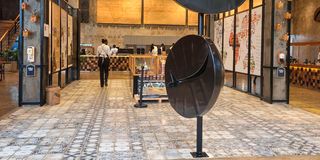
The setting is beautiful - a typical green Karen estate. The main building – an elegant space for the inside café, museum exhibits, art works and attractive wall panels telling the story of coffee, as they say, from the farm to the cup.
After a walk round, Karen and I chose a table outside where I wouldn’t be so easily heard seemingly talking to myself. But I did have a talk with Cedric, the young Kenyan front-of-house manager, who explained that the place was still work in progress.
He pointed out the roastery building where demonstrations will soon be taking place and barista training would be held. He also pointed to the menu where there were descriptions of the signature coffee blends: Romeo, described as combining a smoky dark chocolate flavour with a nutty flavour; Juliet, described as having a fruity flavour with the scent of flowers.
‘It’s all so charming and sophisticated,’ she said. ‘It’s so different from when I was living here – the variety of restaurants; girls and women with their fashionable hair and clothes. And I wish I could taste food again. I really envy that French toast you are eating, soaked in syrup and decorated with blueberries and strawberries.’
We were silent for a while. Then I asked her if it was true that she missed Kenya when she went back to Denmark.
‘It is very true,’ she said. ‘I know it’s not something I should be proud of, but in Kenya I was a kind of queen – someone who was a centre of attention. In Denmark, however, I was just a member of a group of artists and friends.’
I asked her about Beryl Markham, the woman living in Kenya who was the first person to fly solo, non-stop across the Atlantic from Britain to North America.
She claimed that Denys Finch-Hatton was also her lover. Karen’s reply was quick and sharp: ‘She was the kind of person who would say that, wasn’t she? She is also in our Kenya Ghost Club, but we rarely speak to each other. She does seem to spend a lot of time with Denys’ ghost though.’
I asked if she knew that a new biography of her husband, Bror Blixen, was soon to be published in English.
‘So I hear,’ she said. ‘When it comes out perhaps I should visit you again and we can have a chat about it. Seriously, I would like that. I’m also glad you haven’t asked me about what many people assume – that he was the one who gave me the syphilis!’
‘Well, let me ask about it now!’
‘Honestly, I don’t know. For a time, I was a very wild girl, you know.’