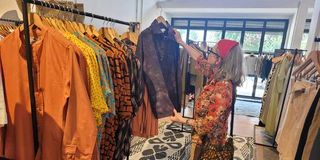
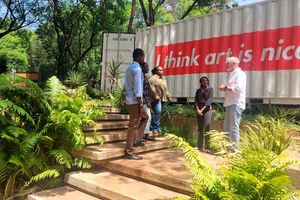
A couple of Sundays ago, sitting on a cushioned black oil drum, I was eating a delicious Chicken Tinga Taco at a black oil drum table. It was in a courtyard of the Heltz House on Ngara Road, where Lut and I had gone to one of the Pop-Up Boutique events of the Kenyan Designer Collective.
But let me finish telling you about the tacos on offer. They were provided by the Jikoni Studio from the first floor of the building. It is a very interesting enterprise that offers a number of courses: Plant-based Cooking, Beginner/Intermediate Cooking, Healthy Cooking, Foundations of Baking, Advanced Cooking.
It also puts on single sessions, such as Sunday Meat Preparation, Street Food from Around the World, Korean Kitchen. As we were soon to learn, this is just one of many creative businesses or projects to be found in Ngara.
And, as Michelle Pino, founder and curator of the Designer Collective, said, when I talked with her the following day: ‘Creativity is something that shouldn’t be applied only to literature, music or art; any kind of problem solving can be called creative.’
Then it could well be applied to the matt black oil drums that solved the problem of finding cheap but stylish furniture for the Heltz House courtyard.
Michelle told me about the origins of the Designer Collective. She has her own brand of clothes called One Hundred Years and, during the Covid time, a market could have no more than 10 people in attendance.
So, she and other designers decided to set up a cohesive shop, where all the brand owners didn’t have to be there. It proved to be a successful strategy, and it has continued. She holds about six events a year – mostly at Ngara and sometimes in hotels.
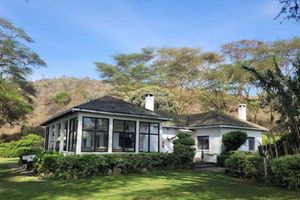
As most of you will know, Ngara used to be mainly an Indian community. The old two-story homes have a number of large rooms with long white walls; they are good for meetings and for holding exhibitions and displays. Now, there are over a hundred brands in the Collective’s roster, with names such as Kiko Romeo, Milles Collines, Kooroo, By Her and, of course, One Hundred Years.
Michelle is clearly proud of the level of quality of the products they are able to showcase. ‘I have been in Kenya for 15 years and in the retail space for 12 years,’ she said, ‘and the level of craftmanship has evolved to a very high standard. There used to be a culture of copying, but now people are exploring different creative choices and coming up with their own designs.’
I asked Michelle whether the group of people we saw on the Sunday afternoon was typical for these events. She said that it might be typical for Sundays, but on Fridays it is very different, because these are the days when the serious shoppers attend – and they are mainly Kenyans and not so many expats.
The big spenders, the people with ‘high baskets’, as they are called, are Kenyans. This is another indicator of how strongly a middle class has evolved in Kenya. And many of them want to wear Kenyan.
It seems that the Kenyan Designer Collective is not the only exciting thing happening in Ngara. A few days before the talk with Michelle, I had read an OkayAfrica article about what it called ‘Ngara’s revival’ – an article for which Michelle had been interviewed.
But the article starts by asking Muthoni Muiri why, in 2024, she opened her Soma Nami bookshop in Ngara. ‘It was a great choice because of all the exciting things now happening there,’ she said. ‘There’s a real rejuvenation. It’s becoming a vibrant, artistic and entrepreneurial hub.’
Soma Nami Books is close to where the Designer Collective and the Jikoni Studio are operating; in fact, for a stretch along the Ngara Road, as the OkayAfrica article says, there are colourful murals, restored storefronts, and a growing mix of design studios and creative hubs.
It points out that students, young creatives, expatriates, and upper/middle-class Nairobians have begun exploring what Ngara now offers. It compares Ngara with ‘cultural hubs’ such as Johannesburg’s Maboneng or London’s Shoreditch.
However, in that article, Michelle, though celebrating this development, is also concerned. ‘Affordable, character-filled spaces are almost impossible to find in this city,’ she said. ‘When something like Ngara opens up, you want to question it…but you also want to try to work with it, not just walk away.’ I asked her what question she had in mind.
She explained that she doesn’t want what is happening in Ngara to be a gentrification process. ‘Gentrification means “Out with the old and in with the new”’ she said. ‘I don’t see that happening here. I don’t think it will happen here. I think there is a blend happening.’ Clearly, she sees many of the old businesses and creative enterprises remaining. But I reminded her that in the OkayAfrica article she had said ‘We’ve seen how quickly a ‘creative’ label can price out the artists who helped build it’.
She agreed that, with new businesses being set up in Ngara, there is always a risk that original tenants can be priced out. However, she argues that it has been a creative enclave for many years. It is where things are made – other than designer clothes, bags and jewellery.
The oil drums at the Designers Collective were bought there by Michelle. She is confident that the old and new businesses – artists and artisans – will continue to co-exist in Ngara.
I asked her why she calls her brand One Hundred Years. ‘Because we are thinking about what’s going to matter in a hundred years’ time,’ she said. That seems, to me, a very Kenyan thing.
When I occasionally go back to the UK, I think there is so much looking backward; whereas in Kenya there is much looking forward. But only a month ahead there will be another Pop-Up Boutique in Ngara – from 10 to 12 April.