The waitress was looking intently at me and she said, ‘Can I slap your neck?’
‘Sure!’ I said, though wondering what was going to happen. So she did it – quite a smart slap. Then she held out her hand to show me the squashed mosquito.
We were at Bilashaka Lodge, down Lake Naivasha’s Moi North Lake Road – much more pleasant than the Moi South Lake Road with its clutter of hotels, lodges, resorts, camps, flower farms, townships and fuel stations. However, on the way there, we had diverted for a lunch on the southern side of the lake.
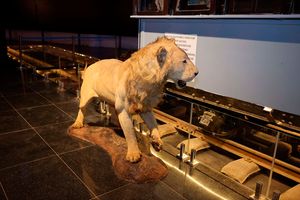
Two of my nieces, Carolanne and Dominie, were with us on a two weeks holiday from the UK. We wanted them to experience a visit to Elsamere – once the home of Joy Adamson and now a conservation centre, with its cottages and a small museum that celebrates the lives of Joy and her husband, George. We knew that both Carolanne and Dominie had seen and enjoyed the film, Born Free, that tells the story of how Joy and George raised Elsa the lioness.
We had never seen Elsamere so busy. It was a day after Valentines Day, and two white marquees with their white chairs with red ribbons seemed somewhat out of place on this rustic and peaceful lakeside retreat. But, in the museum, we enjoyed Chege’s tales of the mainly separate lives of Joy and George.
The buffet lunch was good, too. We laughed at the colobus monkeys that were using the roofs of the marquees as trampolines, and we were, as always, stirred by the lilting calls of duetting fish eagles – the most iconic sound of the East African lakes.
After lunch, we made for Bilashaka. We didn’t follow the murram road that takes you round the west side of the lake, because we were in a saloon car with low clearance; we drove back to the main road and followed it until the turn-off of the Moi Lake North Road. It is a winding and very pleasing road with smooth tarmac.
The Bilashaka Lodge is mentioned, and mentioned kindly, in the latest copy of the Rough Guide to Kenya, but nothing at all is said about the northern lake road. It is a green drive, tree-lined and sometimes below rugged cliffs. On the right, you pass the Great Rift Valley Lodge and Golf Resort; on the left, there are ranches and flower farms.
The Bilashaka Lodge is set within one of the flower farms. It is owned by a Dutch couple, Ingrid and Joost Zuurbier who once had a flower farm in the Netherlands. In 2001 they brought their technical knowledge to the farm in Kenya that was set up by Ingrid’s mother. Now, each night, between 300,000 and 400,000 of their roses are flown out to the Netherlands. But I am getting ahead of myself. Ingrid would be taking us on a tour of the farm the following morning. Our first task was to settle in our rooms at the Lodge.
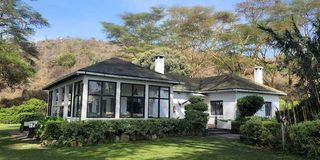
The Lodge is well separated from the buildings of the flower farm. It has five rooms that are in a line; all with verandas that look out over a broad lawn and through yellow-barked acacia trees to the lake’s shore. Each en-suite room has a distinctive décor. ‘Regardless of whether you spend the night in the Moroccan themed room or in the cool Ocean room,’ says the website, ‘you can be sure of a peaceful night. The only thing that might wake you up is the snoring of the hippos.’ And, during the day, you are bound to hear those plaintive calls of the fish eagles.
My two nieces are both keen bird watchers – especially Carolanne. They had already been able to identify more than a hundred different species from their time at the Ark in the Aberdares, at Ol Pejeta near Nanyuki and in our Lavington garden. I had promised that they would add to their list at Lake Naivasha. I wasn’t wrong. They had already spotted some new ones at Elsamere, including a hamerkop on its large untidy nest and a grey-headed kingfisher perched on a low branch.
Then, on their first walk to the lake shore at the Bilashaka Lodge, they had an experience like that of a birding friend from the UK 25 years ago who had lifted his binoculars on the shore of the Naivasha Country Club and whispered ‘Heh, I’ve just added about a dozen birds to my world list’.
After a peaceful night and a good breakfast, Ingrid came to take us to the flower farm. We started at the most appropriate place – the huge greenhouse where the 16 different varieties of roses were being grown and harvested. No weird varieties, Ingrid said – just the usual ones. She told us that it takes about six weeks to get a new stem after one is cut. And the plant takes four to six years to grow and produce blooms. She also assured us that they take great care about the fertilisers that are used, and they are doing their own composting.
We moved across the road where chrysanthemums were being grown as an experiment. We went on to what Ingrid called the European Room, where the cut flowers were temporally stored. After the heat of the greenhouses, we were surprised by the cold – and glad to move on to where the roses were being quality controlled and packed for air-freighting.
We learnt that the Bilashaka flowers were being sent to the Royal FloraHolland Auction in the Netherlands before being distributed across Europe. Both Carolanne and Dominie had been rather sceptical that such a tour was on their itinerary, but they were fascinated by it. By the way, the flower farm tour is open only to guests staying at the Lodge.
For me, Ingrid’s tour triggered a little research. I discovered that Naivasha has an ideal profile for flower farming. Like other high-altitude regions of Kenya, the Equatorial climate means consistent sunlight year-round; such regions produce strong, long-stemmed flowers; the volcanic soils are rich in nutrients.
And Naivasha has the advantages that it has the freshwater lake that can support large-scale greenhouse operations. There is also good access to international shipping through the Jomo Kenyatta International Airport.
But back to the Bilashaka Lodge. If you would like more information about its facilities and its prices – very reasonable, I think – then go to their website. Also, follow its directions; if you rely on Google Maps, you will find yourselves at the neighbour’s place.