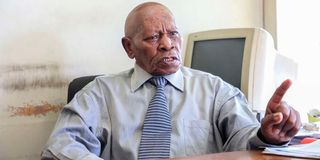
Dandora Housing Scheme chairperson Peter Wango Muhoro during an interview at his office in Nairobi on August 27, 2026.


The year is 1962. Kenya is in its final lap of colonial rule, but racial prejudices still run deep. At a grocery shop a few metres from Nairobi’s railway station, owned by an Asian trader, an employee in his twenties is getting fed up.
That man is Peter Wango Muhoro. He is not impressed by the fact that he and fellow employees are frequently insulted by their boss and his wife for every minor mistake they make. This being a shop dealing in fresh fruits and vegetables with a sizeable European clientele, something as simple as a fruit falling attracts a heap of insults to the staffer involved. When that insult comes his way for the umpteenth time, he cannot take it anymore and takes matters into his own hands. He beats up his employers, saying he is no dog. That’s not all; he also locks up the boss’ wife in the toilet.
The police are called, and two English inspectors arrive in a vehicle. Recounting that incident 66 years later, Mr Muhoro vividly remembers what he told the policemen.
“I said, ‘This guy insults us. He calls me a dog,’” Mr Muhoro told Nation Lifestyle in an interview. “I was taken to Kingsway Police Station [which is today the Central Police Station in Nairobi]. I was locked up in the cell meant for the hard-core criminals. My legs were tied up with chains.”
He was arrested from the shop that was located on the then Victoria Street, which is today Tom Mboya Street. He would later be taken to a court located in the building inside the Nyayo House compound, facing Kenyatta Avenue. The magistrate would later find him guilty of assault. To determine how long he would serve in jail, the magistrate swung his key holder on a finger. The number of turns would determine the duration Mr Muhoro would spend behind bars.
“It swung six times, and he jailed me for six months. He called me Mau Mau blood,” recalled Mr Muhoro during an interview in his office in Nairobi’s Bruce House.
He spent the six months at the Kamiti Maximum Prison. He remembers being under tight watch and carrying the waste pail on various occasions. After the jail term, he was to be taken to his rural home in Lower Kabete in today’s Kiambu County. Officers dropped him in Kiambu and told him to walk home. By then, he had the money paid by his Asian boss on that eventful day as “severance” pay.
“I’d told the policeman: ‘Let him give me my money; I won’t work here again.’ I was given the money. It was Sh90 in total,” Mr Muhoro recalled. His salary then was Sh160. That encounter was one of the many conflicts of a racial nature that Mr Muhoro faced. Born in 1940, he confesses he was a firebrand who would dare challenge some of the prejudices.
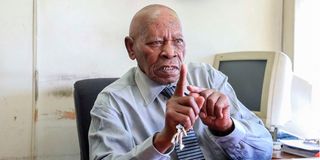
Dandora Housing Scheme chairperson Peter Wango Muhoro during an interview at his office in Nairobi on August 27, 2026.
Asked whether he regrets beating up his boss, he answered with a firm no.
“They used to treat us as children. And if you dared insult them back then, you would be in trouble. You would be called a boy even though you were a man,” he said. “They used to insult us a lot. We were their employees, and they would call us dogs and all manner of names.”
Regarding the Europeans, he recalls, an African worker was expected to call his male boss “bwana mkubwa”, the sons “bwana mkubwa mdogo” and his wife “memsahib”. The daughters were typically called “binti”, he recalls, adding that an African calling his British employers by their name was frowned upon.
The unofficial racial hierarchy then, he says, was that whites were at the top, followed by Goan Asians, then the other Asians, while the Africans were at the bottom of the pyramid. A notice that was once placed outside a top hotel in Nairobi is etched in his memory. It said: “Africans and dogs not allowed.” There were police officers manning the gates to ensure that it was heeded.
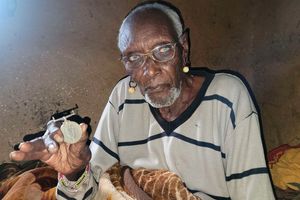
Mr Muhoro is one of the ever-decreasing number of Kenyans who have witnessed goings-on from the time when the country was Queen Elizabeth II’s territory to now, when it is a republic under its fifth president. He has kept some mementos along the way, among them the passbook his late father was given in 1958 to enable him to enter Nairobi for treatment at the King George VI Hospital, which is today the Kenyatta National Hospital. The passbook was issued to the Kikuyu, Embu, and Meru, and without it, entry to Nairobi was not allowed. He has also kept a card he got allowing him to attend a State House garden party on Jamhuri Day in 1978, barely four months after Daniel arap Moi had become president.
He is a living witness to some of the extremes of racial discrimination starting from the colonial era and extending many years into post-colonial Kenya. One reality he remembers is that in colonial Kenya, Africans were not allowed in Europeans’ houses or offices.
“You only got in if you were working there. And you needed to have a uniform,” he says.
Entry into Nairobi for Africans was also restricted, especially for the ethnic groups that needed a passbook. There were roadblocks in major arteries into Nairobi from the central region to ensure compliance.
“On the western side, the gate was in Kabete, at the approved school. From the north-western part, there was a barrier at Banana. From the northern part, the gateway was at Ruiru. There were none on the eastern side. It is the gateways to the Central region that were affected,” he says.
Other discriminatory practices happened long past independence. For instance, in 1969, Mr Muhoro recalls entering the Molo Farmers Club, in today’s Nakuru County, which was a whites-only space six years after independence. Together with four other men, he confidently drove into the club in his Hillman vehicle.
“I went in proud that we were independent. I sat among them and ordered a drink,” he recalls.
Their presence did not augur well with the white patrons, and an exchange ensued. Mr Muhoro recalls the white men as bushy, sporting long beards and unshaven chests. They stormed out in their Land Rovers, leaving the Africans there. Mr Muhoro could only smile.
“I fought them because of their maringo [pride],” he said.
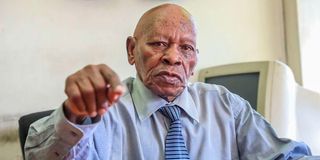
Peter Wango Muhoro.
There are some instances where he had to comply. A few years after independence, he recalls a time he had to improvise a tie, as he would not be allowed into the New Stanley Hotel without one. He was a salesman with a company called Stationery and Office Supplies, and he was to attend an evening meeting. He had chosen not to wear his tie as he knew he would be having a drink.
“I never wore a tie to a place where people could drink, in case someone wanted to grab me by the neck. Whenever I intended to go to a drinking place, I left my tie behind,” he said.
“After being turned away at the door of New Stanley, I went to a curio shop at Rehema House. I looked for a dried piece of banana fibre and improvised a tie. I attached it to my collar using pins, and with that, I was allowed in,” added Mr Muhoro, laughing as he displayed an equivalent.
“The policeman who saw me must have wondered what was wrong with me. He let me enter.”
A car he bought in the early 1960s also came his way because of racial prejudice. A European official at the Barclays Bank’s Queensway Branch (which is today Absa Bank) had to sell his car at a throwaway price because he could “not stand seeing Africans take power”.
“As independence neared, he was one of the Britons who could not accept the fact that they were being ruled by Africans. He sold me the car at a price, which may not have seemed much, but that was my savings. It cost Sh800,” he says.
He made his money from supplying cut flowers. He would source them from farms in Kinangop, Naivasha, Limuru and Karen, then supply them to various sellers in Nairobi. The Asian couple he assaulted were among his clients. Even as he worked, he was still a distributor.
He has since left the flower business. Today, he is the chairman of the Dandora Housing Scheme, which is laying claim to an 818-acre parcel of land that covers the better part of Umoja II, Civil Servants, among other Nairobi localities. A long-winding court case over the area has been meandering in the corridors of justice for more than five decades.
In his opinion, Kenyans were at their freest in the 15 years that followed independence.
“After independence, we stayed well for 15 years. We enjoyed our independence for 15 years, during Jomo Kenyatta’s reign. A year or two after he died, the problems began,” he says.
“I am one of the people who suffered a lot under [his successor, Daniel arap] Moi. I would be arrested every so often for holding meetings, yet it was a water project I was leading. We would meet as committee members only, but I’d be arrested anyway. I would then be a guest of the State at the Industrial Area Remand Prison.”
Whereas Mr Muhoro had little to admire about the colonialists, his friend and fellow director at the Dandora Housing Scheme, Mr Kimani Ng’ang’a alias Wamuthoni, picked up the habit of wearing a scarf-like tie (cravat) from them.
Born in 1932, Mr Ng’ang’a has, since his youth, been in love with the European-inspired piece of dressing. The cravat is typically fitted between the neck and the collar, covering the front part of the neck and extending slightly into the button line.
“It was a fashion trend among white farmers,” says Mr Ng’ang’a, who also hails from Kabete. “It impressed me.”
From the late 1960s till around 2023, Mr Ng’ang’a’s main job was selling newspapers in Nairobi. He would obtain copies from registered distributors then sell for a commission.
“Because I wasn’t [formally] employed, that became my source of livelihood. It also educated my children,” he says, noting that the cover price of the very first newspaper he sold was Sh2.
Whenever he was on the streets in the mornings, he could be spotted wearing his cravat. He says it ensures warmth because it insulates the neck from exposure. He has about five cravats, he says, which are available in high-end clothes shops in Nairobi.
Mr Ng’ang’a also has regular neckties, which he wears to church.
“I wear [cravats] when doing my work or when moving about,” he says.
He believes that newspapers in Kenya are assured of good sales when they place politics on the front pages.
“It sells to those who love politics,” he says, quick to add that he, personally, is not a big fan of politics.
“My politics ended in December 1964,” he says, implying that he stopped closely following the goings-on in the country’s political scene after Kenya became a republic.
Follow our WhatsApp channel for breaking news updates and more stories like this.