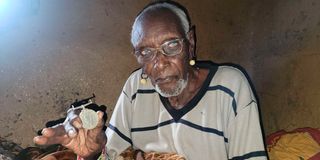
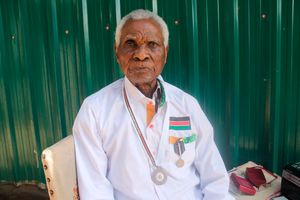
On a windswept hill in Ng'ari area on the outskirts of Maralal town in Samburu County is a dimly lit manyatta. The humble abode is home of 101-year-old Ngaato Lesiokono.
Though frail and bedridden, he remains sharp-witted and lucid.
He rests on a simple wooden bed with a worn-out mattress and faded blankets, occasionally lifting his head with effort to narrate a piece of his untold story.A pair of old crutches leans against the wall, his only means of movement on good days.
But despite his frailty, the former colonial sergeant speaks with clarity, recalling his time in the British military during the colonial era and his secret role in feeding the Kapenguria Six in Lokitaung Prison during the 1950s Mau Mau rebellion.
“They came looking for labour force,” Mr Lesiokono recalls.
Ngaato Lesiokono,101, an ex-colonial sergent, holds his World War II medal at his home in Ng'ari area in the outskirts of Maralal town on April 12, 2025. He secretly fed Mzee Jomo Kenyatta alongside other 'Kapenguria Six' detainees in Lokitaung Prison, Turkana District, at the height of the Mau Mau rebellion in the 1950s.
Photo credit: Geoffrey Ondieki| Nation Media Group
By 1936, he had undergone Samburu initiation rites and joined the 'Lmekurii' age-set of morans. He attended Sirata Oirobi Primary School between 1938 and 1941, the first school established by colonialists in the then Samburu District.
World War II was underway and British officers came to recruit the strongest morans for military service. Lesiokono was among 20 young men chosen to join the Military Guard (MG).
“They hand-picked the strongest morans. I remember others running away to avoid being recruited,” he says in the interview with Nation.africa.
He recalls the battlefield’s brutality, harsh drills and strange military songs they were forced to sing in praise of colonial war leaders. Even today, he hums fragments of those tunes from his bed.
After the war, in 1949, he joined the colonial police in Nyeri, serving under a captain he identifies only as “Captain Miller.”
But his most unforgettable assignment came in 1952, when Kenya was declared a state of emergency and six key independence leaders, Jomo Kenyatta among them, were arrested and detained in the remote Lokitaung prison in Turkana.
After the declaration of a state of emergency in late 1952, Mr Lesiokono was transferred to Lokitaung Prison in Turkana District (now County).
It was there that the legendary Kapenguria Six..Jomo Kenyatta, Paul Ngei, Bildad Kaggia, Achieng Oneko, Fred Kubai, and Kung'u Karumba—were secretly detained.
“It was in Lokitaung that I met Kenyatta face-to-face. In his words, he told us, ‘I have held the lion’s mouth, so you can beat it.’ It was a metaphorical statement for the sacrifices he was making to free Kenya from colonial rule,” Mzee Lesiokono says.
The freedom fighters dubbed the 'Kapenguria Six', who were tried by the British Colonial Government and jailed in the semi-arid north of the country for allegedly managing the Mau Mau revolt. They are from left, Paul Ngei, Fred Kubai, Jomo Kenyatta, Achieng Oneko, Kung'u Karumba and Bildad Kaggia.
Photo credit: File| Nation Media Group
While he and other police officers were forbidden from speaking to the detainees, Mr Lesiokono and other sympathetic police officers did the unthinkable as they pooled a shilling each from their meager salaries to buy a goat which they secretly cooked for the detained Kapenguria Six in Lokitaung Prison.
According to the ex-colonial sergeant who was earning up to Sh42 monthly, a single goat was going at Sh7 in 1952.
“We used to cook and serve them secretly. It was a risky move, but we fed them. We decided to wake up in the dead of night to throw away the leftovers so no one would know. We could even go on to bury the bones and skins because if we were found, the punishment would have been dire,” he chuckles softly.
Lesiokono says his act of secretly taking care of the Kapenguria Six was not without risk, but Mzee Jomo Kenyatta noticed.
“He told me when we attain independence, if we manage to, you are a great man who should be remembered,” he says.
A detention camp at Lokitaung town in Turkana County where founding President Mzee Jomo Kenyatta and other political detainees were held.
Photo credit: Sammy Lutta | Nation Media Group
In 1961, Mzee Jomo Kenyatta was brought to Maralal town, where he was detained in the present-day Kenyatta House as negotiations of the terms of independence were ongoing.
The colonial-era bungalow, which is now under the management of the National Museums of Kenya, played its fair bit during Kenya’s independence struggle. The weather-beaten colonial era building still stands decades on.
While in Maralal, Jomo Kenyatta was allowed freedom to walk to nearby shopping centres in the company of guards and was not allowed to talk to anybody without permission.
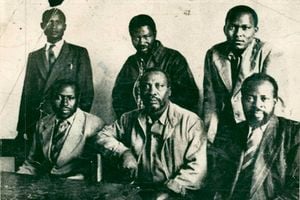
The Kapenguria Six. Seated: Kung’u Karumba, Jomo Kenyatta and Bildad Kaggia. Standing: Achieng Oneko, Fred Kubai and Paul Ngei.
Photo credit: File | Nation Media Group
“He could move to town occasionally and sometimes visit his friend called Lekalja. That is the second time I talked to him and could vividly remember me,” Lesiokono says.
He, however, never got a chance to see him again, even after he ascended to power in 1964 because of local political forces. Mr Lesiokono believes to date, not everyone was happy about this recognition.
He was jailed for eight months and flogged with eight strokes daily after beating his wife—an incident he says was twisted by those who did not want him to reunite with Kenyatta.
“But the then District Commissioner (DC) and the first Member of Parliament blocked me completely. They feared the recognition I could have received from the President to the extent of creating trumped-up charges to have me jailed,” he recalled.
Now, more than 70 years after those secret midnight meals, the retired sergeant lies quietly in his manyatta in Ngari area, far from the national stage but rich with the weight of untold history.
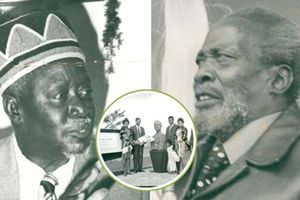
Former President Mzee Jomo Kenyatta.
Photo credit: File | Nation Media Group
He may have never received official recognition, but in his own words, he holds a legacy far deeper, and the World War II medal he has is a testament.
“I wish I met him (Mzee Jomo Kenyatta), but it never happened. If possible, I would like to meet Mama Ngina Kenyatta or retired Uhuru Kenyatta before I die,” he says, staring at his medal he received after the Second World War.