A fisherman who earned a living from the shifting depths of Lake Victoria and picked cotton for his pocket money is now marking 40 years of priesthood.
John Oballa, the Bishop of the Catholic Diocese of Ngong, also marked 14 years as a Catholic bishop, a journey that has taken him from Ahero to Rome, where he spent six years studying Canon Law, earning a PhD at the Pontifical Urban University.
Bishop Oballa, often referred to as ‘Ole Owaa’, speaks fluent Italian, Latin, German, French and Dholuo, and is now mastering the Maasai language.
He says his parents were his first spiritual guides, as they created a prayerful home environment and allowed him to dedicate his life to God.
“My mother was very keen on education. Before I went to nursery, she had taught me how to read and write, yet she only studied up to Standard Three. She turned 100 in May this year,” said Bishop Oballa.
“My late father recited his rosary every single day, but didn’t force anybody to join him. He would not eat until he had completed the prayer.”
His former parish priest, John Kutna, assisted young Oballa in securing a place at St Peter’s Junior Seminary, Mukumu, in 1973 and encouraged him to join priesthood.
“I found him inspiring. His sermons were engaging, as he would ask questions during the homily,” Bishop Oballa says.
As he grew older, his desire to become a priest intensified.
“We used to pick flowers at the parish and sell them in Nakuru for pocket money. That showed me that the church was not only a place of spiritual guidance, but also a source of livelihood. My home is not too far away from Lake Victoria, and as children we would go fishing,” he says.
“We would sell the fish and pick cotton, so I grew up knowing I was capable of generating income. I used the money to buy clothes, and pocket money when I joined Form One.”
On March 5, 1973, Maurice Cardinal Otunga had just been appointed a Cardinal, the second-highest position in the Catholic Church, coming just after the Pope.
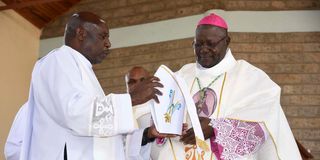
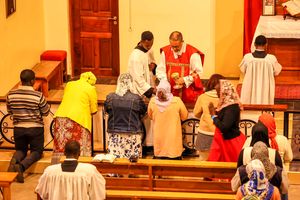
Bishop John Oballa Owaa puts on a mitre that was gifted to him as he marked his 68th birthday and 40 years as a priest, 14 years as the Bishop of Ngong on August 28, 2026 at St Joseph's Cathedral-Ngong.
Photo credit: Pool
Bishop Oballa and his step-sister walked from their home in Ahero to Kisumu, a distance of about 18 kilometres, to attend the Cardinal’s celebration mass.
“After mass, despite the long queues, we held on with just one shilling and fifty cents each, which our elder brother had given us for lunch. We were determined to greet the Cardinal, and when our turn came, we placed the coins in his hands.”
“After that, I told my stepsister Leonora to call me Father, and she told me to call her a nun. The next year I joined St Peter’s Seminary, and she later joined the Franciscan Sisters. She is now a nun in Wisconsin, US,” he says.
His decision to pursue the priesthood was met with quiet support from his parents, even though they were mindful of the challenges he might face.
“It was as if my parents knew I would become a priest because when I told them, my mum remained silent while my dad told me that should I find it difficult, the gate would always remain open for me to return. To date, our home does not have a gate. I took and passed the interview for admission to St Peters Seminary, sat my O-levels there in 1973, then went to Tindinyo College for my A-levels.”
Pope Benedict XVI, who at one time taught him while he was studying for a PhD in Canon Law in Rome, appointed him the third Bishop of the Catholic Diocese of Ngong on January 7, 2012.
“The lessons were in Italian, and I really struggled in my first three weeks,” he says.
Bishop John Oballa flanked by his parents Mr Jacob Owaa and Mrs Tabitha Owaa during his ordination mass in Kisumu on August 28, 1986.
While in Rome, he also worked as an official of the Pontifical Council for Health Pastoral Care between the years 1995 and 1997.
He was consecrated as Bishop on April 14, 2012, by Cardinal John Njue, who also taught him philosophy at Mabanga Major Seminary in Bungoma, where he was the Rector.
Oballa is the first Kenyan-born Bishop for Ngong after the late Bishop Colin Davies (1976-2002), and Bishop Emeritus Cornelius Schilder, who served from 2003 to 2009.
“My journey would be impossible without the support of the clergy and Christians,” he says.
Ngong Diocese is made up of 42 parishes. “We are opening another one in Kitengela and one more before December.”
He adds: “The Ngong Catholic Diocese was established to serve nearly all Maasai communities in Kenya, apart from those in Samburu and a few other regions. Today, its territory spans more than one million people, stretching from Ngong through Kilgoris in Narok County, down to the Tanzanian border at Mt Kilimanjaro–Oloitoktok–Moshi, Arusha, and even touching the Mombasa Archdiocese in the South.”
Bishop John Oballa flanked by St Peters Seminary Alumni soon after celebrating mass at the St Jospeh's Cathedral to mark his 40 years as a priest, his birthday and 14 years as the Catholic Bishop of Ngong on August 28, 2026.
Photo credit: Pool
“Yet there are still areas we have not fully evangelised, and that remains a deep concern for me. It is why I place such strong emphasis on mass evangelisation, to ensure the gospel touches every corner of Maasailand.”
He was appointed at a time when the Church was intensifying its focus on educating girls within the Maasai community, a society where illegal traditions such as female genital mutilation (FGM) and early forced marriages remain persistent challenges.
“Despite declining prevalence of FGM in Kenya, enforcing the law in remote or semi-nomadic pastoralist regions remains complex. There are some parts of Maasai land that have no roads. The practice persists, sometimes with support of local chiefs,” says Bishop Oballa.
He says he worries about the grinding poverty, water scarcity, poor roads, and inadequate health and education infrastructure in Kajiado and Narok counties.
“The sheer number of distressed families seeking help with rent, school fees, and medical care is truly alarming.”
He also condemns political intolerance, goonism and land grabbing, which he says is rampant in Maasai land.
“In Maasailand, there are too many parcels of land being fenced. One day the Maasai will wake up and find all their land gone. Former President Uhuru Kenyatta said that Kenya loses Sh2 billion every day to corruption. Nobody has ever challenged him. The level of corruption is too much.”
“As we head to the elections, I appeal for peace. If I could, I would print enough prayer cards of St Francis of Assisi prayer for Kenyan families to hang on their walls.”