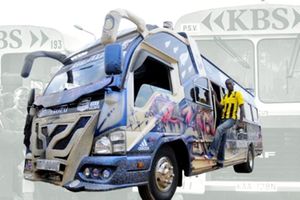
Every month or so, a new pimped-out matatu or nganya is launched on Nairobi’s popular routes: Ongata Rongai, Embakasi, Ngong and Umoja. A driver is handpicked because he is the ‘wheel’ behind the million-shilling investment.
Driving a flashy nganya is not just about how fast one manoeuvres the roads. In Nairobi’s competitive matatu scene, these drivers, who have cult followers, are handpicked with precision.
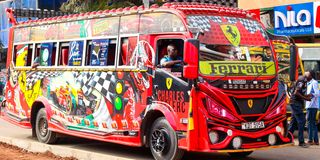
Isaac Nzioka, known in his circles as Gateri, the man behind the wheel of ‘Ferrari’, one of Ongata Rongai’s most recent nganyas, divulges what it really takes to sit in the driver’s seat of Nairobi’s most hyped rides.
A matatu nicknamed Ferrari on Moi Avenue in Nairobi on July 24, 2025.
Photo credit: Bonface Bogita | Nation Media Group
‘Ferrari’ hit the road two months ago, and the buzz around it has not died down. One of the major challenges in being picked as a driver is earning the trust of the vehicle’s owner. Gateri says no investor hands over a nganya to a driver overnight.
“You have to earn it. Even for me, I had to prove myself. Once I did, the ‘Ferrari’ investor brought me on as a driver full-time. That trust is not given lightly.”
“A good driver can make or break a matatu’s success. When a new nganya hits the road, investors know exactly what they’re looking for in a driver, and it’s not just who can drive the fastest. A driver’s experience and loyalty matter. Imagine a driver joking around with a 12-million-shilling investment by letting people hang on the side mirrors, playing with the headlights, clinging to the edge of the door, or driving recklessly? A good driver protects that investment,” says Gateri, who is 40 years old.
Pressure of fame and road competition
However, being the driver of a new nganya isn’t just a job; it’s a high-stakes performance. From day one, the pressure to outshine rivals begins.
“When a newly pimped matatu hits the road, it instantly becomes the centre of attention. You’re the driver of the ‘new baby’ in town. There’s pressure to make it stand out and stay ahead,” he says.
“At first, it may seem like there’s rivalry or tension among us drivers, but really, it’s each of us trying to bring something different to the game. We’re all hustling to attract passengers because this is our livelihood; nobody wants to operate at a loss. The competition can be tough. It’s like politics sometimes, there’s gossip, rumours, and attempts to bring you down. If you’re not mentally strong, it can wear you out and lead to stress or even depression. And once that happens, the investor may start doubting your ability and bring in someone else to run the show, a team they believe can grow the business,” he says.
“There is no nganya that has been fought as hard as ‘Ferrari.’ My competitors spread rumours to bring me down and make me lose customers, but I never gave up. Some even started making empty trips to the bus station to arrive before me and pick up passengers first. However, my passengers would call me and ask where I was, and once I assured them, they didn’t mind waiting for me. I have the most loyal passengers, and their loyalty is what keeps me in the game,” he says.
For Gateri, a driver who has earned passenger trust is just as important. “My passengers know me. If someone forgets their bag, they’re confident it’ll be returned. That loyalty is everything. It’s about humility and being human.”
He says in the battle for drivers, investors value a driver who is responsible and accountable, from managing service costs to maintaining the vehicle’s condition.
“What people don’t know is that this kind of investment is so profitable. On average, the least profit a nganya can make in a day is around Sh15,000 after deducting its expenses; fuel cost, together with the driver’s and conductor’s pay. In a month, it can generate approximately Sh400,000 in profit, which totals to about Sh4.8 million annually,” he says.
“A single major service costs up to Sh300,000. But with a responsible driver, the vehicle can go for up to two months without needing repairs,” he says.
The major routes favoured by nganya investors are Ongata Rongai, Embakasi, Umoja, and Ngong. Why?
“The investors behind these matatus understand what their passengers want: the vibe, the desire, and the unique experience. For example, some vehicles have music systems installed at a cost of not less than Sh2 million, while the lighting setup alone can cost around Sh1.2 million,” he says.
Gateri joined the public transport industry as a matatu driver for the Ongata Rongai route in 2014. With 18 years of experience in this field, I ask him how he got into the profession.
“Well, I just found myself here. I can’t say it was a dream or a passion to be in this field. My love for music, fashion, and art perhaps fueled my growing interest and joy in being a nganya driver,” he says. “Now it feels like a fun skill, almost like a hobby that I truly enjoy.”
Despite the rowdy reputation often associated with matatu crews, Gateri says most of it is misunderstood.
“People think we’re always fighting. It’s a way of psyching each other up. This job can be extremely exhausting without those good vibes. It’s our way of creating morale, of psyching each other up.”
As a family man with three children, he says his motivation is simple. “I’ve got mouths to feed. That keeps me going. And so does my pride in what I do.”