To a first-time visitor, Holy Cross Church in Nairobi’s Lavington looks like any other Catholic parish. The scent of incense drifts through the sanctuary. A large crucifix towers above the altar, flanked by statues of the Blessed Virgin Mary, St Joseph and other saints.
Fourteen Stations of the Cross line the walls. Fresh flowers frame the tabernacle, the sacred place where Catholics believe Christ is truly present in the Blessed Sacrament. Only after the Mass begins do the differences emerge.
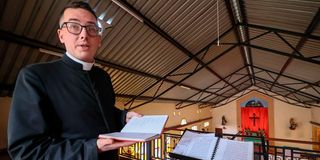
Fr. Louis Gravrand, School Chaplain, Deputy Director and Vicar inside Holy Cross Catholic Church in Lavington, Nairobi, on July 9, 2026.
Photo credit: Wilfred Nyangaresi | Nation Media Group
There is no entrance hymn accompanied by drums or keyboard. No congregants greeting one another. No lively choir leading familiar Swahili or English hymns. Instead, solemn Gregorian chant rises gently through the church as the priest, clothed in a flowing black cassock beneath richly embroidered vestments, walks towards an altar fixed against the sanctuary wall.
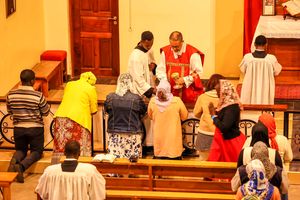
Congregants during an evening Mass at Holy Cross Catholic Church in Lavington, Nairobi, on July 10, 2026. Worshippers stand and kneel in prayer during the liturgical celebration.
Photo credit: Wilfred Nyangaresi | Nation Media Group
Throughout the Eucharistic Prayer, he never turns to face the congregation. Instead, he stands before the altar with his back to the faithful. The posture, known by its Latin name ad orientem, “towards the East,” is one of the defining features of the Traditional Latin Mass celebrated by the Society of St Pius X (SSPX), whose only Kenyan parish is Holy Cross.
“Can you imagine if a pilot faces the passengers during a flight? There would be a crash. I am the people’s intermediary to Christ. I am leading them in worship, not addressing them as an audience. That is why we all face the altar during Mass,” says Father Louis Gravrand, who is among four priests serving at Holy Cross church.
For many new-age Catholics, the experience is unfamiliar and intriguing. The liturgy follows the 1962 Roman Missal, commonly known as the Traditional Latin Mass or Tridentine Mass, rather than the Novus Ordo Missae introduced after the Second Vatican Council in the late 1960s. Although the Scripture readings and homily are delivered in English, almost every prayer is sung or recited in Latin. Every pew contains bilingual Latin-English missals, allowing worshippers to follow the ancient prayers line by line.
A statue of Virgin Mary stands at Holy Cross Catholic Church in Lavington, Nairobi, on July 9, 2026.
Photo credit: Wilfred Nyangaresi | Nation Media Group
“The Mass we celebrate has been said for nearly 1,500 years,” says Fr Louis. “When we speak to God, we use the language of the Church.”
Yet what strikes many visitors is not the language, but the silence. Unlike the Mass celebrated in most Catholic parishes today, where the congregation frequently responds aloud to the priest, Holy Cross is marked by long periods of profound quiet. Much of the dialogue takes place between the celebrant and the altar servers, while the congregation participates inwardly, following the prayers in their missals and joining the sacrifice through silent prayer. At several points, for instance, the period after the Sanctus (Holy, Holy, Holy), until just before the Our Father (Pater Noster), the priest's voice drops almost to a whisper.
These are not forgotten words or awkward pauses. During the most sacred part of the liturgy, when Catholics believe the bread and wine become the Body and Blood of Christ, the prayers are intentionally recited quietly. For the Society of St Pius X, this silence draws attention away from the personality of the celebrant and towards the mystery unfolding upon the altar.
Fr Pierre Champroux, the priest in charge at Holy Cross, says many visitors struggle to explain what first attracts them. “They don't necessarily know all the theological terms, but they tell us there is so much silence, so much respect for the Holy Eucharist. They recognise that this is Catholic.”
Inside Lavington's Holy Cross Church and the Catholic movement challenging Pope Leo’s authority
That atmosphere extends to every movement within the sanctuary. Unlike in many Catholic churches where the altar stands freely at the centre, Holy Cross preserves the older architectural arrangement. The altar rests against the wall beneath a large crucifix and six tall candles. An altar rail separates the sanctuary from the nave, where worshippers later kneel to receive Holy Communion. Even the priest’s gestures differ. During a single Mass, Fr Louis explains, the celebrant genuflects around 14 times, far more frequently than in the ordinary form of the Roman Rite.
“Each bow and each genuflection is an act of adoration before the Blessed Sacrament,” he says.
Rather than choirs accompanied by keyboards, drums and clapping, Holy Cross relies almost entirely on Gregorian chant, named after Pope Gregory I or St Gregory the Great. This is the ancient form of sacred music that has accompanied Roman Catholic worship for over a millennium. Sung in Latin and without instrumental accompaniment, its flowing melodies create an atmosphere of solemn prayer rather than congregational singing.
Fr Louis believes the disappearance of Gregorian chant from many Catholic churches after the liturgical reforms remains one of the greatest losses in modern Catholic worship. Participation inside the sanctuary is equally traditional. Only boys and men serve at the altar. Scripture readings are proclaimed by the priest or ordained ministers rather than lay readers. The SSPX says this practice reflects the older understanding that serving at the altar has historically been linked to priestly formation, with many priests first discovering their vocation as altar boys.
Fr. Peter Champroux administers Holy Communion to congregants during an evening Mass at Holy Cross Catholic Church in Lavington, Nairobi, on July 10, 2026. He was assisted by altar servers during the liturgical celebration.
Photo credit: Wilfred Nyangaresi | Nation Media GRoup
Likewise, many women attend Mass wearing veils or head coverings. Parishioner Purity Kavidza is quick to clarify that members do not see this as a unique SSPX custom.
“People say women in our church cover their heads,” she says. “But we believe Catholic women have always covered their heads while praying. It is not something that belongs only to Holy Cross. It is not that we pray in Latin in our church. We believe Catholics are supposed to pray in Latin. It is not that we receive Holy Communion only on the tongue. We believe that is how Catholics are supposed to receive Our Lord. These are the original traditions of the Catholic Church.”
Nowhere is that conviction more visible than during Holy Communion. When the time comes, there are no Extraordinary Ministers of Holy Communion assisting the priest, as is common in many Kenyan parishes. Only ordained priests distribute the Eucharist. Worshippers approach the altar rail, kneel side by side, tilt back their heads and receive the consecrated Host directly on the tongue. Communion in the hand is not permitted.
“That is not simply bread,” says Fr Louis. "It is the true Body of Christ hidden under the appearance of bread. It deserves the highest reverence."
A view of the Holy Cross Catholic Church in Lavington, Nairobi, on July 9, 2026.
Photo credit: Wilfred Nyangaresi | Nation Media Group
To members of the Society of St Pius X, every gesture, every prayer, every moment of silence and every act of reverence serves one purpose: to emphasise that the Mass is not primarily a gathering of believers but the renewal of Christ's sacrifice on Calvary.
For Sam Magero, one of the faithful at Holy Cross, his attraction to the church was never about nostalgia for an older form of worship. It began with questions. Like many Catholics, he found himself trying to make sense of conflicting opinions about the Church, liturgical reforms and Catholic tradition. Instead of relying on social media debates or online commentary, he turned to older Catholic writings, the lives of the saints and centuries of Church teaching.
“I said okay, there are too many opinions today so what I did, I took books like The Soul of the Apostolate by Dom Chautard, and Christ the Ideal of the Priest by [Columba] Marmion. The church is teaching modernism but shut yourself off from those opinions and just go take a book before 1958 and see what they teach, and what was the [original] attitude of the church. That journey eventually led him to Holy Cross.
Fr. Louis Gravrand, School Chaplain, Deputy Director and Vicar, during an interview at Holy Cross Catholic Church in Lavington, Nairobi, on July 9, 2026.
Photo credit: Wilfred Nyangaresi | Nation Media Group
Magero says he did not come looking for something different simply for the sake of being different. He was searching for what Catholics often describe as the interior life—a spirituality rooted in contemplation, discipline and silence. "The Mass helps you focus less on yourself and more on what is happening on the altar."
It is an observation Fr Pierre Champroux has heard repeatedly from newcomers. "They tell us there is so much silence, so much respect for the Holy Eucharist. They may not know all the theological explanations, but they recognise that this is Catholic. Many people come once and they never leave."
Extensive catechism classes
Some return because they are captivated by the solemnity of the liturgy. Others say they have rediscovered traditions they had assumed had disappeared from Catholic life altogether. For Fr Pierre, those reactions reveal a hunger among some Catholics for a deeper sense of continuity with the Church's past.
A statue of a saint is displayed inside Holy Cross Catholic Church in Lavington, Nairobi, on July 9, 2026.
Photo credit: Wilfred Nyangaresi | Nation Media Group
Besides daily and Sunday Masses, the parish runs Holy Cross International School, which offers the Cambridge curriculum, as well as extensive catechism classes for children, adult converts and practising Catholics seeking a deeper understanding of their faith.
It prides itself as running “the only traditional Catholic bookshop in East Africa” where they stock spiritual classics, missals and devotional literature that are difficult to find elsewhere in Kenya. The parish's Gregorian chant choir has earned admiration even from visitors unfamiliar with the older liturgy, while its handcrafted rosaries have become sought after by Catholics from different parts of the country.
A hymn book and liturgical music stand overlook the sanctuary inside Holy Cross Catholic Church in Lavington, Nairobi, on July 9, 2026.
Photo credit: Wilfred Nyangaresi | Nation Media Group
Holy Cross is currently served by four priests—Fr Pierre Champroux, the Prior, together with assistant priests Fr James Ngaruro, Fr Louis Gravrand and Fr Alexandre Lambert—as well as two religious sisters. Four Kenyan seminarians are currently studying in Switzerland under the Society of St Pius X, preparing for the priesthood before returning to serve communities across Africa.
“We don't have enough priests," Fr Louis admits. "We could open a new parish in any city, and it will be full, but we don’t have enough priests. That is our biggest limitation.”
The Society estimates that it has about 20 priests serving across the African continent, with apostolates in South Africa, Gabon, Nigeria, Tanzania and Madagascar, while priests regularly travel to neighbouring countries to celebrate Mass and administer the sacraments. Its Kenyan presence, however, remains centred entirely on Holy Cross in Lavington. Fr Louis dismisses suggestions that the society operates hidden chapels elsewhere in the country. "We only have Holy Cross," he says.
The movement itself traces its origins to French Archbishop Marcel Lefebvre, who founded the Society of St Pius X in 1970. Long before that, however, Lefebvre had walked Kenyan soil. Hanging inside the priests' residence at Holy Cross is a photograph of him attending Kenya's independence celebrations in 1963 while serving as Superior General of the Holy Ghost Fathers, years before establishing the society that would later become one of the most debated movements within contemporary Catholicism. Few Catholics realise that the founder of the SSPX once visited the country decades before Holy Cross Church was established.
A bookshop inside Holy Cross Catholic Church in Lavington, Nairobi, on July 9, 2026.
Photo credit: Wilfred Nyangaresi | Nation Media Group
Despite the public controversy surrounding the society, Fr Louis says interest in the Traditional Latin Mass extends beyond the parish's own membership.
"Some priests would like to come, but they are afraid of being ostracised or sanctioned."
The Society acknowledges that its relationship with the Vatican remains complex. While Church authorities have at various times described many of its sacramental ministries as illicit—meaning carried out contrary to canon law—the society maintains that the Mass it celebrates is valid and that it remains firmly within the Catholic tradition.
But Fr Pierre says, “Don't be afraid of big words. Come and see for yourself.”
NB: Kenya's bishops have warned Catholics that attending SSPX priories, including at Holy Cross Catholic Church, places them outside full communion with Rome.