When we parted ways here last week, I was still wrestling with Fiolina’s shylocks on the phone. These people had installed a full-call-centre operation dedicated solely to me. They rang all my known numbers relentlessly, denying me even a moment to breathe.
When they realised that I was annoyed but unmoved, they changed strategy and went for a softer target – my father.
They didn’t need much. Just a few calls and a couple of well-placed threats, and Mzee was already looking for me, ready to settle the debt. When he noticed I wasn’t exactly enthusiastic about paying, he even offered to sell one of his cows so we could clear Fiolina’s loan.
The old man simply couldn’t withstand the calls and threats—especially after they told him I could be arrested, or worse, that he could become a “State visitor.”
“My son, can you sort this problem?” he pleaded when we met. “Please pay these people. I can’t even use my phone, and my pressure imepanda .”
“Those are thieves. Don’t give them any money,” she said. “Ask them how much I borrowed and compare with what they’re demanding.”
“Matumizi ya nyumba tu ,” I understand that she told him. “Your son does nothing in the house. Nothing.”
In case the fire wasn’t hot enough already, she added petrol.
“Kama uko na pesa, nipee. Usiwalipe ,” she told my father.
So here I was—being blamed for not participating financially, while also being instructed not to pay.
When Mzee complained about my “non-participation,” I swallowed my annoyance and assured him all would be well. As I said this, I switched on my phone after two days of silence. On Monday morning, immediately the phone came alive, so did the shylocks. Threats resumed.
Honestly, convince me Safaricom is not involved. How else did they know the exact moment I switched my phone back on?
Over the weekend I tried to discuss the loan with Fiolina. She suddenly became a United Nations conference—able to discuss climate change, global peace, and school gossip, but not the loan.
On Tuesday she went to school as usual—Nyayo dropped her. She said she’d return on Wednesday, again via Nyayo. But when Nyayo went to pick her on Wednesday, she was nowhere to be found and unreachable. I called all her colleagues I knew; none knew her whereabouts, except to confirm she had left school jovially—as usual.
Imagine that: Fiolina jovial, while Mzee and I were on blood pressure medication over a problem she created. To survive, I bought another line. My two numbers were unusable. Mzee refused to do the same.
I asked Nyayo to come back just in case she appeared. My biggest fear was that she had gone to Apostle Elkana’s church—THOAG. She didn’t come home., and she was not at THOAG.
Fiolina's abusive language
On Wednesday evening, when I switched on my phone after two days, I got a message from an unknown number:
I called back. It was a police officer from Kakamega Police Station. He told me Fiolina was in custody for several offences, including nonpayment of a Sh70,000 loan. It was too late to travel that night. I called my brother Pius to seek his opinion. Pius, our resident jack-of-all-trades, tried to reassure me.
“No one can be arrested over a debt. That’s a civil case, not criminal,” he told me.
I couldn’t tell the difference between criminal and civil cases. To me, a case is a case.
I reached Kakamega Thursday morning and finally saw Fiolina. I had bought her breakfast. She hugged me tightly, looking tired but grateful.
She explained that the lenders had come to her house and she told them they couldn’t demand Sh70,000 when she had borrowed only Sh18,000.
“No. I insulted them. I told them to go to hell. Next thing I knew, I was handcuffed and bundled into a vehicle.”
I spoke to the officer who had called me—OCS or OCPD, I still don’t know. Kenyan police ranks need subtitles. I tried my new lawyer English:
“Debt is a civil matter, not criminal.”
The officer went quiet. That’s when I knew I had messed. Police don’t like English, and hate lawyer English.
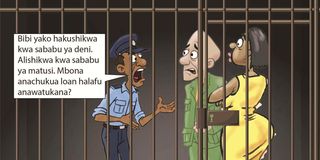
“Bibi yako hakushikwa kwa sababu ya deni ,” he said. “Alishikwa kwa sababu ya matusi. Mbona anachukua loan halafu anawatukana ?”
Apparently, Fiolina had also insulted the police.
Thursday became a full-day seminar on Kenyan law. Bottom line: Fiolina had been arrested for using obscene, abusive, and insulting language. The creditors were willing to have her released if we paid at least 50 per cent, Sh35,000.
Mzee and I sold a cow each and raised Sh45,000. Friday, I returned and paid the creditor Sh35,000. Even then, the police still needed “motivation,” especially the senior officer, who was clearly punishing me for speaking big English.
As she was being released, Fiolina looked at the creditor and said: “Umbwa wewe !”
This nearly earned her a return ticket to the cells, but the man smiled, said at least he’d received something, and let her go—on condition she’d look for the remaining Sh35,000. She added that Fiolina needed to be out to go look for the Sh35,000.
“Chunga mdomo ya bibi yako ,” the OCS told me before we left, adding that it would land me in trouble.
We went straight home. I left Fiolina showering and went to Cosmos Bar and Restaurant. I had money. And when you have money, you don’t go to Hitler’s.
Come rain, come sunshine, we will not pay the balance. The Sh35,000 we paid was all we could raise.