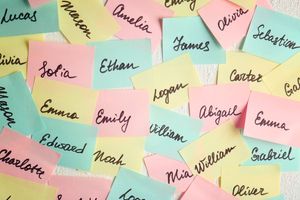
Across the country, names such as Jayden, Skyler, Ellie, Ivan, Darrel and Rowland are increasingly appearing on birth certificates.

A child’s name is often the first gift parents give, carrying family history, cultural pride and memories. But for a growing number of Kenyan parents today, names handed down through generations are losing their appeal, making way for modern choices.
Across the country, names such as Jayden, Skyler, Ellie, Ivan, Darrel and Rowland are increasingly appearing on birth certificates, challenging the tradition of naming children after grandparents, relatives, cultural events and prominent personalities.
For some parents, the attraction lies in the sound, uniqueness and perceived sophistication of modern names. Others see them as an opportunity to give their children identities distinct from those of previous generations. Yet, as naming becomes a more personal choice, concerns are emerging over the cultural meanings and family histories that risk being left behind.
Two weeks after completing her Kenya Certificate of Secondary Education (KCSE) examinations in 2018, Jane Akinyi gave birth to a baby girl. Before delivery, she and her boyfriend had already agreed on names for their firstborn, although they did not know the baby's sex. A girl would be called Ellie Rose, while a boy would be named Jayden Rowland.
Following delivery, Ms Akinyi expected hospital staff to ask her what she wanted to name her daughter, instead, her grandmother, who was holding the newborn at the time, informed her that the child had already been named.
“I asked my grandmother who had given my baby the name on the birth notification. She told me she had chosen it because I was still unconscious after delivery,” Ms Akinyi says.
Margaret was chosen in honour of her grandmother's mother, while Akoth reflected the circumstances of her birth. In Dholuo, koth means rain, and the child was born during rainfall.
Although uncomfortable with the decision, Ms Akinyi did not immediately challenge her grandmother. She felt doing so would be disrespectful, particularly given the role the elderly woman had played in raising her.
She also kept the development from her boyfriend until 2023, when she relocated to Kisumu to live with him. By then, the child had developed a relationship with her father, who had occasionally spoken to her over the phone but usually referred to her as Toto.
During one of their bonding moments, he casually asked the little girl her name.
“She responded, ‘Nyinga en Magarita Akoth, inyalo denda ni Maggie,’ loosely translated as, ‘My name is Magarita Akoth, but you can also call me Maggie’,” Ms Akinyi recalls.

For some parents, the attraction of non-traditional children names lies in the sound, uniqueness and perceived sophistication of modern names.
The couple eventually agreed to change it from Margaret Akoth to Ellie Rose, the name they had settled on before her birth. For Ms Akinyi, the decision was partly influenced by her discomfort with the traditional name, which she considered outdated.
“Margaret sounded a bit old-fashioned. I was not comfortable even being called Mama Margaret. It felt awkward,” she says.
Fancy Treezer, another mother, says she turned to the internet when she found herself struggling to choose a name for her child.
“I had no time to think, so I just Googled male names. That is when I came across Jayden. I chose it because it sounded good to me,” she says.
However, the preference for modern names does not always enjoy unanimous support between parents. John Wafula had planned to name his son Benson Odimbo after his grandfather to preserve the family lineage. His wife rejected the suggestion, describing the name as old-fashioned.
Wycliffe Odera attributes part of the shift to rural-urban migration, which he argues has weakened traditional community structures that once gave grandparents, relatives and elders considerable influence over naming decisions.
Ethnically neutral names
“While in the village, a child belonged to the entire community. Naming was a collective responsibility, with grandparents, relatives and elders playing an important role. Today, the decision is largely left to the father and mother. In some cases, it has become an individual initiative,” he says.
Mr Odera adds that some parents deliberately opt for ethnically neutral names to avoid being identified or judged based on their backgrounds.
“Some don’t want to be identified as belonging to a certain ethnicity. They say some feel a certain ethnic group is inferior to another,” he adds.
Yet, not all parents are abandoning traditional naming practices. For some, a name remains an expression of family history, values and the qualities they hope their children will embody.
Emily Otieno named one of her children after their pastor, hoping he would grow up to emulate his character and commitment to faith.
“I wanted him to grow up with similar values and commitment to the church. I am now seeing him develop an interest in going to church,” she says.

Some parents view modern names as an opportunity to give their children identities distinct from those of previous generations.
Pilister Karewa, an elder, says traditional naming was deeply rooted in family history, cultural identity and admiration for influential personalities.
“Personally, my livestock and even my cat have names. Every name is associated with the character of the animal. I have a bull that is very stubborn, so I named it after a Kenyan politician who was known for being stubborn,” she says.
Ms Karewa believes some parents have increasingly associated traditional names with inferior social status, while foreign names are perceived as sophisticated, fashionable and prestigious. This, she argues, has created a generational divide in which names once regarded as symbols of family pride are dismissed as outdated.
Jotham Ajiki, the Luo Council of Elders Organising Secretary, says traditional Luo naming practices were guided by seasons, weather conditions, family relationships and significant events surrounding a child's birth.
“Every name had an identity and a meaning. You could tell something about a person simply by knowing their name. If someone was called Akinyi or Okinyi, you could immediately associate the name with the morning because it identified the time of birth,” he says.
Naming also provided a link between the living and the dead. According to Mr Ajiki, the Luo traditionally believed dead relatives could communicate through dreams, sometimes influencing the names given to newborn children.
Mr Ajiki is concerned that the growing preference for names whose origins and meanings are unfamiliar to members of the community reflects a gradual erosion of cultural identity.
“Today, you hear a name and cannot even understand its meaning or the circumstances behind it. We are gradually losing our identity as a community.
There is a need to reconnect with our roots and appreciate the cultural significance of our names,” he says.
Sociologist Joan Momanyi says the shift towards modern and sometimes invented names reflects wider changes in family structures, social aspirations and individual identity. She notes that declining family sizes have also changed naming dynamics.
Unlike previous generations, when couples had several children and could distribute names among grandparents and other relatives, many contemporary families have only one or two children.
Popular culture has further expanded the choices available to parents. Movies, television programmes, celebrities, social media and the internet have become important sources of inspiration. Some parents even turn to online name generators and artificial intelligence chatbots to find names they consider attractive or unique.

As naming becomes a more personal choice, concerns are emerging over the cultural meanings and family histories that risk being left behind.
Ms Momanyi says the popularity of names such as Jayden and Skyler partly reflects changing social tastes and a growing 'copy-and-paste' culture, in which parents adopt names because they sound fashionable without necessarily investigating their origins or meanings.
Naming can also be an attempt to give a child an identity independent of difficult family histories. Some parents deliberately avoid names associated with relatives remembered for alcoholism, violence or other undesirable behaviour.
“Names can carry family memories and social expectations. Where a family has had a relative associated with behaviour considered undesirable, parents may deliberately avoid passing that person's name to a child. They may feel that choosing a different name gives the child an opportunity to develop an identity independent of that family history,” she says.
However, Ms Momanyi cautions against interpreting the preference for modern names as evidence that traditional names are inherently inferior, rather, the shift reflects changing social values, greater individual choice and the influence of global culture.
Anthropologist Prof Kennedy Opande traces the transformation to historical changes brought about by Christianity, colonial influence and modernisation. He says the introduction and spread of Christianity brought new naming conventions, with converts increasingly adopting biblical and Western names as expressions of their religious and social identities.
“The introduction of Christianity and the wider process of modernisation brought a new sense of belonging and identity. People began adopting names that reflected their religious affiliations and the social environments they were becoming part of. Gradually, some indigenous names were regarded as old-fashioned, while foreign names acquired a perception of sophistication and social acceptance,” he says.
Follow our WhatsApp channel for breaking news updates and more stories like this.