Phyllis Ekwuempe who donated a kidney to her mother late last year (left) and Esbon Mwangi got a kidney transplant 14 years ago.
On the day he received a kidney transplant, Esbon Mwangi woke up in the middle of the surgery.
“I could hear them exclaiming that I was awake,” he recalls. “But I couldn’t move. I couldn’t speak.”
That’s all he remembers before the doctors quickly put him under again. The next time he came to, he was being wheeled out of the operating theatre.
“I could feel the turns and bumps as they pushed the bed towards the ward,” he says. “Then I heard some women screaming and saying, ‘That’s Esbon!’”
He chuckles at the memory.
“I was still on the same bed they had operated on, with a lot of machines hooked up to me. And my body at the time was so wasted they must have thought I was a gone case.”
Fourteen years later, however, the 58-year-old businessman is still going strong. That is not to say the journey has been easy. The months leading up to his life-saving surgery had been among the most difficult of his life. Years of heavy alcohol use, smoking, and an inherited predisposition to hypertension had cumulatively led to the failure of both his kidneys, forcing him onto weekly dialysis sessions just to stay alive.
“The first time I realised something was wrong was when I got drunk on three bottles of beer and (the effect) lasted three days,” he says. “I used to drink up to 10 or more bottles in a day, but over time, that number kept dropping until three bottles put me out of commission.”
Esbon Mwangi, 58, got a kidney transplant 14 years ago
Unable to hold his liquor anymore, he stopped drinking. Life went on until strange symptoms began appearing about three months later.
“I felt weak and tired all the time,” he says. “I would lose my breath often, even after walking a really short distance, and there was a constant heaviness in my chest.” What followed were weeks of hospital visits, misdiagnoses and worsening symptoms. “I was feverish, in constant pain and nauseated,” he remembers. “I couldn’t eat, move or even sleep.”
It was not until a friend took him to Naidu Hospital in Thika that the problem was finally identified: One kidney had already failed, and the other was barely functioning.
Transferred to Kenyatta National Hospital, the doctors confirmed the diagnosis and placed him on dialysis, awaiting the possibility of a transplant.
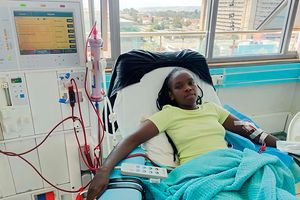
Two or three times a week, he travelled to the hospital for the four-hour process. It often left him exhausted. It did not help that dialysis machines were scarce in the country at the time. “There were thousands of us at Kenyatta and only four machines,” Esbon says. “One time I went, and they told me I was 84th in line. It took days before I finally got to the machine.”
The financial strain also mounted quickly. Each dialysis session cost Sh5,000 at the time, while medication cost another Sh2,000. Unable to work and without insurance coverage, he began selling his assets to keep up with the treatments. “I became a beggar relying on people’s generosity,” he says.
Six months into dialysis, doctors recommended a transplant. But finding a donor proved difficult.
“My relatives were willing, they showed up in numbers, but none of them was a good match,” he says. “This included my late brother, whom I had pinned my hopes on, but ended up actually needing treatment himself for hypertension.”
Continuing dialysis
After another potential donor fell through just weeks before the surgery, Esbon resigned himself to continuing dialysis until a nephew stepped forward and offered to donate his kidney. Tests were done and a surgery date was set, but the procedure had to be postponed after Esbon developed a cardiac complication. Eventually, with the help of the late MP Stanley Munga Githunguri, who contributed towards the Sh700,000 needed for the operation, the transplant went ahead. On January 23, 2012, Esbon was wheeled into surgery and given a new kidney.
Read: 'I'm grateful my sister used my kidney for 215 days’: Moving tribute by sister of DJ Krowbar’s wife
“I had my fears going in,” he admits. “I knew of people who’d died either on the table or days after the operation.”
He regained full consciousness the following afternoon. His body was still aching, but for the first time in months, hope outweighed fear. “I went home after 12 days,” he recollects. “But I kept going back for follow-ups, first every morning, then weekly, then after two weeks, and later monthly. Now I only go when something feels wrong.”
Aside from a temporary catheter popping out one night and constant memory loss, Esbon’s recovery has largely been smooth.
“That catheter coming out was probably the most painful incident of the whole experience,” he muses. “But while I’m on my feet now, I can’t say that I’m fully recovered. I’m not normal like you. I’m still a patient.”
A patient who must take immunosuppressive medication for the rest of his life to prevent his body from rejecting the transplanted kidney. And that medication remains his biggest challenge.
“A transplant recipient cannot live without these drugs, but they are very expensive,” he says. “I have to take them twice a day, mornings and evenings. In total, it costs me Sh700 per day, and that’s on the cheapest side.”
Although the Social Health Authority (SHA) is supposed to cover these medications, getting them is another struggle. “I know SHA works because I am a beneficiary, but it’s strange how when we were buying the medication out-of-pocket, they were always available,” he says. “But now that SHA pays for it, they are never there.”
Unwilling to stake his life on the inconsistent supply, Esbon now imports the medication in bulk from India. It took him about two years for life to start feeling normal again.
“By 2014, I felt fully functional, enough to return to business,” he says. “I’m currently in the transport industry.”
To maintain his health, Esbon keeps a strict routine that includes long walks, sometimes up to eight kilometres.
“The worry is always there,” he says. “If my kidneys failed once before, they could fail again, but I know I manage myself as I’m supposed to.” Every transplant story, however, has two sides: the person who receives an organ and the person who chooses to give one.
Phyllis Ekwuempe donated a kidney to her mother late last year.
Phyllis Ekwempu decided to give her kidney late last year.
“My mother was diagnosed with kidney disease about four years ago,” she says. “She had reached end-stage renal failure, so she immediately went into dialysis.”
Her siblings were tested, but none turned out to be a match. Phyllis suspected she might be compatible, but was pregnant at the time and unable to undergo testing. After delivering her baby, the mother of three waited a year to recover before beginning the screening process. Within four months, her compatibility was confirmed. During that time, she and her husband began preparing for the practical realities of surgery and recovery, including arranging childcare. “I had an overwhelming sense of peace when the process began,” she says. “But as the date drew nearer, especially as I was planning where my children would stay, a sense of fear crept in as I thought about the risks.”
Still, the possibility of giving her mother a second chance at life outweighed the anxiety.
On December 3, 2025, Phyllis and her mother checked into the hospital at 6am, nervous but ready.
“We were put in separate rooms, but they took me first because I was the donor,” she says. “I remember nothing of the operation, but when I woke up, I was in a lot of pain.”
Having previously delivered through a C-section, the pain was familiar. But without a newborn to care for this time, recovery felt a little easier.
“I was able to walk and move around that same day,” she says. “But I took things very slow during the first two weeks.”
By the fourth week, she felt largely like herself again and could engage more comfortably with her children.
“It’s been about 12 weeks now, and I feel about 95 per cent healed,” she says. “I‘m ready to start exercising at this point.”
One of the questions she is most often asked is whether she feels like something is missing.
“No,” she says simply. “I went through extensive counselling before the surgery, and that allowed me to deal with it a lot better than if I had not. If anything, I felt relieved that the day had come and gone, and we could focus on my mother’s recovery.”
Money-wise, how much did it cost her?
“Nothing,” she says.
Having done the surgery in the United States of America, where she resides as a citizen, she was able to secure a grant that covered all her expenses, including child care, post-surgery accommodation, food, travel and every medical bill, tests and post-surgery check-ups included. If she was working, the nursing student says, the grant would have also compensated her for the time taken off work.
Unlike transplant recipients, donors typically do not require lifelong medication. After the initial follow-ups, her checkups will gradually extend to six months, one year and then two years.
“There was no genetic indication that mom’s disease was hereditary, so my main responsibility now is maintaining a healthy lifestyle,” she says. That includes reducing her protein and sodium intake and paying attention to medication she may take in the future, as some drugs can be harder on the kidneys than others.
Watching her mother endure dialysis also left a lasting impression. “It really took a toll on her body,” she says. “Seeing that made me appreciate my own health and that of my family. It has also made me more intentional about raising my children to live healthy lives.”
After losing an aunt in Kenya, partly because dialysis became too expensive, Phyllis believes organ donation can change lives.
“If you are able to do it for someone, I’d highly recommend it,” she urges. “Make sure your decision is informed, then go change a life.”
Dr Mehreen Adam, a nephrologist at Kenyatta Hospital, estimates that about eight to 10 per cent of the Kenyan population, roughly four to five million people, are living with chronic kidney disease. Of these, more than 12,000 have reached end-stage kidney failure and require dialysis.
“It’s a growing challenge affecting a large number of Kenyans,” she says.
The leading causes are uncontrolled diabetes and hypertension.
“But we also see kidney failure resulting from infections and abuse of over-the-counter painkillers and some herbal medications.”
While dialysis and transplants are both treatment options, Dr Adam says transplantation offers the best long-term outcome. “A transplant provides a much better quality of life,” she explains. “Data shows that 60-80 per cent of patients survive more than five to 10 years after surgery,” she explains.
Dialysis is not curative
“It’s simply a machine performing the function of a kidney,” she says. “Patients can live on dialysis, but the longer they remain on it, the higher the risk of complications such as heart attacks and stroke.”
Globally, kidney donations can come from both living and deceased donors. In Kenya, however, transplants are currently restricted to living donors who must also be proven relatives of the recipient.
“This is to ensure the donation remains purely altruistic and that no financial exchange takes place,” Dr Adam says.
Potential donors must also meet strict health requirements.
“They must be between 22 and 65 years old, free from conditions like diabetes, hypertension and cardiovascular disease, and able to maintain a healthy lifestyle after donation,” she says. “We also do not consider someone who is obese or underweight.”
Donors are also screened to ensure they are mentally sound and not being coerced.
“We even allow them to withdraw from the process at any stage,” she adds. “If someone gets cold feet, we can cancel the surgery and provide a medically sound explanation to protect them.”
Currently, SHA provides a transplant package of Sh700,000 covering both donor and recipient.
“In private hospitals, the cost can go up to two or three million shillings,” Dr Adam says. “But some facilities have agreements with the insurer allowing patients to access services there as well.”
For kidney recipients, even after a successful transplant, they have to remain under close medical supervision. The immunosuppressive drugs that prevent organ rejection weaken the immune system, leaving patients vulnerable to infections.
“These are infections that a healthy person would fight off easily,” she explains. “But transplant patients are susceptible to (diseases) like tuberculosis or herpes.”
Some of the drugs may also trigger other conditions, including diabetes.
For donors, however, long-term outlooks are generally very good.
“The body compensates naturally,” the expert says. “The remaining kidney simply works harder, but this does not affect quality of life or life expectancy.”
Her biggest concern remains late diagnosis.
“Kidney disease is a silent killer,” she warns. “Many people wait until they have symptoms, but by the time symptoms appear, the disease may already be too advanced.”
She is encouraging Kenyans to take advantage of free screening programmes offered in hospitals across the country during World Kidney Day, which is marked on March 12.
Early detection, she says, can make the difference between managing the disease and needing a transplant to survive.
Follow our WhatsApp channel for breaking news updates and more stories like this.