Having settled the Iran–US war between Fiolina and Catherine, it was now time to focus on school matters. It was time to get back and focus on that which brings food to my table every day. And Monday was the day I was getting back to school.
It was not a good day, as you all know what happened in the country. It was the fuel strike day. Initially, it was supposed to be mainly a matatu strike and since very few members of the Mwisho wa Lami fraternity come with matatus, I did not anticipate much disruption — or any disruption for that matter.
As usual, when I give focus to school, I arrived early. And as usual, I was the first teacher to arrive. Nzomo, who was the teacher on duty, was nowhere to be seen, as were the other teachers.
I took charge of things, supervised the students during morning cleanliness, and joined them for parade when it was time. By the time of parade, only two teachers had arrived: Eric and Lenah, the terrible hairstyle in tow.
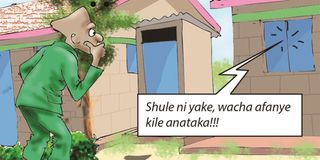
“Shule ni yake, wacha afanye kile anataka,” I later heard them say.
“Niko Nakuru,” she answered after several attempts.
“I was travelling from Nunguni, Ukambani to Mwisho wa Lami. Our matatu got spoiled in Nakuru and there are no vehicles coming.”
“Yes, and I started travelling over the weekend,” she said. “It is just that the matatu broke down yesterday.”
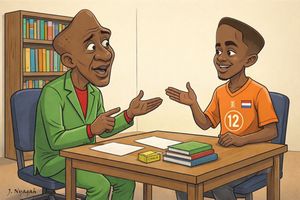
With Nzomo away, I decided to engage the two teachers around: Eric and Lenah.
“I have to go home early,” said Eric, adding that he had almost been lynched in the morning when he used his motorcycle to come to school.
He went on to explain that he would walk home and that required him to leave early. All the other teachers were unreachable.
With only two teachers in school, I released all the students after lunch. As expected, despite the fact that we did not use public transport, the next day was slow, especially after the chaos we had watched on TV the previous night, where the government and matatu owners were disagreeing loudly.
When the government announced an end to the strike, I sent a message to the staffroom WhatsApp group informing the teachers that we would have a staff meeting the next day at 10am.
“Please note that the ongoing matatu strike has been suspended,” I added.
Everybody was seated by 10am, except, of course Saphire, who was not expected to be in school anyway. I started the meeting by reading the minutes of the last meeting held last term as we checked this term’s progress.
“I was handling a very sensitive issue,” he said.
I asked what the issue was and whether it was something that could affect one of us. He said it could affect me, but I told him to allow us to finish the school meeting first, then continue with his sensitive issue later.
Outside, I heard coughing. Aggressive coughing. The type that only comes from an old man carrying authority and unresolved anger.
Then suddenly the staffroom door opened. It was Fiolina’s father. Behind him stood Tocla, his son and Fiolina’s brother, and two old men I had last seen during dowry negotiations in 2013.
My stomach immediately organized prayers. The entire staffroom went silent. Even spoons stopped moving inside tea cups. The old man entered slowly carrying a walking stick that had absolutely no medical purpose. It existed purely for authority. Then he looked directly at me.
Then, without warning, he attacked directly.
Staffroom tension increased immediately. One teacher removed glasses slowly. Another pretended to mark books while listening with both ears.
“This is not a matter to be discussed at school,” I said calmly. “We can discuss it at home.”
“Shut up!” he thundered. “I invited you to come so we talk and you refused! We must discuss it now and you must give me an answer now!”
“Even if we wanted to, it should be discussed by my wazee, who are not here today.”
“Call them now! They are not far away, are they?”
I could see teachers nodding slightly. Traitors. One of the old men he had come with spoke for the first time.
At this point even pupils outside had gathered near the windows. I tried calming the situation diplomatically again.
“Mzee, these matters can be discussed at home.”
The staffroom exploded internally. Teachers love drama more than students. One female teacher quietly carried her tea and shifted closer.
Even Tocla, who normally contributes nothing useful, nodded aggressively.
Then Mzee decided to embarrass me completely. He started listing Fiolina’s achievements publicly like KCSE results.
“If she left you today, ten men would line up immediately!”
I almost killed him, but at that point I could not stop anyone from talking.
“Over one million,” the father said. “That is why I am angry.”
“Mzee, come, let us talk. I am Dre’s brother,” Saphire said.
He led them to my office, which was open. They started walking there and all sat down.
“You cannot participate in your wife’s dowry talks,” one of the old men told me. “Let us discuss with your brother.”
Word had already reached them about what was happening in the staffroom. They joined the group and greeted each other warmly.
“Mzee, if you had an issue you should have called me. You have my number,” my father said.
“Let us go and discuss these matters at home, not here. Utafanya mtoto wangu amwage unga.”
While I was relieved to see them leave, the shame remained heavy on me. Later I heard my father had agreed that we would visit Fiolina’s family next Saturday to discuss dowry.
They should plan to travel alone, and if they agree on additional dowry, my father should be ready to pay.