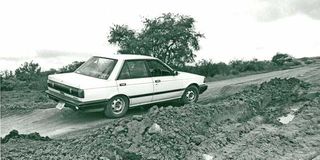
In 1926, the colonial government resolved to have a road connecting Mombasa and Nairobi. By then, the railway was the only link between the coast and Kenya’s interior.
Roads don’t just appear, and especially not in the forested, animal-infested swathe of land that existed between the two places then. One of the crucial first steps in making a road is surveying, where a team of experts selects the best line that the road can follow.
One of the surveyors from the 1926 project, Mohamed Sadiq Cockar, later wrote down his experiences and drew sketches capturing what he went through.
Sadiq was born in India in 1911 and came to Kenya with his parents in 1913. He joined the Public Works Department aged just 15. By the time he joined the team, being engaged as an assistant surveyor, the survey works had reached Tsavo from Mombasa.
In 1967, after he had retired, he wrote down his recollections in words and illustrations.
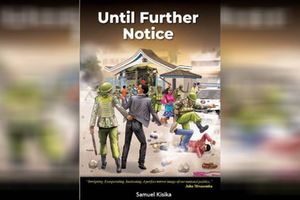
Sadiq died in 1987 aged 76. It was until 30 years after his death that his book, The First Road to Nairobi, was published. His son, Parvez Cockar, edited the original writings he left behind.
“I tried my best to edit my father’s original manuscript,” he writes in the book’s foreword.
“For a young boy of 15, he showed tremendous courage and dedication to his responsibility because the route he selected lives on today,” adds Parves. “He did such a sterling job of charting out the alignment of the road that there has never been any need to alter any part of it and thus it remains intact.”
Complementing the text of The First Road to Nairobi are 21 drawings that Parvez did to relay his experiences in a diagrammatic format. For instance, on the day when he got bitten by a monitor lizard, prompting his assistants to cut it in half, he drew himself and the reptile after it had been slashed, its mouth still stuck on his right foot. He also drew the other workers and what the scene was like.
And from the days when he and his team slept in Manyani and dozens of lions would casually sleep on their building’s veranda, he drew the beasts resting as he saw them. At Manyani, the workers had to sleep in railway houses and not their tents as the danger was monumental.
Sadiq’s drawings went out before the text. According to the book’s introduction that was written in 2014 by lawyer Pheroze Norwojee – who died in 2025 – the drawings were in 2000 included in the Asian African Heritage Exhibition at the National Museums of Kenya. They were on display until 2005.
“Now, the text and drawings have at last been brought together in this wonderful history book,” wrote Pheroze.
So, how was it like surveying Mombasa Road? The book says it was a daily dice with death. With the area teeming with wildlife of every kind, it required special skills to avoid being killed.
At a moment’s notice, Sadiq writes, an animal would come charging at the group. Sometimes this animal was a rhinoceros, known for its short temper and murderous attitude. To be safe, everyone had to climb a tree quickly.
In one instance, a rhino sped towards them as they prepared to have their lunch.
“Just as we were about to eat our food, we heard the cries: ‘Kifaru! (Rhino!).’ Everyone ran for safety. Mr Tadjin (a surveyor) climbed a tree quickly as I helped him by pushing him up. Mr Birch (the road engineer) tried to climb the very tree he had been under but, as he was heavy, he called his gun bearer, Pande Kilima, and told him, ‘Push by (behind).’ Mr Pande Kilima and I quickly pushed him up the tree,” he writes. “When we had safely clambered up trees, a dark brown fully grown rhino with a very long horn charged full speed ahead with a loud whizzing noise.”
At one point, a wildebeest also made the group run for the trees. It then furiously gored the trunk of a tree where some of the workers had perched and broke its skull as its horns got stuck on the trunk.
“We alighted a few minutes later. The porters quickly cut up the wildebeest and we shared the meat,” wrote Sadiq.
He also made an illustration of the dead wildebeest with workers aiming their machetes at it. This was one of the many instances when the team ate game meat.
By retelling the instructions he was given by HM Birch, the road engineer, Sadiq lays down some of the thinking behind the path that was chosen.
“Mr Birch told me that while selecting the possible alignment and layout for this new road, I should try to keep it as straight as possible and to try and avoid any unnecessary bends. The road was always to be kept on a hard surface and I was supposed to try and avoid baobab trees and any other objects such as swamps and marshes,” he writes, adding that the survey went with a great deal of bush clearance and felling of trees.
Near Kibwezi, they encountered lava rocks that were a big obstacle.
“We had no bulldozers or other heavy equipment to dig out the hard lava here, and our men couldn’t cut into the lava with pick axes. Mr Birch ordered me to change our route to avoid the lava stones,” he writes.
Areas infested by lions, like Tsavo and Manyani, stressed out the workers and they had to end their day early. Tales of the infamous Man Eaters that had devoured railway construction staff left them scared.
He had encounters with elephants, monkeys, wildebeests, snakes, lions, cheetahs, hippos, zebras, wild dogs, wild cats, baboons, rhinos, tsetse flies, among others. His narration of these interactions, for instance a snake that slithered into his tent at night while a lion waited outside, paint a vivid image of the challenges the workers had to surmount to deliver the road. The vegetation was thick in most instances, and the words “a very thick forest of acacia” occur numerous times in the book.
Their work ended at the Machakos Junction because “there was already an existing motorable track from Nairobi to Machakos”.
“Our job had been to link up with this track,” Sadiq writes.
The book was published by Old Africa Publishers, who are also handling its distribution.