Members of the National Assembly rejected amendments by the Senate on tallying and transmission of presidential election results, which were negotiated by the teams of President Ruto and the late Raila Odinga.
The proposals sought to impose specific timelines on electronic transmission of results from the polling stations to avoid inordinate delays in declaring presidential election results.
They were also designed to ensure the results transmitted were an accurate record of the votes tallied, verified and declared at the respective polling stations.
This, as the courts had observed, would help citizens compare the live-transmitted results with the final declared results to confirm the accuracy of the election results.
Specifically, the Senate had passed amendments compelling the electoral commission to electronically transmit the results within two hours of the declaration of the results, from a polling station to the constituency tallying centre, national tallying centre, the candidates or their agents and election observers in the prescribed form.
The Senate Bill had elaborate procedures to replace the entire Section 39 of the current Elections Act, including provisions that had been declared unconstitutional by the courts, such as one that sought to downplay the significance of results transmitted electronically.
“The Commission shall, to facilitate public information, allow a candidate and their agent, observers and any other person authorised to access a polling station or tallying centre to record and document the tallying, announcement and declaration of results,” read another proposal by senators intended to promote transparency.
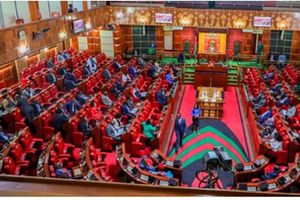
Members of the National Assembly during a past sitting.
Photo credit: Dennis Onsongo I Nation Media Group
Besides the requirement to publish the polling result forms on an online public portal maintained by the electoral commission, Suba South MP Caroli Omondi had proposed amendments to improve public access to results further.
“The Commission shall at the national results centre establish a mechanism for live-streaming and display of presidential election results announced and at the point of declaration in each of the constituency tallying centre plus the diaspora vote,” the MP had proposed.
Mr Omondi said the country needed to deal with the issue of the presidential results because they are the core of the Bill.
“How the presidential results are tallied, verified, who is responsible for what, how they are communicated to the Republic, how people get to know, how parties can interrogate them and how technology will be used. This issue is so critical that pretending we cannot provide legislative provisions for it is akin to deceiving Kenyans. We cannot allow that. That would amount to a conspiracy to subvert our mandate,” Mr Omondi said.
But during consideration of the Elections (Amendment) Bill (Senate Bill No. 29 of 2024), Homa Bay Town MP Peter Kaluma, backed by Majority Leader Kimani Ichung’wah, successfully petitioned the House to delete the proposed amendments.
The action drew furious reactions from members who supported the changes they believed were necessary to address the legal concerns raised by the courts and also to secure live-streaming of election results.
Suba South MP Caroli Omondi at Bunge Tower in Nairobi on March 24, 2026.
Photo credit: Dennis Onsongo | Nation Media Group
“The amendments contained in this Bill are what I suppose constitute the negotiated National Dialogue Committee (Nadco) report. The idea was that whatever had been negotiated upon should be passed. Majority leader, I thought you were part of the team?” asked Funyula MP Wilberforce Oundo, referring to Mr Ichung’wah, who co-chaired the 10-member Nadco committee with Wiper leader Kalonzo Musyoka.
“I am afraid that the deletion seems to be masking a very serious concern raised during the last elections: The issue of opaqueness and delays in transmitting election results. Why should Kenya wait for seven or eight days to declare presidential results and yet, a country such as the United States of America declares results eight hours after voting? The intention of this provision is to ensure that results are submitted electronically,” Mr Oundo added.
Embakasi West MP Mark Mwenje also queried the deletion of the clause, which he said would have facilitated public access to presidential election results.
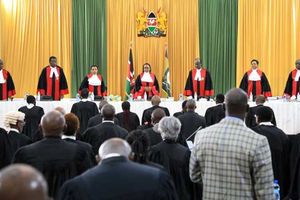
“We have not addressed the issue that I believe we need to consider. How will those results be transmitted to the public? That is one of the main issues at hand. We thought we were legislating on it as it was, and I was ready to support the amendment to Clause 22,” Mr Mwenje said. In a ruling delivered on April 6, 2026, Justice Chacha Mwita declared Section 39G of the Elections Act on the live-streaming of results unconstitutional.
“The Commission shall, to facilitate public information, establish a mechanism for the live streaming of results as announced at polling stations, and the results so streamed shall be for purposes of public information only and shall not be the basis for a declaration by the Commission,” reads Section 39 (1G).
The court had outlawed this clause because it sought to downplay the veracity of results from the polling station that petitioners successfully argued were final but which the clause termed as merely ‘for purposes of public information’.
The court questioned why a country would spend massive resources on election technology that the country would use merely ‘for information purposes’.
“I am persuaded that sub-section (1G) is a mockery of the requirements for free, fair and credible elections. It violates the principles of electoral systems in the Constitution. In that regard, therefore, this amendment cannot hold in our transformative constitutional dispensation,” the court ruled.
“You cannot have results that are streamed live from polling stations but which are of no value when it comes to declaration of final results. The results streamed live from polling stations are the primary source of those finally declared. Final results are a product of the same process. One process cannot have two different results,” declared the court.
“The Commission shall at the national results centre establish a mechanism for live-streaming and display of presidential election results announced and at the point of declaration in each of the constituency tallying centre plus the diaspora vote,” reads the original Bill from the Senate.
“The Commission shall at the national results centre, an open public space within the capital city of Kenya, in a live-stream announce results as verified, collated, tallied and declared by the returning officers in the constituencies and diaspora, aggregate the said results and thereafter verify the provision of Article 138(4) of the Constitution has been met by any candidate,” reads Clause 22 (6) of the Senate Bill.
IEBC denies plan to ban live election result streaming
The National Assembly, however, maintained it did not ban live streaming, saying the process remains active under Section 39 (1G) of the Elections Act.
“The National Assembly after public participation on the Bill and guided by the recent judgement resisted the attempt to interfere with Section 39 as it is currently provided for in the Elections Act and the attendant established procedure for the determination and declaration of election results,” the National Assembly said in a statement last week.
KNCHR Commissioner Claris Ogangah (left) and NADCO co-vice-chair Javas Bigambo address journalists in Nairobi. MPs’ rejection of proposed reforms to livestream presidential election results threatens to undermine the National Dialogue Committee’s recommendations on electoral transparency and accountability.
Photo credit: File | Nation
The lawmakers also warned that making key changes to the electoral laws with less than one year to the poll would go against recommendations of the Kriegler report released after the 2007/2008 post-election violence, which advised against changing electoral laws at least one year before elections.
The lawmakers concluded that it would be risky to legislate the same with barely 10 months left to the next election. However, the provision that polling station results are final remains in place.
During submission of views by various entities to the National Dialogue Committee at Bomas, former IEBC commissioners Ms Juliana Cherera, Mr Justus Nyang’aya, Mr Francis Wanderi and Ms Irene Masit submitted that by operation of Section 39 of the Elections Act, 2011, the Commission was required to electronically transmit tabulated results and an image of the result declaration form confirming the authenticity of the polling station results.
According to the four, the former chairperson, the late Wafula Chebukati, unilaterally took the decision to deny the country the benefit of a running tally based on tabulated results as a countercheck of the transmitted images and the results declared in the Constituency Tallying Centres and the National Tallying Centre.