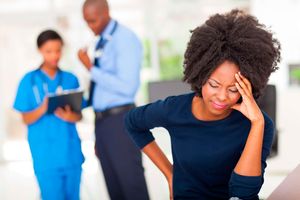
When a teenage girl clutches her stomach in pain every month, she is often handed a hot water bottle and a few painkillers. “It’s just cramps. You’ll be fine,” she is told.
For many parents, it is seen as a normal part of growing up, yet behind those waves of pain could be a hidden disease. Specialists warn that what starts as “bad cramps” for some girls can turn into years of silent agony — missed school days, endless hospital visits, and no clear answers.
Dr Joe Njagi at his office at 3rd Park Hospital in Nairobi on February 1,2023.
Photo credit: Evans Habil | Nation Media Group
Doctor Joe Njagi, a consultant obstetrician and gynaecologist who specialises in the excision of endometriosis, says such pain can be an early warning sign of endometriosis or adenomyosis, conditions now appearing more frequently in teenagers.
“Most patients who have endometriosis and those we diagnose later in life will tell you their pain started at menarche — their very first period,” Dr Njagi explains. “If your child experiences excruciating, recurrent pain, you need to be suspicious. That could be an early sign of endometriosis.”
Over his years in practice, Dr Njagi has seen an alarming rise in teenage cases. The pattern is often the same: Severe menstrual pain, heavy bleeding, mood swings, and sometimes depression.
“When period pain begins to affect your daughter’s quality of life, when she can’t go to school, needs strong painkillers, or can’t function normally, that’s not normal,” he stresses. “There’s no such thing as bad cramps. If the pain is that severe, it could be endometriosis.”
Endometriosis and adenomyosis are chronic conditions where tissue similar to the lining of the uterus grows where it shouldn’t. In endometriosis, this tissue grows outside the uterus and on the ovaries, fallopian tubes, or other pelvic organs. In adenomyosis, it grows into the muscular wall of the uterus. Both conditions can cause crippling pain, heavy bleeding, and fertility challenges later in life.
“Unfortunately, we don’t have highly reliable diagnostic tools for teenagers,” says Dr Njagi. “We mostly rely on symptoms. In some cases, a trans-rectal ultrasound can reveal small lesions, but the absence of visible signs doesn’t rule out endometriosis.”
Sometimes, doctors use hormonal treatment as a diagnostic clue. “If a young girl responds to hormonal therapy, that is if her pain improves, that could be suggestive of endometriosis,” he explains.
Globally, endometriosis affects about one in 10 women of reproductive age, according to the World Health Organisation and Endo Sisters East Africa (2023). Among adolescents with chronic pelvic pain or severe cramps, the rates are likely much higher.
A 2020 review in the National Library of Medicine found that about 64 per cent of adolescents who underwent laparoscopic investigation for pelvic pain were confirmed to have endometriosis.
Endometriosis is a common inflammatory condition affecting one in every 10 women globally.
Photo credit: SHUTTERSTOCK
In Kenya, a 2021 study by the Science Publishing Group reported a 6.8 per cent prevalence rate among women aged 18 to 49 who underwent laparoscopic surgery. But specialists believe the real number is far higher, as many girls never reach a surgical diagnosis.
Cultural taboos, stigma, and limited access to gynaecological care all contribute to this underreporting.
“Menstruation is still treated as a private or even shameful matter in many African homes,” says Dr Njagi. “Girls end up suffering in silence.”
He adds that while there appears to be a genetic link, science has yet to pinpoint the exact gene. “We’ve seen patterns where mothers and daughters both have endometriosis — but not always.”
When detected early, teenagers often have what doctors call superficial disease — small lesions on the abdominal lining.
“The first line of treatment is usually hormonal therapy,” says Dr Njagi. “If symptoms improve, that’s great. If not, then we consider surgery.”
Surgery can involve two approaches: Ablation, which burns off lesions, or excision, which cuts them out.
“For superficial disease, ablation works,” he explains. “But for deep endometriosis, excision is better. Still, there’s no guarantee of a complete cure. This condition often requires lifelong management.”
Even after surgery, recurrence is common. “That is why we put patients on hormonal suppression afterward. It helps delay recurrence and keep symptoms under control.”
The Question of fertility
One of the most distressing concerns for parents is whether their daughters will be able to have children.
“Endometriosis doesn’t automatically mean infertility,” Dr Njagi assures. “But advanced disease can affect fertility, especially if the ovaries or fallopian tubes are involved.”
A young woman suffering abdominal pain, one of the symptoms of endometriosis. Another often overlooked symptom is fatigue. FILE | NATION
When endometriosis forms cysts called endometriomas on the ovaries, it can reduce egg quality and quantity. “We’ve seen cases where fallopian tubes are attached to the ovaries, disrupting their normal function,” he says.
Still, early diagnosis and proper management make a huge difference.
“About 50 per cent of women with infertility are found to have endometriosis, but not all women with endometriosis are infertile. The key is early intervention.”
Where fertility is affected, technology offers hope.
“In cases where the disease damages the ovaries or tubes, IVF (in vitro fertilisation) is an option. Sometimes, we recommend egg freezing before surgery, so future IVF remains possible. That way, the surgery doesn’t deplete the ovarian reserve.”
For those avoiding surgery, non-surgical management can still offer relief.
“Endometriosis doesn’t always need to be managed surgically. Hormonal treatment works well for many, and we’re learning more about how inflammation drives the disease,” Dr Njagi notes. Lifestyle also plays a crucial role.
“Endometriosis is an inflammatory process,” he explains. “Diets low in red meat and processed carbohydrates help. Reducing inflammatory foods, staying active, and doing pelvic floor physiotherapy can all ease symptoms.”
The emotional side of care
“One of the most important things parents can do is believe their daughters,” says Dr Njagi. “We shouldn’t dismiss their pain. Sadly, even in hospitals, girls are often told it’s all in their heads. That it is just part of being a woman.”
He believes emotional support and early intervention go hand in hand. “When parents take these symptoms seriously, it empowers young girls to seek help early.”
The biggest challenge, however, is lack of awareness.
“There’s very little education in schools and communities. Menstrual health education should be part of the curriculum. We need to normalise these conversations.
“It is time to talk openly and drop the taboos. When we educate girls early, we give them power. The power to understand their bodies, seek care, and demand better health.”