Visiting places to remember three mzungu women...
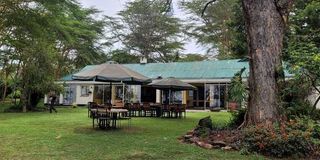
The Elsamere Conservation Centre on Lake Naivasha. It was the home of Joy Adamson, the author of Born Free, and her husband, George

When I asked my niece, Helen, what she wanted to see or do when she came to visit us a few weeks ago, as well as a wild lion (which I have already written about), she said ‘places of historical interest’.
I reckon I made a good choice: places associated with three famous mzungu women – Karen Blixen, Elspeth Huxley and Joy Adamson. All three wrote memoirs that were turned into films; I knew that Helen had read the books and, most likely, had seen the films.
Baroness Karen Christentze von Blixen-Finecke, wife of Bror von Blixen-Finecke, lover of Denys Finch Hatton, wrote about her life in Kenya in her memoir, Out of Africa. The famous opening line is ‘I had a farm in Africa, at the foot of the Ngong Hills’.


It was a coffee farm in the place we now know as Karen, where she lived from 1917 to 1931. Her house was called Bogani (the house in the woods), that is now the Karen Blixen Museum. It was clearly the place to take Helen. Donated by the Danish Government at the time of Kenya’s independence, it became one of the national museums in 1986. Great care has been taken to furnish it as it would have been when Karen Blixen lived there.
We had a very different feeling when we went back down the Karen Road to have a look at the Swedo House in the Karen Blixen Coffee Garden. It had belonged to the Swedish company that had the coffee farm before Bror and Karen Blixen bought it. The farm manager used to live there and, for a time, so did Karen Blixen’s brother.
When the Coffee Garden was owned by the Tamarind Group, it was a reception for the guest cottages, but it was kept in the style of an old colonial farmhouse. There can be few examples left of a building like this, with its walls of plastered mud over chicken wire. The rooms were furnished as they would have been during the years of the coffee farm.
And there were photos of the rugged Swedish workmen who lived in it before the Blixens took over. The current owners have made it a very stylish reception and a comfortable modern lounge for the residents of the cottages. ‘They have sanitised its history,’ Helen said, ‘just like the Fairmont owners have done to the Norfolk Hotel.’
We also took Helen to the Aberdare Country Club and the Ark. On the way back, we called in at the Blue Post Hotel on the edge of Thika. In her memoir, The Flame Trees of Thika, Elspeth Huxley describes the ride on an ox-cart with her mother from the Norfolk Hotel in Nairobi to the Blue Post Hotel in Thika. It was in 1913.
The journey took them two whole days. ‘We set off in an open cart drawn by four whip-scarred little oxen and piled high with equipment and provisions.’ Among the equipment and provisions on the cart were a sewing machine, a crate of five Speckled Sussex pullets, and a lavatory seat. When they arrived, they must have found a very different place from what the hotel is now – a small building with undressed stone walls and a makuti thatched roof. Now, buildings are spread over its 32 woodland acres.
We sat under a parasol at one of the tables set out on the lawn and Helen walked down to have a closer look at the Chania Falls. ‘Quite something to have at the bottom of your garden’, she said. It was a weekend, so there were many families enjoying themselves in the sun. When Elspeth Huxley arrived there as a child, the hotel was merely a staging post for travellers on their slow way between Nairobi and Nyeri – and for only European travellers.
Helen rated our visit to Elsamere at Lake Naivasha as one of the highlights of her two weeks in Kenya. I think you will know that it was the home of Joy Adamson, the author of Born Free, the story of how she and her husband, George, raised Elsa, a lioness, and released her to the wild.
Now known as the Elsamere Conservation Centre, it is beautifully placed on the lake shore, guarded by mature acacia trees where colobus monkeys frolic. Always, you can hear the lilting calls of fish eagles. Before, the only available meal was an excellent afternoon tea; now, lunches are offered too.
Elsamere is also looking very smart these days. It has been renovated and extended since I was there last. George Adamson’s battered old Land Rover, in which he was killed by Somali bandits at his Kora Camp, is still there, though tucked away inside the smart reception area – which doesn’t seem right because it was very much a bush car.
I have been to the Elsamere museum a number of times but, on this occasion, it was especially informative and entertaining. There is a wide range of memorabilia that belonged to Joy and George; there is an amazing collection of books by and about their lives – lived more apart than together, it seems. It shows a rather romanticised video that focuses on Joy.
But this time, there was Chege. He used to be a boatman at Elsamere, but now he is a guide in its museum. He has really applied himself to learning about Joy and George – also about the less romantic aspects of their lives.
Chege is thoroughly enjoying his work, and he is very good value. As Helen said, ‘The museum may be small, but it is full of really interesting things – including Chege. He is so well read – and a mine of information. What an asset to the place!’
Follow our WhatsApp channel for breaking news updates and more stories like this.
John Fox is Chairman of iDC Email: [email protected]


