Premium
Street children who made second chance count
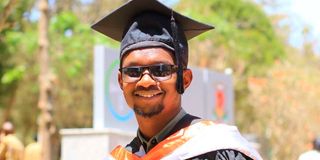
David Kanyingi, 27, medical intern.
What you need to know:
- From a rudderless loiterer in the streets of Nairobi and Nakuru, a helping hand was stretched towards some hapless street boys
- They took it with renewed hope and determination, dusted themselves up and grew wings to fly
Children have dreams, but fate does not always favour them. The dreams of street children many a time are far-fetched, unattainable fantasies.
About 250,000 to 300,000 children are living and working on Kenyan streets, and few have gotten a second chance at life.
We caught up with three former street boys, all beneficiaries of Street Children Assistance Network of Nakuru (Scann), a rehabilitation center that equips such children with the skills and competencies not only to fend for themselves but also live as independent, self-supporting and respectable members of society.
Now graduates and respected professionals, they share their life stories, from the gutter to self-actualisation.
David Kanyingi, 27, Medical intern
David joined Scann, a street children’s rehabilitation centre in 2007. He was 13 years old. A volunteer working at the non-profit organisation connected him to Shamsher Gilanis, the programme’s chairman.
“Life before Scann was difficult. Following the death of my abusive father in 2001, we lost almost everything we had, had nowhere to go and nothing to eat. Our mother was not able to adequately care for me and my siblings. I had to drop out of school and relocate to a mud-house that did not even have a door or window, just to have a roof over our head,” he says. His mother, a housewife, was sick at the time. Together with his siblings, David would go to the streets of Nakuru, begging for food.
“When my mother felt better, she started accompanying us to the streets to beg for food. In the process, my elder brother and I ended up in a children’s home in Njoro, but things did not work out. There was speculation that they were to stop schooling us, so we had to move out,” David recalls.
They left their home without their mother’s knowledge. But then the brothers parted as David’s brother had gotten support from another well-wisher. David tried returning home but found their mother had moved, so he spent time in the streets alone.
That was how she met a volunteer who asked him if he would like a place where he could study and get food.
“I accepted and joined Standard Five at Jamhuri Primary School, under the full sponsorship of Scann. I got food, shelter, clothing and most importantly, education,” he says.
Having scored 279 marks in the Kenya Certificate of Primary Education (KCPE), David joined Menengai High School, where he attained a B+ (plus) and proceeded to Egerton University in 2014 for a Bachelor’s degree in medicine and surgery.
David says that he kept working hard in his studies, believing that one day he will attain his dream of becoming a doctor so he can not only provide for his family, but also give back to society.
Recently, David graduated from Egerton University and is currently an intern doctor at Trans Nzoia County Referral Hospital.
As he ventures into the career world, he hopes to specialise in surgery.
Stanley Ndichu, 29, Microbiologist, QA manager
A third born in a family of nine, Stanley’s childhood memories were pleasant. Back in the 90s, his father had a shop whose income could sustain the family.
Stanley Ndichu, 29, Microbiologist, Quality Assurance manager.
“Towards the end of 1990s, my brother fell ill and was in and out of hospital. Soon after, the shop collapsed and our father was forced to seek other means of feeding his growing family. He became a mason, seeking casual work while my mother stayed back to take care of the family amidst trying to start a small business that would eventually fail,” Stanley recalls.
He joined Kaptembwo Primary, but struggled, from going to school hungry to being sent away for fees or books. This made him start hating school, he even started skiving altogether and later ran away from home for months. He says he has no recollection of him attending Class Five and a large part of Class Six.
Then he got an opportunity to join the Scann family when he had no hope of furthering his education as he could not afford to.
“I joined after my primary school teacher pleaded for my high school sponsorship. She had noticed that when I transferred to Kisulisuli Primary in Standard Seven, I ended up with less than 170 marks, but in my KCPE, I managed to get 291 marks, although I expected better results,” he says.
“I joined Flamingo Secondary School in my second term. I was 14 years old at that time. Scann ensured that all my fees were paid on time and in return, I worked as hard as I could in my studies. I scored an A- (minus) in the Kenya Certificate of Secondary Education (KCSE). Scann sponsored me to the University of Nairobi after which, I graduated with a second class upper in microbiology and biotechnology,” he says.
Stanley says that education has changed his whole life. He now works at Frigoken Limited as the company microbiologist, assistant quality assurence manager, and quality management systems coordinator.
“Without education, my life would have been bleak, full of suffering and self-loathing, unable to assist my parents and siblings. I plan to continue to excel to greater heights where I can assist in educating young minds.”
He notes that education can not only lift the veil of ignorance but also add to the self-worth and mental well-being of a child. It instills discipline and ensures that to those willing to work hard and follow the process, success will align itself automatically.
George Njuguna, 32, Pharmacist
George, a registered pharmacist currently teaching in a technical college in Nairobi, was born in Nakuru, then they later relocated to Kayole, Nairobi.
“The first five years of my life hold happy memories of a great family; a loving, hard-working father and a caring mother, attending a pre-primary school, good meals, friends,” he says.
George Njuguna, 32, Pharmacist.
But all these changed and he ended up plying on the streets of Nairobi for survival.
This, he says, was after his father became a drunk, constantly fighting with the mother and causing conflicts that would end up hurting the children.
“I was too young to know what the conflicts were all about. My mother could not withstand the abuse, so she ran away, leaving my older brother and me in our father’s care. Life thereafter became a survival as his binge-drinking worsened and the fear I had of him grew,” George says.
In the late 90s, George was in the streets, feeding off dustbins, occasionally sleeping on the cold verandahs, using drugs, sniffing glue, smoking, and together with other street boys, fighting school-going children for mocking their misery.
“I lived on the streets for about three to four years before being taken in by Scann on August 2000. Before then, I had no dream, I did not know of any. My world was about the haves and have nots, and I belonged to the latter, begging. Receiving was the dream,” he says.
George joined Scann when he was nine years old, after an aunt of his, who lived in Nakuru, forwarded a request to the management.
“I had no clothes nor shoes for the journey to Nakuru. On the first day at Scann, I had four proper meals in a day, interacted with my peers without feeling embarrassed, played soccer and had a comfortable bed to sleep on. It was more than I could ever have asked for,” he says of his turnaround journey.
George says that the transition from the streets to school was tough considering that he had been out of class for close to two years.
“I joined Kisulisuli Primary School, with no worry on what I will eat, how my school fees will be paid. I had access to a readily available, fully equipped library, teachers to assist with tuition and a wide range of extra-curricular activities. My performance drastically improved, I was among the best in both primary and high school,” he narrates.
George then did a five-year degree in pharmacy at Kenyatta University as a self-sponsored student, fully paid for by Scann. He graduated in 2016.
- “Education instilled a dream in me and allowed me to live it. I have been in a position to do so many things based on the academic qualifications I possess. I feel confident, respected, and among important people in society. I am proud of the moments that I have offered professional services to people,” he says.


