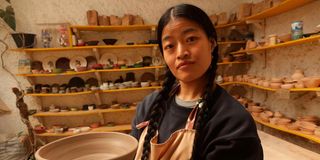
Across the city, young people and even older crowds are trading candlelit dinners for something different: working clay with their hands and, in the process, changing how they connect.
Bianca Murgor says she first came across pottery dates on social media.
“I used to see people I follow going for pottery dates, and I was always curious about it,” she says. “Until one day my friend and I decided we were tired of always going out for drinks, clubbing and events. We said, let’s try something different. I went with two of my friends. We came up with a whole activities catalogue, and pottery happened to be the first one we did.”
For Bianca, the experience felt unexpectedly emotional.
Bianca Murgor says pottery dates create calm, phone-free bonding moments filled with laughter and shared creativity.
Photo credit: Pool
“Oh my gosh, I left feeling like I had healed my inner child,” she says. “It was so fulfilling hanging out together, no noise, just calm. Each of us paid Sh2,500 at Kuzi Pottery. The music was so nice. We were singing along to Sauti Sol, telling stories and making things. It was something new for us.”
“Your hands are dirty, you do not have access to your phone, so you are really in the moment. You actually talk. Doom scrolling is a pandemic, and pottery forces you out of that. You take time to catch up on life.”
Despite its hands on nature, she says there was no awkwardness. “The instructors were really nice, and the music made it even better. We were even asking them to share their playlist.”
Bianca recalls the challenge of learning the craft. “We did two kinds of pottery, wheel throwing and hand moulding. The wheel was the real challenge because you have to coordinate your hands and feet using a pedal.”
At one point, things went wrong. “My hair got tangled in the wheel. I thought I was done, but the instructors helped me start over. Pottery teaches you not to give up. I was excited to try again because I knew the result would be rewarding.”
Did the activity help her know her friends better, as compared to past bonding activities?
“Yes it does because it brings out banter, you laugh at each other’s mistakes. If it is a first date, you definitely see a different side of someone.”
She also notes that the experience unfolds over time. “You go for the first session to make the pots, then come back weeks later to glaze them. The glazing part is also very fun. I would definitely go back.”
For Bianca, the popularity of pottery dates is easy to explain. “From the videos I have seen, everyone looks so happy. It is a really fun activity, you just have to try it for yourself. I would recommend it 100 per cent.”
She pushes back on the idea that it is only for women. “It is not just a girls’ thing. I went with a male friend and he really enjoyed it.”
“I had been seeing people post videos of them making pottery and having fun,” she says. “It looked calming and different from the usual outings.”
Unlike many, she chose to go alone. “It was not a date in the traditional sense. Going alone made it feel more personal, like I was doing something for myself without pressure.”
She admits she felt unsure at first. “When I walked in, I felt uncertain, but the people were friendly, and the environment was warm. That helped me relax.”
Zeal Chow demonstrates how pottery is done at her Imani Ceramic in Karen, Nairobi on April 29, 2026.
Photo credit: Evans Habil | Nation Media Group
Once she began, the experience drew her in. “Working with clay is enjoyable. I forgot about everything else. By the time I was leaving, I felt calm and satisfied, even though my piece was not perfect. It still felt meaningful because I had made something different.”
For Chelangat, the appeal lies in the activity itself. “At dinner, you are mostly just talking, and sometimes that can feel forced. With pottery, you are doing something together. It is more interactive and less pressured.”
It also softens conversations. “Your hands are busy, so there is less pressure to maintain eye contact or keep talking. You can have pauses without the other person feeling awkward. At the beginning, there is a bit of uncertainty, but once you start working with the clay, you get out of your head.”
The process, Chelangat adds, is both humbling and humorous. “You think it is easy until you try. Then you just laugh at your mistakes, and everything feels lighter.”
What stood out most to her was how it felt. “It is messy, tactile, and forces you to be present. The environment is calm and creative, not overly formal.”
She believes pottery reveals personality. “You see how patient someone is, how they handle mistakes, whether they are perfectionists or more relaxed. It shows who they are in action.”
Although she has only gone once, she understands its growing appeal. “It is relaxing, creative, and every experience is different because you are making something new.”
She links the trend to changing social habits. “People are looking for more meaningful experiences, not just going out to eat or drink. Pottery is both aesthetic and genuinely fun. It is perfect for anyone who wants to try something new. It is also great for introverts because it removes the pressure of constant conversation.”
The experience, she adds, is open to all. “Whether you are with friends, exploring something new, or starting a romantic journey, anyone can go.”
For Sarah Burache, a digital creator and founder of 254 and Beyond, pottery dates first appeared on her radar through TikTok.
“It struck me as a cool experience that had not fully saturated Nairobi yet,” she says. “So I decided to try it and share it with my audience. Walking into the studio took me back to childhood, playing with mud and clay. It is a visceral feeling you do not get in this digital heavy life.”
She contrasts it with conventional outings. “With drinks or dinner, you are mostly consuming. Pottery is active. You create something and leave with a tangible, handmade product. It turns a simple hangout into a shared achievement.”
The process requires patience. “You have to be gentle and in sync with the wheel. As a first timer, it tested my patience because you do not always get it right. But it also brings out laughter, which helps break the ice.”
Zeal Chow demonstrates how pottery is done at her Imani Ceramic in Karen, Nairobi on April 29, 2026.
Photo credit: Evans Habil | Nation Media Group
She highlights the environment, referencing her visit to Imani Ceramics. “The space is calm, and the customer service is exceptional. Our guide was patient and stepped in whenever we needed help, which is important when you are learning something new.”
Pottery, she says, reveals character. “You see how someone handles challenges. It requires patience, resilience and care. People want more intentional ways to spend time together.”
Though it was her first experience, she plans to return. “I will definitely be going back. I also featured a full breakdown on my TikTok page. My goal is to bridge the gap between great local brands and people looking to discover the best of the 254.
Zeal Chow, who runs Imani Ceramics in Karen, says the studio began as a hobby.
“I wanted a space to do my work, not necessarily to make it commercial. But more people kept coming, wanting to try it, and I realised I could turn it into a business,” she says.
“I began with polymer clay and sculpture, then trained in pottery during Covid when I went back to China as an apprentice,” she explains. On returning to Nairobi, her goal was to make the ancient craft more accessible.
“Pottery has thousands of years of history, and I wanted people here to experience it in a more approachable way.”
Her studio reflects that vision, with its calming décor and serene aura. “I wanted it to feel warm and joyful, so I chose yellow. Most of the decorations are handmade. When something is personal, people feel connected to it.”
Despite growing popularity especially through Social Media, Chow believes there is still room to create awareness about the craft. “Ninety per cent of our customers are beginners. Many discover pottery through platforms like Instagram and TikTok.”
While pottery dates trend online, couples are only part of the clientele.
“We did not set up the studio specifically for dates. We have individuals, friends, families, schools and corporates. Couples are just a small part. We have a website, so most bookings are done online,” she says.
Feedback has largely been positive, though early challenges included pricing concerns. Chow notes that rates are now standardised. “We used to give discounts to children, but now the pricing is the same for everyone. In fact, children often require more time and attention from instructors.”