Hello

Your subscription is almost coming to an end. Don’t miss out on the great content on Nation.Africa

Ready to continue your informative journey with us?

Hello

Your premium access has ended, but the best of Nation.Africa is still within reach. Renew now to unlock exclusive stories and in-depth features.

Reclaim your full access. Click below to renew.

Salty's By The Creek
Caption for the landscape image:

Dining afloat at Salty's on the Creek

Scroll down to read the article

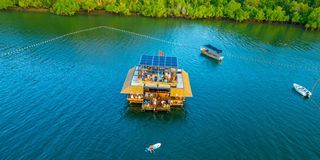
An aerial view of the floating Salty's By The Creek bar and restaurant in Kilifi Creek, Indian Ocean.

Photo credit: Courtesy

My friend Ajema is loud, gloriously loud. Whenever I try to hush her, she always goes into defensive mode. 

But my boisterous friend possesses more than just the gift of gab, she's the ultimate plug.

Whenever I visit the Coast, she always has a plan, sometimes spontaneous, other times suspiciously well thought out.

From Mombasa to Kilifi, Ukunda to wherever there’s music and mischief, she’s been there, danced there, and probably knows the bartender too. 

“I know Frankie, too.” (We will get to Frankie).

Ajema's mapped every hangout spot like a cartographer of coastal nightlife. She’s the kind of person who can tell you which hangouts once ruled the scene, which are buzzing now, and who owns them.

She knows which celebrities are misbehaving, who's secretly coupling with whom, whose wealth is genuine, and whose Instagram lifestyle is pure fiction, just curating an illusion.

A breezy tuk-tuk ride

Two weekends ago, I'd reached my limit with her relentless tittle-tattle. She noticed, and a contingency plan followed. 

"Let's go to Salty's," she announced, already plotting. "Do we Uber or take a tuk-tuk?"

Given the distance, a 40-kilometer stretch from Mombasa to Mnaran Ruinsi in Kilifi, and the torturous coastal humidity, the tuk-tuk was the obvious choice. 

I craved the merciful breeze that only a tuk-tuk could provide. And that's how I found myself chasing sunset at Salty’s on the Creek - a floating restaurant and bar in the middle of nowhere, suspended improbably in the Indian Ocean.

Once at Mnarani Old Ferry, Salty’s doesn't float in the open sea and so to get there, you’ll need to hop onto a small motorboat that glides across the creek for about 10 minutes, the ride costing anywhere between Sh100 and Sh500 per person.

Salty's By The Creek

An aerial view of the floating Salty's By The Creek bar and restaurant in Kilifi Creek, Indian Ocean.

Photo credit: Courtesy

Here’s the catch, though, only three boats ferry guests between Old Ferry and Salty’s, running strictly from 12 pm to 7:15 pm. Miss that window, and your quick trip turns into a costly adventure with fares shooting up to a staggering Sh3,000.

The journey, however, is worth every shilling. Between the 14th and 17th centuries, the Mnarani Ruins stood as a bustling Swahili trading hub, connecting the East African coast to merchants from Arabia, India, and beyond. The ancient port, perched on a cliff overlooking Kilifi Creek, still whispers stories of the dhows that once sailed in with ivory, spices, and gold, hence the name ‘Mnarani Old Port.’

It's by this scenic creek stretch where the majestic two-storey wooden restaurant floats.

When Frankie Zahlten (remember him?) Salty’s General Manager and a group of investors first conceived the idea of building a floating restaurant on the Indian Ocean, some dismissed it as a fantasy. 

Frankie Zahlten

Frankie Zahlten, the General Manager of Salty's By The Creek in Kilifi Creek, Indian Ocean.

Photo credit: Courtesy

“We spent many afternoons sailing these waters, and there wasn’t really a space where you could just float, unwind, and enjoy the beauty around you.

That’s how the idea of a floating bar was born, a dream three years in the making.” Frankie told BD Life.

The structure itself is an engineering marvel, crafted from high-grade steel and wood, and powered entirely by 24 solar panels that double as a sleek rooftop for the upper deck. Next year February, Salty’s will celebrate its second anniversary.

“We spent days researching how to make it work, from the logistics to the kind of engineering required for a fully floating structure. It’s 100 percent afloat, with no pylons anchoring it to the seabed. Instead, it rests on barrels and anticorrosive plates designed to last a decade. 90 percent of it is made of wood, with floors built from recycled Tetra Pak boards, true to our eco-conscious vision.” Frankie explained.

All waste generated at Salty’s is ferried back to land for proper disposal, nothing is emptied into the ocean.

You’d imagine the restaurant floats freely on the water, swaying gently with every ripple, but it doesn’t.

“We’ve got an anchorage system that holds it steady at four corners. Thanks to our sailing background, we understand exactly how and where to place the anchors. They’re positioned strategically, locking the structure firmly in place and preventing any drift. There’s an allowance for a sway that responds to the tides, but doesn't allow the restaurant to move.”

Beneath it all, it's the precision in the barrels.

“We calculated the total weight of the structure, and from that, we determined the exact number of barrels needed to keep it afloat, ensuring perfect buoyancy.”

With that kind of engineering, the structure is movable.

“We move it twice in a year, depending on the sun's shift degrees (where the sun drops). We are always in one cove, then shift to the other cove the next season. For clarity, it’s not a moving boat; it has no engine. It’s a floating structure, one that can be towed across the water or even set up on land if needed.”

The wind direction is another reason to move the restaurant.

“The wind normally comes from the south and then shifts to the north. There is Kaskazi (north) winds during December to March and Kuzi (south) winds during June to September. On Kuzi, we need to be sheltered, it's the windiest time of the year, and so we move the restaurant for the comfort of our clients. During the rainy season, it’s a little bit tough being an open structure, and there are times you will get wet, but we do manage. Some clients prefer that kind of weather.”

However, in May, the heaviest rainy season, the restaurant closes.

“We close service during this season because there is no point in staying open. It's also the low season in Kilifi, so there isn’t much clientele. That's when everybody gets time off, and also allows us to revamp it.” 

As the December high season approaches, Salty’s is currently on a short break for renovations, just a little polish to match the festive glow.

“Because it’s a floating space, it’s constantly exposed to the elements, the wind, rain, and salty air. Like a dhow, it requires maintenance throughout the year. What we’re doing now is mostly aesthetic maintenance,” Frankie said.

Only 50 guests

To have a good time at Salty’s, you don’t just show up, you plan ahead. Reservations are made at least a day in advance on a first-come, first-served basis, and there’s usually a waiting list. The restaurant hosts a maximum of 50 guests at a time.

“Technically, we could accommodate between 80 to 100 people at full capacity,” Frankie explains. “But we never go beyond 50, not just to maintain the structure’s weight, but to ensure the quality of service. We’d rather serve fewer guests exceptionally well than chase numbers for bigger margins. Even with just 20 guests, that’s fine by us. If they have a memorable experience, they’ll come back and that repeat clientele is what we value most. Honestly, we’re always fully booked whenever we’re open.”

Salty’s menu is exclusively seafood and vegetarian, drawing inspiration from Japanese and Mediterranean cuisines. Guests dine to the rhythm of the ocean breeze, the sound of waves, and sweeping sea views.

Irine Kabura Michire

Waitress Irine Kabura Michire serves diners at Salty's By The Creek in Kilifi Creek, Indian Ocean.

“It’s always a good day out here. You can swim around the restaurant, rent a stand-up paddleboard, or take a speedboat for surfing or skiing around the creeks. It’s a full day on the water.” Frankie adds. 

Of course, that experience comes at a price.

“The logistics of bringing supplies out here aren’t simple. Everything arrives by boat, and there is an added cost to that. Then there is the experience we offer.” Frankie explains.

He’s also quick to dispel the notion that Salty’s caters mainly to white guests.

“There hasn't been a single day that we have only had white clients. It isn’t a restaurant meant to cater to a certain demographic. It’s an open platform for everyone.”

The chat with Frankie had to end. Ajema was craving attention. Perhaps another hot gossip is brewing. 

Follow our WhatsApp channel for breaking news updates and more stories like this.