Intimate partner violence is both condemned and outlawed. Yet, for some couples, violence sits at the very heart of their relationship — a dark rhythm they cannot seem to live without. To stop the violence, for them, would be to end the relationship itself. Two recent cases come to mind.
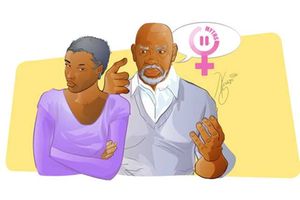
The first is Harriet, a middle-aged woman who has been married for eight years. She came to the Sexology Clinic with a peculiar concern. Her husband had stopped showing interest in her.
“We fight at least twice a week, many times three times,” she explained.
“That is really sad,” I interjected, “In this age people should not be fighting, especially with the ones they love. In fact the law prohibits it.”
“No, you don’t understand,” Harriet interjected, “My worry is that for two months now, he just won’t fight as usual, he comes home late and just goes to bed, I feel neglected and rejected, I want the wars back.”
I reclined on my seat, trying to fathom Harriet’s issue. It was confusing. I encouraged her to explain more and it turned out that Harriet and her husband did not really fight in the true sense of the word. Their foreplay included inflicting pain on each other and that for them led to sexual arousal.
“The fight includes slaps, punches, pinches and even kicks,” Harriet explained. “At one point I broke one of my fingers but did not notice it until after the sexual act. The pleasure of the moment was just too intense.”
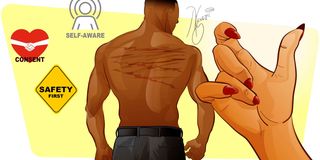
The second case was of a man, John. He came to the Sexology clinic with infected wounds in the upper part of his back that oozed pus.
“They were inflicted by my girlfriend,” he explained. “I think they got infected because she keeps injuring the same place so the wounds do not heal.”
Just like Harriet, John enjoyed the pain and seemingly his girlfriend enjoyed inflicting the pain.
“I didn’t imagine they would get this bad. I actually encouraged her to do it,” he explained remorsefully.
My conclusion was that both John and Harriet were in sadomasochist sexual relationships. This is where one gets pleasure by either inflicting or receiving pain as part of sex. The one who inflicts pain is the sadist while the recipient is the masochist. Occasionally roles may change but there is always the one who dominates in inflicting pain.
At some point psychiatrists and psychologists thought that sadomasochism was a mental illness. They just could not figure out how people would have sexual pleasure by causing or receiving pain. Later research has shown that sadomasochism is a common sexual behaviour. It may vary from very mild forms to severe acts of violence leading to injury. Mild forms may include scratches on the skin, bites or gentle punches among others.
There are three rules if you happen to have traits of sadomasochism. The first rule is that you should be self-aware. You should know that unlike others, pain gives you pleasure. This awareness reduces mental stress since the realisation that you should inflict or receive pain for pleasure can cause mental trauma. Several sadomasochists get into anxiety and sometimes depression because they cannot come to terms with their behaviour.
The resulting psychological and sometimes psychiatric problem traumatises them, yet their sexual behaviour remains unchanged.
The second rule is that any sexual act must be consensual. If you are a sadist you should look for a masochist. Do not inflict pain in people who do not appreciate it. The laws against intimate partner violence are applicable if your partner has not consented to your style. Communication is most vital in letting your partner know what makes you happy and finding out if they are ready to be party to your way of performing pleasure.
The third rule is that any form of sexual act must consider safety as fundamental. Whether it is missionary style or whatever gymnastics you may want to employ, your safety and that of your partner must be the overriding factor.
This rule applies equally in sadomasochism. The pain inflicted must have a limit. The couple has to openly agree on what can be done safely. Fractures and infected wounds are definitely beyond what one would consider safe. Again, communication is vital in letting your partner know if the pain is too much to bear. Of course the hope is that the intensity of the pleasure does not cloud the injuries being inflicted.
Back to our two clients. Harriet was right. Her husband had lost sexual interest as symbolised by lack of ‘fighting’. The couple was recruited into sex coaching classes to revive their intimacy.
John on the other hand received treatment for his infected wounds. In addition, he and his wife were recruited into sex coaching to learn how to keep safe in their sadomasochist sexual practices.
Strange as it may sound, that is the nature of sex, it is as varied as the number of people having it in the world and in many cases you and your partner are the only ones who know how different yours is from the rest of the world. It however helps to seek professional help when your strange ways become a worry and if they endanger your wellbeing.