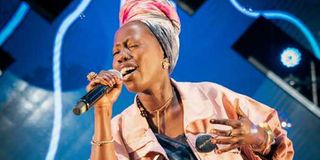
It always begins with a good song. In a sitting with Nation Lifestyle's Michael Ochieng , Zaituni Wambui opens up about the road that made her. From the girl who was insecure about her skin, to her mother's initial refusal to acknowledge her choice of being a musician, to being a single mother who is still learning how to hold everything together.
When did you start writing music?
I started writing in 2018 when I joined Sauti Academy. My teacher then was Mordecai Dex. He was the one who started me off. Before that I did not even know I could put my feelings into songs; I began tapping into emotions I had felt before and also in the moment. I do not talk about my feelings easily. I hold everything inside. So music became my outlet. It still is. It is how I sit with myself and understand where I am at.
Take us back. How did you end up at Sauti Academy in the first place?
Oh, it was not even planned! My friends wanted to audition and I just went along to pass time during a long school holiday, in 2015. I told myself, I am already here, I might as well try. I was not even trying to get admitted, I just wanted to use my time well. And guess what, I got in! My friends did not. I was shocked. From there I went straight into what they call the first class, which is for people who already show some promise. You do not get placed there if you are still raw.
Was it easy to stay in the programme?
Not really. When I was told to come back for the next stage, I almost said no. I told the coordinator, this is where it ends for me, because I could not afford it. My parents could not carry that cost. She told me to speak to someone who could help, and just like that, I was given a scholarship. I could not believe it.
Zaituni Wambui, a contemporary singer, whose debut EP Labor of Love was released on September 2, 2025.
Photo credit: Pool
Tell us about your very first performance?
I only did one term before I went back to school, because my mother wanted me to finish my studies first. But I got to perform for the first time in front of a real audience, and got my first standing ovation. I remember standing there thinking, okay, this is nice. That is the moment the spark was born in me. Something shifted inside me.
You mentioned finishing your studies. What exactly were you studying?
I was doing a Bachelor of Commerce, with a finance option, at Laikipia University. That was supposed to be my whole life plan; very predictable, very structured, one thing leading to the next. I was always a good student. But somewhere along the way, that plan changed completely.
So when did you fully commit to music?
I graduated in 2017, took my certificate, handed it to my mother, and told her I was not going to use it for anything. My pitch to her was simple. I am average at many things, even in school, but I am exceptional at singing. She was not convinced. She told me plainly not to tell her what I was going to do, she didn’t want to be involved. It took years, all the way to around 2022, before she softened and admitted that maybe I was building something real.
Let's talk about ‘Labour of Love’, your debut EP. What is it about?
Labour of Love is my first body of work, and it means so much to me. It has eight songs, and it takes you on a full journey of love. It starts with looking for love, then love being sweet, then love getting complicated and full of pressure, then when it finally ends and you never look back. It was not inspired by one relationship. It is a culmination of everything I have felt in love, put into one project.
How would you describe your sound or genre?
I built my sound the honest way, by performing live and watching how people reacted. Before I ever recorded these songs properly, I was already testing them out on stage during regular gigs, mostly singing covers, then sneaking in my own songs to see how the crowd responded. Songs like “Tick Tock” and “Tamu” were grown that way, tested in front of real audiences long before release. How we played them on stage is exactly how they ended up sounding on the EP. That really helped me understand what worked.
You mentioned you stayed home for a long stretch before releasing music. What were you doing during that time?
I was writing constantly. I wrote around 35 completed songs, plus so many more that never got finished. I would perform at small regular gigs to test my music. There was a hotel in Nyeri where I performed every Friday, and I was paid Sh4000 each time, transport included. That was enough to at least cover a week. It was a grind, but it shaped me.
Who supported you through all of that?
My father, honestly, he is an angel. The very first time I had an audition, he borrowed his friend's car because he could not get time off work that morning, and he drove me and my friends there himself. He saved my number in his phone as a celebrity the day I told him I wanted to do music, and he’s never changed it. Whenever my mother was upset about my choices, he was the one who told her to let me go and build my own life. Even now, whenever production costs pile up, he is still the person I call and he comes through.
Now let's talk about motherhood, since that is such a big part of your life. When did you become a mother, and how did it fit into everything you were building?
I actually got pregnant in 2020 while I was still living in my mother's house, right in the middle of everything I was building with my music. It was not planned around a convenient time, it just happened, and I had to figure out how to hold both things together.
Did you feel like your career paused because of motherhood?
It never fully stopped, but it definitely slowed down in certain seasons. During the Covid period especially, we were not getting big gigs at all, just small ones here and there. I kept writing and kept working toward Labour of Love the whole time, even while raising my son. It was more like everything moved at a different pace, quieter, but it never actually stopped.
You are a single mother. How do you balance being an artiste and raising your son alone?
Honestly, I do not think balance really exists. Everything has an opportunity cost. Even sitting here doing this interview has a cost somewhere else. Being a single mother makes it even heavier, because there is no one else to hand things off to when it gets hard. What I try to do is be fully present wherever I am. When I am with my son, I try to give him all of me. One thing that actually helped me was Covid. It kept me home for almost two years, and in that time I saw all of his milestones, including the very first time he walked. Two full years of uninterrupted time with him changed how well I know him.
Do you have support systems around you?
Yes, and I am so thankful for them. My mother helps a lot, and I have had the same nanny since my son was four months old, all the way to now, as he turns six. Whenever I had gigs, she was always there for me. Without those women around me, I honestly do not know how I would manage.
Is it still hard, even with all that support?
It really is. I still struggle with leaving him at home. Even during this interview, honestly, I feel a little lost sometimes just talking about it, because motherhood is something I take so seriously. Being a single mother means there is no shared weight, it all sits on me. I already worry about how I will manage once touring starts, because I want to do all these big things, but that child is my heart.
You mentioned earlier you struggled with insecurity growing up. Did becoming a mother change how you see yourself?
It changed everything. My son is the spitting image of me, and honestly, I did not even know I was beautiful until I had him. Looking at him made me look at myself differently. He has taught me so much. He has grounded me. He is the reason I have the drive and tenacity I carry today. I remember thinking about school fees and just feeling this fire to keep going for him.
Would you say those insecurities are fully gone now?
I would not say fully, no. I am still working through some of it, especially around how I show up for him versus how I show up for my career. But I can never regret having him. Never. He has taught me more about myself than almost anything else in my life.
Let's shift to the business side. How do you fund your music?
First of all, thank you Tusker, truly. When I won Tusker NextGen, that prize money was what allowed me to survive and pay the musicians who worked on the EP. Beyond that, my income comes from gig money and royalties. I own my masters, which means I get a bigger share of royalty earnings whenever my music is streamed. I have not gotten any grants yet, though I am still searching. My parents have also carried a lot of that weight for me.
Can you break down what it actually costs you to put out your music?
It varies a lot, honestly. For a single show, makeup alone can cost between Sh2,000 to Sh7,000, depending on how elaborate it is. Styling adds at least Sh10,000. Before I even step on stage, I am looking at close to Sh15,000, and that does not include transport for rehearsals or sound check costs. Producing a single song can range from Sh20,000 up to Sh70,000. A full music video, with styling, cover art, and crew included, can cost close to Sh80,000 to Sh100,000, even when people do you favours along the way. Yet after all that spending, you are still never fully sure the song will connect with people.
Outside music and motherhood, how do you take care of yourself?
Honestly, I need to work on this. I’m getting burnt out, and it is not good. I am a firstborn, so I am wired to keep pushing until my back literally breaks. I don’t even remember the last time I properly caught up with my friends, because my schedule is packed. My production team has basically become my circle now. I cannot multi-task either, so when I switch from music to being a mother, I try to fully switch, not split myself in half.
Finally, let's talk about your signature look. What can you never leave home without?
Ooh, my turban! I can never leave the house without it. Honestly, I never have bad hair days because of it. Beyond just style, it comes from my love for natural hair. I do not like manipulating my hair constantly, especially with how many shoots and shows I am in. The turban just works for me.
Does it mean more to you than just style?
It does. It has become part of how I express who I am. I am unapologetically Black; a dark-skinned Black woman. That confidence did not come easily. My mother is lighter in complexion than me, and people used to call me black beauty as a child. I never understood why they never called lighter girls ‘brown beauty.’ It took me a long time to fully love myself the way I do now. Having my son, who was also born dark-skinned like me, brought some of those old feelings back to the surface, especially with comments made by people around us. But it has also pushed me to make sure he never carries the same weight I did growing up.