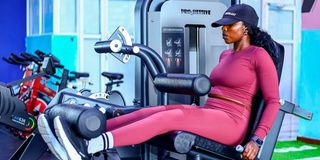
When we walked into FeminaFit, a women-only gym, almost everything around us suggested that we were in a space designed, run and occupied by women. The reception was warm, feminine and welcoming, with just enough girly essence without leaning into the stereotypical pink-and-purple gym aesthetic.
Women walked in and out, some carrying their workout equipment while others set up their tripod stands to record their sessions. Behind the reception desk were women. The trainers were women. The other employees were women.
As we waited to meet the person behind the business, we assumed a woman would walk through the door. Instead, Issa Ahmed, the director of FeminaFit, walked in.
Issa Ahmed who runs a women-only gym in Nairobi with about 150 members
Photo credit: Wilfred Nyangaresi | Nation Media Group
He has built a business around creating a space where men are deliberately kept out of the workout area. Mr Ahmed says his idea came from watching women choose a secluded small section of a gym that he previously operated.
“I’ve been in this fitness business for a long time, since the early 2000s, although it was not the women-only kind. We were the old-school type; we were concentrated more on building muscles and being bulky,” he says.
But while working with a partner, he noticed something that changed his thinking.
“We had a small section for just women, especially Muslim women. Although it was a small space, I noticed a lot of women, and not only those from the Muslim religion, preferred that space.”
That observation later became FeminaFit, which opened in April 2025.
“I decided, why don’t I just open up a women’s-only space, not only a gym, a space where they could come, work out, feel free, connect, network?” he says.
From muscles to metabolic health
He says many enquiries come from women dealing with weight concerns and conditions such as polycystic ovary syndrome (PCOS). “People suffer a lot from lifestyle conditions, especially type 2 diabetes, cardiovascular, obesity, PCOS in women,” he says.
Pauline Ochiel performs a dumbbell chest press during a workout session at FeminaFit Gym & Spa in Kilimani, Nairobi, on August 21, 2026.
Photo credit: Wilfred Nyangaresi | Nation Media Group
Upon enrollment, members undergo a body assessment using a body analyser that measures factors including body fat, muscle and water content. The gym then develops a diet and training plan. The gym also has trainers equipped to work with pregnant women, breastfeeding mothers and women recovering from childbirth.
“We have qualified trainers who understand how to handle not only breastfeeding mothers, but also pregnant women and women who are undergoing, let’s say, postpartum conditions. They guide them professionally, because the type of training that they’re supposed to do is not of course, the same as a healthy or a normal person.”
The gym has a space where mothers can breastfeed or sit with their babies while they wait to work out. A house help accompanying a client can also use the reception area. FeminaFit also offers steam services, cardio classes such as aerobics and a women-only Pilates studio.
When it comes to the number trajectories, Mr Ahmed says that by June 2025, FeminaFit had about 150 to almost 200 clients.
He adds that since then the gym has continued to operate with at least 200 active members in a good month. Mr Ahmed says the economics depend partly on scale.
“It depends number one on the space that you have; the bigger the space you have, of course the more lucrative it will be,” he says.
“The demand is there; more women appreciate women’s space, and the fact that looking good was due to social media, looking good has become part of beauty, so not only do women go and make themselves more attractive at the salon, they also want to have a nice body,” he adds.
Not every woman necessarily wants a female trainer. Some clients, Mr Ahmed says, believe male trainers offer a different kind of motivation.
“Some women prefer to be trained by men. When it comes to anything to do with workouts, you need some motivation; you need someone to push you. They feel like maybe women cannot push them as hard as a man can,” he says.
“Once the woman comes inside, she’s completely safe when it comes to anything, prime eyes of men, or anything to do with men, so it’s a completely safe space for women,” he says.
Mr Ahmed says about 60 per cent of FeminaFit’s clients are Muslim women, while the remaining 40 per cent are from other faiths.
Pauline Ochiel rides a stationary bike during a workout session at FeminaFit Gym & Spa in Kilimani, Nairobi, on August 21, 2026.
Photo credit: Wilfred Nyangaresi | Nation Media Group
Pauline Ochiel, who also goes by the name Fit Chiq Paulyne, joined FeminaFit in September last year. She describes herself as a fitness enthusiast and certified trainer.
She talks of pursuing her certification because she wanted to help other women and give them a better gym experience than the one she had encountered.
“There’s no testosterone,” she laughs.
That, she says, is the best part of being in a women-only gym.
There is comfort, she says, and less intimidation from men.
“Being a woman, naturally you don’t want to go close to where a man is because you feel like he is already dominating the space.”
In the women-only environment, there is a sense of belonging.
“Everybody is ready to help, and the trainers are very supportive during workouts,” she says. Even clothing becomes less of a calculation.
In a mixed gym, Pauline says, dressing can be a major consideration. At FeminaFit, she can wear what she wants without wondering whether someone is staring.
“You can basically wear what you want without wondering why someone is blankly staring at you. If I want to take off my jacket and just wear my bra and shorts, it’s okay.”
Her preference is also informed by bad experiences in previous gyms, particularly with male trainers. Pauline says some male trainers deviated from the reasons women came to the gym and developed alternative expectations.
Pauline Ochiel performs a barbell squat during a workout at FeminaFit Gym & Spa in Kilimani, Nairobi, on August 21, 2026.
Photo credit: Wilfred Nyangaresi | Nation Media Group
According to Pauline, hormonal fluctuations and monthly experiences could affect what exercises a woman was able to do, but those concerns were sometimes dismissed by male trainers who assumed they knew better.
“Workout is supposed to elevate you, not to exhaust you. If we have spaces like these, why would I go back?” she says.
Mary Waiganju, another FeminaFit member, started her fitness journey in her apartment gym before moving to her first women-only gym.
Being close to home helped, but the women-only concept made the experience more attractive.
Photo credit: Shutterstock
Mary says she enjoys being around women and finds the community more comfortable for training. As an introvert, joining the gym has also given her an opportunity to make friends, network and find motivation to work out every day.
What makes her the happiest, she says, is seeing women empower one another.
Like Pauline, she says she cannot imagine returning to a mixed gym after experiencing the women-only environment.
Privacy, faith and fitness
Ms Kandeel Butt wanted a space that felt true to her values and comfort as a Muslim woman.
Photo credit: Francis Nderitu
At Lantern Life Fitness, the story begins differently. Kandeel Butt, its founder, was looking for a fitness space that made sense for her as a Muslim woman.
Ms Butt holds a Bachelor’s degree in Medical and Pharmacological Sciences from Coventry University in the UK, a Master’s in Sports Management and a second Master’s in Exercise for Chronic Conditions and Healthy Ageing.
Her sports management studies taught her about facilities, business and entrepreneurship. But the idea for Lantern was personal.
In 2014, as her spiritual journey as a Muslim woman became more ingrained in how she wanted to dress, she decided to wear the hijab.
“I was looking for gyms that were female-oriented and not even so much just female only, but more my coach,” she says.
She wanted a space that felt true to her values and comfort as a Muslim woman. Lantern officially opened in January 2025.
Lantern Life Fitness CEO Kandeel Butt poses for a picture after the interview at Nation Center on August 20, 2026.
Photo credit: Francis Nderitu
From the moment a woman enters, she is in a female-only environment.
“All our coaches, all our consultants, actually, at one point, all our cats at the facility were female. Now we have two little male kittens, but those are the only males that exist in the space,” Ms Butt says.
Male companions are not allowed in the lounge spaces. “You cannot bring your brother or your father or your uncle,” she says.
Then there is the hydrotherapy pool, which Ms Butt describes as the first women-only hydrotherapy treatment facility in a gym in Kenya.
“We have also not put CCTV cameras within the space; it’s only at the entrance so that these women get to have freedom and privacy; it is non-negotiable for them,” Ms Butt says.
“We don’t do music at the space. In Islam, there is some sort of concern around musical instruments and just the role it plays in terms of the heart. So music and the heart, and the concept of Islam is really submission to God. Nothing should compete with what your heart yearns for when it comes to a spiritual element,” Ms Butt says.
Lantern Life Fitness CEO Kandeel Butt poses for a picture after the interview at Nation Center on August 20, 2026.
Photo credit: Francis Nderitu
Instead, Lantern has built its atmosphere around what she calls sakina.
“In fact, one of the main feelings I wanted as a woman was walking is peace. We call it sakina , which is tranquillity, that you’ve walked in and you’re just calm.”
For aerobics classes, the facility uses a Duff, a type of drum, and has curated halal beats or nasheeds.
“We coaches have an extra challenge because we need to keep on it. Like we actually need to create music with our creativity and our motivation for our clients.” Ms Butt says.
Additionally, Lantern operates on a booking-only basis and limits attendance to about 15 women a day.
When it opened, Ms Butt was running the space alone and gradually onboarded consultants and coaches service by service.
From January to March, she says the facility could see about 10 women a day when business was good.
“Ten women. If we were lucky, even when we just started, it was just a couple. By the time you’ve had your consultation, you’ve paid, you’re already on the schedule.”
“We give five-week packages and not four-week packages. What we’ve done is we’ve added that one week in case of any force majeure, anything. If you have your period and you just want to push things a bit forward, at least you have a week to allow for sessions.”
Their group sessions cost about Sh6,000 per individual per month, while personal training can reach about Sh40,000, depending on a client's needs. An eight-week one-to-one nutrition coaching programme costs about Sh35,000, while medical nutrition therapy is also available through a dietician.
“Women who are breastfeeding, especially postpartum women, will need clearance from their gynaecologist or physician to exercise. Once cleared for exercise, depending on also the nature of the birth, whether it was a vaginal birth or whether it was a C-section, we would then have the healing process considered and if she can start her exercise, we have what we call a core is for program for pre-postnatal women and that essentially is done with a physiotherapist that engages the four aspects of what we call our core.”
Currently, Ms Butt says Lantern has completed two cohorts of its pre- and postnatal programme. The women requiring more attention can have a one-to-one physiotherapy assessment, including body composition analysis, before a programme is designed.