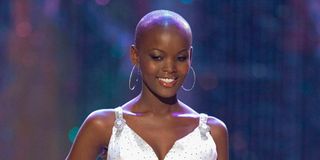
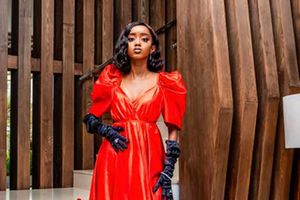
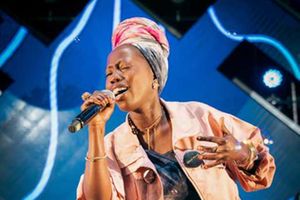
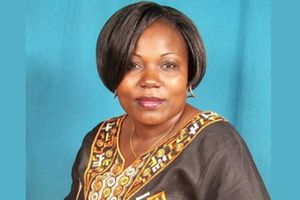
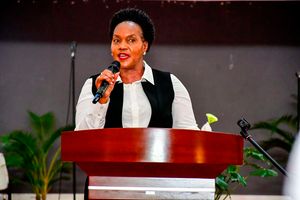
Tanzanian model Flaviana Matata has revealed why she turned down a plastic surgery deal that would have paid her $45,000 (Sh6 million).
The 39-year-old, who is based in New York, says modelling is not nearly as glamorous as it appears from the outside.
Throughout her career, she has had to walk away from several lucrative deals because they conflicted with her values and personal beliefs.
“I once turned down a lucrative deal that required me to advertise a cigarette brand. And smoke, something I don't do. There are other deals I have lost that require you to do nude shoots. There was even another that needed me to do plastic surgery as part of advertising a brand,” she says.
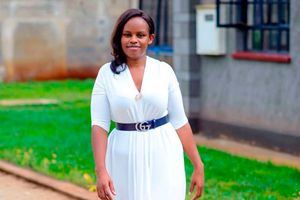
Tanzania supermodel Flaviana Matata also at the premier of film Binti in TZ.
“The plastic surgery deal was paying me $45,000, and I turned it down because I have never done and can never do any modifications on my body. I am okay with how I age.”
But after years of navigating the demands of the global modelling industry, Matata admits she has grown weary of the relentless pressure required to remain at the top.
“I’ll be honest with you, I am worn out, and these days I do other things mostly. Modelling is not nearly as glamorous as it looks. It is demanding and requires a lot from you. Yes, it pays well and can be incredibly lucrative, especially when you are operating at the international level, but I think I am simply bored.”
According to her, the emergence of the digital economy, particularly social media, has completely transformed the industry and how things are done these days
“The briefs brands give you today, and the way they expect them to be executed, are vastly different from what we were accustomed to. I think part of me is still attached to the traditional ways of doing things.”
Her experience on the international runway also exposed her to the unforgiving standards that models were expected to meet.
Matata recalls being dropped from a fashion runway in Paris at the last minute because she was considered ‘too curvaceous’ for the job.
“I was in Paris and was meant to be one of the models on the runway. With my slender physique, I knew I was perfect for it. But I was dropped at the last minute because, in their view, I had a bigger bust and therefore did not quite fit the look they wanted,” she narrates.
“The modelling culture at the international level can be unforgiving. Models go to great lengths to remain thin and maintain the measurements demanded by the industry, and sometimes that means resorting to medication. I always chose to remain natural, and that choice came at a cost. I lost opportunities because of it.”
Ms Matata believes that if she had stayed on the runway longer, she could have risen into the ranks of the world’s most recognisable supermodels and, in the process, earned considerably more money.
“The agency that initially signed me categorised me as a ‘high fashion model’, meaning I was primarily meant for runway shows. That is where the big money is because it gives you visibility, where many brands get to see you, and so jobs keep streaming in. Had I stuck with runway modelling for an extended period, I probably would have become one of the biggest names in the industry. But I simply did not enjoy it enough.”
She says runway modelling is incredibly demanding. There are auditions, fittings, rehearsals, briefs, and endless preparation. It takes so much work before one can get to the actual show.
“I decided to switch agencies so I could focus more on catalogues and campaigns. I remember when I was making the switch, my former boss sat me down and asked why I was leaving the runway, where, in his view, all the money, fame, and international recognition were.”
“Truth is, there is money to be made on the runway because of the constant stream of gigs, but it is never standardised. One show can pay you $3,000, another $1,000, and another $500; it depends on the show, the brand, and the terms of the contract.”
“Victoria’s Secret show, for example, is excellent for publicity because of the strength of the brand, and it also pays well. You could make between $7,000 (Sh906,000 and $10,000 (Sh1.3 million), but it is an annual, and there is no guarantee you will be selected the following year,” she says.
“Then you have another model doing catalogues and campaigns and earning, say, $7,000, while remaining free to work with other brands. And campaigns are rarely a one-time thing.