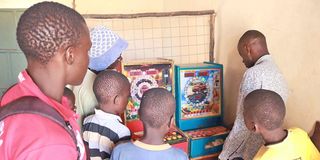
In Baba Dogo, an informal settlement in Nairobi, Mary recalls a moment that changed how she saw her teenage son. On several occasions, she had passed groups of boys scavenging for scrap metal at a dumpsite, never imagining her own child was among them. Then one day, she returned home earlier than usual and found her Grade 9 son crouched in the dirt, playing a coin game with other boys.
“They dig a small hole, then stand a short distance away and throw coins—Sh5, Sh10 or Sh20. Whoever gets it into the hole wins,” she says.
The boys’ clothes were soiled, their hands caked in dirt. Alarmed, Mary sent her son home and later informed her husband. That evening, he was caned.
“We thought that he would change after the beating, but we were wrong. He continues playing but hides when he sees anyone who knows him coming.”
Mary later learned that the boys fund their activities by collecting scrap metal and bottles from a nearby dumpsite, which they sell before gathering to gamble.
Mary and her husband are both casual labourers working at different construction sites in Nairobi. Their job forces them to leave their homes very early in the morning and return late in the evening. She says that her son plays the money game mostly when they are not around.
Mary and her husband are now worried that their son may end up dropping out of school due to this game.
“Nowadays, when something goes missing, neighbours accuse my son of stealing it. Sometimes they tell us that our son does not go to school, but when we ask him why, he says he was not feeling well.”
In Nairobi’s Dagoretti and Kawangware areas, children are moving beyond coin games to digital betting. Here, children no longer gamble by digging holes in the soil; they borrow money and phones from their parents, friends or neighbours. The moment they own a phone, they install the betting application. *Jane, a single mother, recalls her shock when her Form Four son came home with a brand-new smartphone.
“It was still wrapped in its original package. When I asked him where he got it from, he told me that he took his friend’s phone the previous day and played the aviator game,” she says.
Jane did not expect that answer from her son, who was a Form Four student at the time.
Inside a gambling hall in Githurai estate, Nairobi.
Photo credit: Pool
“The previous day, my son had asked me to give him Sh100, but I did not know what he wanted it for. When I asked him where he got the money to bet from, he told me he had won Sh40,000 from the Sh100 that I gave him.”
As a single mother working casual jobs to earn a living, Jane was surprised at how much money her son had. The previous night, the family had struggled to afford dinner. When she interrogated the son, she learned that the smartphone cost Sh15,000.
“I remember that day we did not have even sugar in the house, and he was very quietly sitting in the house as if he also did not have any money. He refunded me my Sh100 and told me he would use the rest to buy some school items that he needed. I thought that was a good idea.”
In her neighbourhood, betting is not a new thing.
“My son was introduced to betting by his cousin, who also won in his first attempt. When they win, they normally buy the latest clothes, and they look very happy. But when they lose, they become very sad.”
But the money game is not confined to urban setups. In Meru County, Monica, a farmer, discovered her Form Three son had secretly bought a smartphone using betting winnings, despite school rules prohibiting phones.
“We have never bought a phone for our son, so when my husband noticed that he had a phone and asked him whose it was, he said that he had bought it himself.”
“He told his dad that he bets using the pocket money that I give him. When we asked him whether his teachers know that he uses a phone in school, he said that he hides it in his trouser pockets.”
The mother of four says that her son is a top performer, and she believes that he was influenced by his older school mates.
“He told us that he started betting when he joined Form Two using a schoolmate’s phone, and after winning some Sh7,000, he bought his own phone. We told him never to carry his phone to school, and last term, when schools reopened, he left the phone at home.”
“You know, once a child earns money, his chances of dropping out of school are very high. He can even use that money to buy drugs.”
In Githurai and Kabiria, school children neither dig small holes nor bet on phones. They go to gambling halls near their homes. This is despite the “not for persons under 18” posters on the wall.
“My younger brother told me that he placed a Sh30 bet, and he won Sh500. I do not know where he gets money from because he is a high school student. I wanted to try it, but I fear losing my little money,” says *Purity,* a sales person.
Purity’s younger brother, who is still a minor, places bets on English Premier League matches.
“There is a betting site next to our home where there is always a crowd of children, especially on school holidays and when big teams are playing.”
In Kabiria, parents report a surge in theft linked to betting.
“Children who don’t have money to bet steal from their parents. In February this year, a group of parents walked from Kabiria to Dagoretti North to protest against the many betting machines in the area where their children are spending money,” says *Sam, a parent in Kabiria.
Sam adds that in his neighbourhood, people of all ages are involved in betting. Locals refer to betting as Kanyonde, which is slang for a small plane.
“Kanyonde is the slot machine that is used for betting. You can place as little as Sh20 and as much as Sh10,000. It is risky because if you put your Sh5,000 and someone wins, a fight can arise, which can turn fatal. So many teenagers are addicted to that game,” Sam says.
By his estimation, Kabiria alone has five betting stations located between five and 200 metres apart. Most of the gambling halls are next to dens where cheap alcohol is sold. But how do children access these halls?
“Those who own the betting machines often protect the minors. They can even close the door so that the child goes about his or her activities without being seen. They know that underage gambling is illegal, but they are after money.”
In Mathare, the practice has taken another form known as Pakakumi, where children use mobile phones to gamble in groups.
According to Margaret Nzuki, a child protection officer who works in Ruaraka Sub-County, Mathare 4A, the situation is worse. Children bet in groups, often using their parents’ phones.
“Children as young as 12 gather along the river to bet using phones,” she says.
“We’ve handled cases of stolen phones involving children,” she says. “In one case, an adult lured children into his shop, gave them phones to bet and later abused them.”
According to Nashon Moisuri, a gender services officer in Dagoretti Sub-County, betting is becoming a widespread public concern.
“Children don’t have income, so they resort to stealing or borrowing,” he says. “Many parents think their children are in school, yet they are spending hours in betting dens.”
“Without close supervision, it may take time before a parent realises their child has stopped attending school. A parent might be thinking that the child is in school, yet the child is locked somewhere, betting. If that parent is not very keen, it might be a long time before they realise that the child is missing school,” he warns.
He calls for stricter enforcement of the Children’s Act (2022), which prohibits exposing minors to harmful activities, and for parents to become positive role models to their children.
“Children do not learn from listening. A child imitates what the person in authority is doing. Perhaps we should have lessons in school to make children aware of the effects of gambling.
“Betting has become a mental health issue, especially for the parents who are practising it. They spend a lot of time betting and when they lose, they become very angry. Betting is like a disease that is being passed down to children.”
Gambling awareness specialist Favian Mbusi.
Photo credit: Pool
Research conducted between 2023 and 2024 across Kisumu, Eldoret, Kericho, Nairobi, Kajiado and Machakos counties by gambling awareness specialist Favian Mbusi found that 18 per cent of the population, including children, engage in betting at least three times a week.
“In densely populated areas, betting dens are everywhere,” Mbusi says. “Within a square kilometre, you can find three, and a significant number of users are children.”
“Children observe adults making money daily, through boda boda work, trading, or farming, and they begin to see betting as another income source.”
For many, especially in low-income settings, betting appears to offer a shortcut out of poverty.
“They start small, coin games or Sh10 bets,” he says. “Then they graduate to online platforms like aviator, chasing bigger wins.”
Mbusi and his team publish personalised messages to create awareness of problem gambling, especially online.
“Dopamine is one of the major culprits that makes gambling so hard to resist once a child has started. It alters a gambler’s brain reward system such that even when they are losing, they feel the same way as they would have felt by winning. That surge of dopamine is felt whether one wins or loses, and that is why it is so hard to stop,” he says.