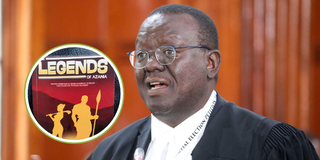
Senior Counsel Paul Mwangi is well known for the legal battles he fights in court, especially on behalf of his long-time client Raila Odinga, but now he has revealed another side of him — a folk storyteller.
This is through a new book about various legends in Kenya, albeit with a twist.
In the book, titled The Legends of Azania , the legendary characters that Kenyans have read and heard about over the years are not assigned to their tribe as is usually the case. They are also assigned an imaginary country — Azania.
For instance, rather than depict Lwanda Magere as a Luo warrior giving nightmares to rival tribes as many are accustomed to, he assigns him no tribe. Nyamgondho, another legend, is also not depicted as a Luo — simply as a man who lived near “the big lake”.
Equally, rather than portray Tapkendi as a Kalenjin heroine, she has a more national outlook in Azania. Nasikufu, the mythical Luhya girl who was a hunchback Luhya, does not have the tribal identity she is known for. The same case applies to Mumbi, whom the Kikuyu recognise as the mother of their tribe.
Mr Mwangi, in the introductory pages of the book, writes that this is a deliberate strategy to promote nationhood.
“It is not true to say that ‘the white man’ brought tribalism to Africa. Tribal animosities did exist way before ‘the white man’ came to the continent and tribal warfare was a reality in Africa as it was in all other continents in the world. What, indisputably, ‘the white man’ did was to exploit these divisions in the African societies in order to divide and rule its peoples,” argues Mr Mwangi.
Explaining that his new book is for teenagers, he says that the first step towards ending tribal discrimination is “addressing what we teach our children regarding their relationship with each other at an ethnic level.”
The cover of the book The Legends of Azania authored by lawyer Paul Mwangi.
“So long as we keep recounting to our children folktales of our respective tribes outsmarting other tribes, there is no way we shall ever reverse an attitude of tribal superiority in them when they grow into adulthood,” Mr Mwangi writes.
“Once a hero or heroine is ethnically appropriated, they become an anathema to members of other tribes. However awesome a hero’s narrative is, it cannot be recited among members of other tribes that the hero is supposed to have vanquished.
“To make our traditional folktales transcend tribe and take on a general African identity, we must have a revised look at our legends. We need to de-ethnicise, de-regionalise and de-militarise our legends so that they become relevant to a larger audience of young Africans and also act as a common cultural heritage for our children,” he adds.
“They should live in our minds. They should not belong to reality. That is the only way they would become sustainable as national icons and become a common heritage that we can pass to our children,” states Mr Mwangi.
“To save our literature, we must look for values in our mythological characters that are relevant to our future generations and the issues that matter to them. We must de-militarise our heroes and heroines and exalt those characteristics and values about them that our future generations would aspire to emulate and represent,” he adds.
Mr Mwangi is a prolific writer who has written extensively on constitutional matters. In the legal profession, he has authored the book The Black Bar: Corruption and Political Change within Kenya’s Legal Fraternity , which was first published in 2001 and has been reprinted this year.
The Legends of Azania, published by Longhorn, packs re-imagined stories of seven legends: Lwanda Magere, Mutui, Nasikufu, Nyamgondho, Mumbi and Sendibadi.
Reading the book, one comes out with the human attributes that have brought misfortune before: greed, defying advice, ego, among others. The narratives are an interplay between the human and the spiritual world, with ogres also co-existing in the mix.
Unsurprisingly, Mr Mwangi dedicates the book to Mr Odinga, whom he describes as “a legend of Azania”.