With age, one learns not to be surprised, even by the inexplicable and the illogical: life is a muddle of forms, of facts, and of meanings — administratively, practically, and metaphorically. And yet, there are some things that happen that make fiction feel pale and feeble, no matter how old one is.
It was like a page straight out of a fiction story when Professor Paul Wainaina (then Vice-Chancellor of Kenyatta University) found himself at loggerheads with the most powerful man in Kenya.
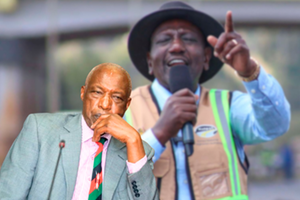
The then President Uhuru Kenyatta, usually known for his unhurried ease, cool demeanour, and the luxuriant air of calm assurance, had thrown all decorum aside and, with his eyes glistening with something stark and piercing, had pounced on Professor Wainaina, leaving him startled by the turn of events — frightened, even.
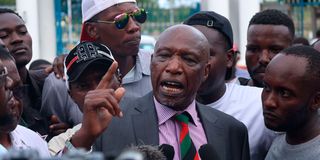
The public brawl between the good professor and the president boiled over on Saturday, July 9, 2022, during the groundbreaking ceremony for the WHO African regional operations and logistics hub, when President Uhuru openly rebuked the Kenyatta University management, singling out Vice-Chancellor Professor Paul Wainaina for resisting the government’s directive to cede part of the university’s land.
The professor resigned shortly after the president’s outburst. Outburst, resignation — in that order, a few days apart. To many Kenyans who didn’t know Professor Wainaina, this conflict is what catapulted him into a wider public view. And this clash is one of the most pivotal narratives in Prof Wainaina’s new autobiography, Firm and Forthright: A Professor with Nine Lives?
The cover page of "Firm and Forthright," an autobiography of former Vice-Chancellor of Kenyatta University Prof Paul Kuria Wainaina.
Photo credit: Nation Media Group
In Chapter 21, entitled “Firm and Forthright” (from which the autobiography gets its title), he writes of the genesis of his battle with the president: “I entered my office early in the morning and looked at the ‘in tray’... Then I saw a letter addressed to me from Kinyua, the Head of Public Service. It was dated October 13, 2020. It read in part, ‘His Excellency, President Uhuru Kenyatta has directed the Ministry of Lands and Physical Planning to fast-track the issuance of title deeds to residents of Kamae Settlement in Roysambu, Nairobi County. It has been established that the Kamae squatters occupy land belonging to the university... In order to... settle these squatters, you are hereby requested to surrender the University title...’.”
After Professor Wainaina had said no to the Kamae squatters issue, he writes that, “In May 2022, President Uhuru chaired a Cabinet meeting that reportedly resolved to hive off a total of 410 acres of KU land to be allocated thus: 190 acres for Kamae squatters, 180 acres for Kenyatta University Teaching, Referral and Research Hospital, 30 acres for the World Health Organisation (WHO) and 10 acres for Africa Centre for Disease Control and Prevention.”
Professor Wainaina resisted the president’s move, and the titanic clash was set in motion. On the day he resigned as Vice-Chancellor of Kenyatta University, after he had given his farewell address, he probably thought back on his life journey, his mind slipping back to the beginning — to another landscape, long ago and far away: the Bahati area of Nakuru.
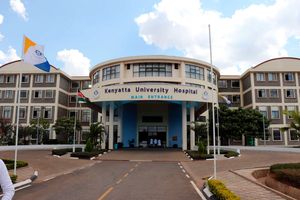
The entrance to Kenyatta University in this picture taken on April 5, 2025.
Photo credit: Wilfred Nyangaresi | Nation Media Group
In his autobiography, he writes, “I was born in 1950... in Bahati...”. And like many children of his generation, he also took care of sheep and goats. He writes, “... As I waited to go to school in the afternoon, I was tasked with several chores that included working on the farm and looking after goats and sheep.”
Perhaps, therefore, it may not be altogether fanciful to suppose that we may see the young Wainaina in those early days — a quiet boy moving among the small wonders of his world, as a shepherd child might walk among his flocks. Around him were the creatures of his first team: the sheep nosing the morning air, the goats shifting in the dust, the birds settling into their hidden nests as evening gathered.
In that small, self-contained realm — far from the noise of men and the sorrows that would one day find him — he led with the unselfconscious authority of childhood, seeing miracles everywhere: in the slant of light across a field, in the hush that fell before rain. There, in that earliest and happiest kingdom, he learnt the beginnings of service — shaping in his youthful self the heart of service to humanity that would one day mark his life.
And as he stood decades later, on the threshold of his departure from KU, it was enough to fill him with a sudden longing for those rural scenes: the pale blossoms of wild pear trees that overhung the footpaths; the soft, chalky dust that clung to his bare feet as he waited to go to school. Those blossoms — whose names he had never known, yet whose scent had so often brought him to a standstill on his childhood walks — returned then with the same heady insistence, as he walked out of Kenyatta University for the last time as its leader (he was later reinstated as VC of KU by the courts).
Of course, Professor Wainaina’s life is textured, rich and complicated, as anyone’s, and more than that one incident in his clash with the president. It is a multi-coloured life that started in Bahati, through Rugongo Primary School in Bahati (later converted into a day and boarding school and renamed Green Hills), Nyandarua High School, Kamwenja Teachers College where he trained as a P1 teacher, teaching at Kapcheplanget in Kapcherop, and joining the University of Nairobi.
One of the most encouraging things about Professor Wainaina is that he always dreams big. After teaching as a P1 teacher and graduating from the University of Nairobi with a Bachelor of Education degree, he was posted to teach at St Anne’s Lioki Girls School in Githunguri, from where he applied for a Master’s degree at the University of Nairobi. He went for his Master’s degree and then later went for further studies in Canada.
In the journey of life, Prof Wainaina has faced many odds, some seemingly impossible, but he never says die and is always firm and forthright. This is an inspiring autobiography — part life treatise, part motivational book.