In the short story “Half a Day” which was once studied by Kenyan secondary school students, the narrator uses an expression that aptly applies to some sections of Nairobi today.
“Good Lord! Where was the street lined with gardens?” the narrator asks. “High buildings had taken over, the street surged with children, and disturbing noises shook the air.”
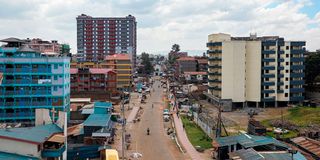
The same remark would be made by someone returning to areas in and around Nairobi, like Kawangware, Eastleigh, Gachie, Ruaka, Ndenderu, Gikambura, Eastern Bypass, Athi River, among others, after being away for a couple of years.
An aerial View of Gachie Sub-location on March 6, 2024.
Photo credit: Billy Ogada | Nation Media Group
In place of the modest, low-rise structures of yesteryear are tall, magnificent structures, occupied by wealthier residents in their glitzy cars. The pressing question becomes: Where did the original owners go?
Their fate is summed up by a concept called gentrification, which is defined as the process by which wealthier individuals move into neighbourhoods largely populated by poor residents, with the newcomers ultimately displacing the original residents.
The term was first coined in 1964 by British sociologist Ruth Glass, who used it to describe the displacement of London’s working-class residents by wealthier newcomers.
Nation interviewed real estate investment analyst Johnson Denge, urban planner Salim Said, and city property dealer Samuel Njoroge for insights on the topic. We also reviewed a 2020 research project by Matilda Carol Dok, who was a Master’s student at the University of Helsinki, which focused on the gentrification of Eastleigh.
The overriding response was that gentrification is inevitable, though it comes with its pros and cons.
“The uniqueness of the Nairobi urban gentrification is that it is developer-led, unlike in other markets,” he said. “Areas like Dagoretti, the Western Bypass corridor, the Eastern Bypass corridor, and some pockets of Syokimau and Athi River are showing a lot of gentrification.”
Many factors contribute to gentrification, and Mr Denge cited generational change among them.
“There is an aspect of cultural or what I would call generational change, especially with the gentrification we are seeing in the Kiambu side of the metropolis. The initial generation was more conservative and hoarded land. Now we are seeing a new crop of owners who are heirs of the initial owners of the land, especially in Kiambu, who are willing to [give up] this land for development,” he explained.
Mr Denge adds that specific groups of people, for instance, a community or a group of immigrants, “invade” places and lead to gentrification.
“A certain crop of a homogenous community or a certain clique of developers may get in, given perhaps their access to capital. But I don’t necessarily think that they sit somewhere and call [each other],” he said.
“I would not necessarily dwell on gentrification being led by a certain community or a certain grouping with homogenous characteristics. That would be a factor. But we assume that all developers are rational, and they are seeing all the opportunities,” added Mr Denge.
The alienation of poorer residents comes with many challenges. Urban planner Salim Said says one of the most concerning issues is cultural erosion and social exclusion.
“Most of the people who end up acquiring these new spaces come from different backgrounds, ethnicity and cultures. Thus, the original inhabitants get excluded socially and spatially,” he explained.
In an earlier post on LinkedIn, Mr Said had described how gentrification is affecting Eastleigh.
“Eastleigh… is currently experiencing rapid and haphazard gentrification and segregation, leading to the displacement of low-income residents with the middle-income class,” he stated. “We must protect the cultural heritage and historical identity of neighbourhoods undergoing gentrification to maintain their authenticity and sense of place.”
“Rapid increase of the number of wealthier immigrants of Somali origin in Eastleigh, developments initiated by the national and county government, among other factors has led to an expansion in business. It has seen the rise of new and relatively high-rise buildings that are slowly replacing the old buildings. There is increased demand for housing as well as cultural, economic, and social integration among other changes,” it said.
For her study, Matilda interviewed some of the people who had been displaced from their cheaper residences in Eastleigh to make way for the richer investors.
“These rents have gone up [in some cases] from Sh40,000 per month to Sh100,000 per month,” one respondent said.
“These houses are not for the commoners. They are being built for foreigners,” said another.
Another local said, “Years back, a single room would have been Sh5,000. Nowadays, if you have Sh8,000, you only get a house as big as a tiny toilet.”
On the issue of losing culture, Mr Denge gave an example of the old estates.
“You remember people who say, ‘I live in Calif’, or who’d identify with Mbotela or Jogoo Road, those initial estates. They now end up losing that culture,” he said.
Mr Denge said gentrification also leads to some people losing livelihoods, “especially for the small-scale informal sector”.
In terms of advantages, he listed improved services and living conditions. Also, thanks to gentrification, areas with a bad reputation quickly become attractive.
“A good example would be Banana [near] the Ruaka area, which was known for vices. It is now an address to reckon with,” he said.
An aerial view of Kawangwae, Nairobi, showing informal housing in the foreground contrasted with emerging high-rise residential and commercial buildings in the background, highlighting rapid urban development in the area on January 19, 2026.
Photo credit: Lucy Wanjiru | Nation Media Group
Samuel Njoroge, who runs Lighthomez Properties that specialises in letting and selling of property there, has seen it happen.
“For the longest, it has been seen as more of a ghetto area. But recently, let’s say from three to four years ago, that’s when new developments started coming up,” he said.
Today, when you visit Kawangware, a suburb 10.1 kilometres from the General Post Office in Nairobi on the quickest route, you are confronted with structures cropping up everywhere you look. They are almost always surrounded by shorter structures with rusting roofs and looking ill at ease.
Plots that would sell for about Sh15 million a few years ago, Mr Njoroge said, are not selling for up to Sh40million.
Some people argue that the attractiveness of Kawangware has been due to people from certain regions and countries flocking to the area. However, Mr Njoroge said the interest from an interrelated group of wealthy investors doesn’t tell the whole story.
An aerial view of Kawangwae, Nairobi showing informal housing in the foreground contrasted with emerging high-rise residential and commercial buildings in the background, highlighting rapid urban development in the area on January 19, 2026.
Photo credit: Lucy Wanjiru | Nation Media Group
He reckoned that wealthy buyers from Sudan, Ethiopia, and even Eritrea have been known to concentrate themselves in some areas of Kawangware, but the interest is from a wider pool.
“I think it’s all about demand and convenience. People used to think Kawangware had a bad reputation. But they have come to see a good side of it, mostly the convenience,” Mr Njoroge said.
The central location of Kawangware, he noted, has seen it get increased attention.
“Kawangware is convenient to Westlands, to town, to Kilimani. And nowadays there are so many offices in Kilimani and Lavington, all over that area. When the people rent at Kawangware, it’s convenient for them to go to Kilimani for their work. That’s one of the reasons for the growth of Kawangware,” said Mr Njoroge.
We asked Mr Njoroge whether the gradual displacement of poorer Kenyans is a good thing. He answered that it is inevitable.
“When the development comes, you have to go with it. It’s like technology. Once the technology comes in, you can’t fight it. And you have to either cope with it or it [locks] you out. We generally have to agree with it,” Mr Njoroge noted.
“If in a certain building a one-bedroom house used to cost like Sh5,000 or Sh6,000, and in the next plot now it’s going for Sh20,000, the landlord feels like he also has to add some cost on it, and there is that pressure. You have to sell. Also, there is that pressure that ‘we can’t build a house for Sh20,000 for one bedroom, the next one is for around Sh18,000, and yours is around Sh7,000 or Sh6,000’. Pressure falls on the landowners to sell to the new developers who are able to build the high-rise apartments,” he said. “As a result, tenants who used to live on a low budget have to shift.”
He added that on Kikuyu Road, one of the most coveted areas in Kawangware, those with lesser purchasing power have been forced to move farther inwards.
“[Landowners] also feel that it’s good to sell because the land rate has gone up. They can buy somewhere else and build another apartment and maybe get their own house. That way, they can make some earnings instead of sitting there and charging a low amount of rent,” said Mr Njoroge.
He added that joint venture arrangements are gaining a foothold in Kawangware. This is where a developer takes up land, builds, and gives some units to the original owner.
“A joint venture is where you have land, and you don’t have the ability to build. So, investors come in with the money and the market and build a structure. They sell their units and leave you some. Now, you decide to either sell or let,” he explained.
In prime areas of Kawangware like the stage, a quarter of an acre can fetch up to Sh50 million today, Mr Njoroge said.
However, recent modifications like improved road networks, streetlights and sewerage systems have seen investors trooping in.
“There are apartments for sale, especially along Naivasha Road and off Kikuyu Road. That development of apartments for sale gave confidence to people who wanted to buy plots and build apartments,” explained Mr Njoroge.
“It created confidence for the new buyers. Before, they used to wonder whether Kawangware was marketable. But once those buildings were done, it gave confidence to other buyers and developers to get interested in Kawangware,” he added.