Doctors are raising concerns over the growing number of women seeking treatment for painful ingrown nails.

Across Nairobi’s downtown streets, nail salons have mushroomed, luring women with promises of cheap manicures and pedicures.
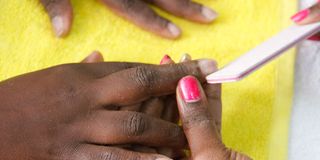
However, in these tiny salons heavy with the smell of acetone and no basic washing basins or sterilisers, no manicurist will ever mention: the cuticle clippers that are never properly cleaned, the nail files passed from one customer’s dusty toes to another’s hand, and the quiet risk of infections waiting to cling to freshly scraped skin.
Now, doctors are raising concerns over the growing number of women seeking treatment for painful ingrown nails that often lead to pus, bleeding, and foul smell, with emerging tetanus cases traced to unhygienic nail salons. Clostridium tetani spores are often in soil or dust, and if tools are contaminated and there is a cut in the skin, tetanus infection could occur.
Doctors are raising concerns over the growing number of women seeking treatment for painful ingrown nails.
Dr Mark Siboe, a general and laparoscopic surgeon, says although tetanus from rusty nail parlour instruments is rare, “the risk comes not from rust itself but from clostridium tetani spores (usually from soil and dust), which can contaminate unsterile instruments.”
Many downtown nail salons operate without running water, meaning customers’ hands and feet remain unwashed. Attracted by the low prices, clients with poor hygiene flock in, and the same tools are often used from one customer’s dusty or muddy feet to another customer’s hands.
While tetanus is uncommon, ingrown toenails are a routine issue. Dr Siboe says he sees two to three patients with ingrown toenails each week. An ingrown toenail, he explains, happens when the nail edge grows into the surrounding skin, causing pain, swelling, and sometimes infection.
"It usually develops from improper nail trimming, tight shoes, or trauma to the toe," he says.
The big toe is most often affected because it bears the most pressure during walking and is compressed in shoes more than the smaller toes. "Certain foot shapes, curved or thick nails, and a family history of curved nails predispose people to recurrent ingrown toenails," he says.
In addition to poor nail cutting, teenagers, athletes, people with excessively sweaty feet, and those with diabetes or poor circulation face a higher risk of developing ingrown nails, as constant moisture softens the skin and makes it more vulnerable.
So, what causes ingrown toenails?
"Cutting nails too short or curved, wearing tight or pointed shoes, trauma (stubbing or repetitive sports impact), excessive sweating (softens skin), and genetic nail curvature,” he says.
When a pedicure causes you more agony
Prevention starts with footwear. "Avoid tight, narrow, or pointed shoes," Dr Siboe advises.
Additionally, wearing shoes with a wide toe box and breathable socks that reduce sweat will help lower the risk. “On the other hand, salons should sterilise instruments (preferably with an autoclave), disinfect foot baths between clients, use gloves and proper hand hygiene, and avoid aggressive nail digging.”
Also Read: How safe is your beauty salon?
If you suspect a salon-related infection: “Seek medical attention within 24 to 48 hours. You should not attempt to self-drain the pus,” he warns.
Toe amputation
For mild cases, Dr Siboe recommends soaking the toe in warm water, gently lifting the nail edge with cotton, and using topical antiseptics.
If pain persists or signs of infection appear, professional care is necessary.
Severe cases may require partial nail removal, with or without root destruction. "Recurrence ranges from 20–30 per cent with conservative care to less than five per cent with modern surgical approaches," he says.
Also Read: You could get hepatitis from mani-pedi: WHO
After treatment, most people can walk within one to three days, with complete healing in two to four weeks. However, when an ingrown toenail is ignored, Dr Siboe says it can lead to chronic infection, tissue overgrowth, and abscesses, especially in high-risk patients like diabetics, serious complications such as bone infection (osteomyelitis) or amputation.
"Early treatment prevents complications, especially in high-risk patients," he says.