Jogoo Road, Nairobi — January 14, 1993.
It was late at night, with a light drizzle — just enough to blur the streetlights and soften the city’s edges. It was the day after President Daniel arap Moi had named his first multiparty-era Cabinet, following a controversial election that had ended Kenneth Matiba’s, Mwai Kibaki’s and Jaramogi Oginga Odinga’s dream of leading Kenya.
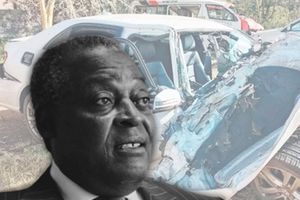
City journalist Mwenda Njoka was driving home from Tumaini House, where he worked at Society magazine. As he approached the Likoni–Jogoo Road junction, a Mercedes-Benz — registration number KAC 330U — surged past at near-lightning speed. In a heartbeat, it mounted the traffic island and slammed into an electric pole.
Behind the wheel, shaken and bleeding from a small scratch on his head, was the all-too-familiar face of Cyrus Jirongo — the brash Youth for KANU ’92 chairman whose name, after the just-ended election, had become synonymous with power and money. He was alone.
Njoka, now a media executive, recalls that Jirongo was not rattled by the crash, or even by the cut. What unnerved him was what lay in the boot. Not the cash many assumed followed him, but a cache of weapons.
Jirongo opened the boot and, together, they offloaded the deadly cargo — a box of grenades and several bazooka-type weapons — into Njoka’s car. Slightly inebriated, Jirongo summoned his friend Francis Chahonyo to pick him up. Chahonyo, the managing director of Post Bank Credit — a conduit for YK ’92 campaign funds — arrived shortly and drove Jirongo to Lavington before police reached the scene.
At the height of his reign, Cyrus Jirongo appeared to possess everything that mattered — power, money, weapons, public land, security details, and an ever-changing cast of beautiful women. Friends spoke of a man who ran on little sleep, collecting projects the way others collected trophies. His appetite stretched easily from deals to influence, from cash to conquest. By most accounts, he was a ladies’ man.
Yet what lingered, even among those who disapproved of him, was not the excess but the discipline beneath it. No matter how punishing the night before, Jirongo would still arrive at work at 7.30 am — a punctuality so unwavering it unsettled even those who knew his tastes best.
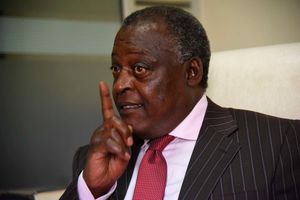
Former Member of Parliament for Lugari Constituency the late Cyrus Jirongo.
Photo credit: File
Of all his offices, the one at Anniversary Towers was the most revealing. It was less a workplace than a carefully staged display of power. From the door, visitors had to cross nearly 10 metres of open space — a deliberate walk that made you feel seen, measured and diminished with every step. His mahogany desk sat on a raised platform, bench-like in its authority. He occupied a high-backed chair that placed him above eye level. When you finally reached him, you were not merely arriving at a desk; you were approaching a dais. The room did not invite conversation — it summoned you.
When in Nairobi, Jirongo always took lunch at home — first in Muthaiga, later in Gigiri. His meal never changed: ugali and mrenda, paired with beef, chicken or fish. For “investors” and brokers, rice was served. After lunch, he stepped onto the balcony to smoke, then took black tea — the part of the ritual he loved most.
This orderliness extended to his inner circle. He was strikingly accessible, kept the same mobile phone number for years, and returned calls when he could. His retinue rarely changed — the same driver, Saulo, and a long-serving secretary who was fiercely loyal, plainly trusted and unmistakably favoured. There was tidiness in his untidiness.
Jirongo read politics the way some men read scripture: as instruction. His shelves leaned towards books on power — Niccolò Machiavelli’s The Prince, Robert Greene’s The 48 Laws of Power, and modern manuals of strategy. He was not merely consuming theory; he was practising it daily, calibrating rooms, choosing angles, learning the uses of patience and pressure.
Evenings reflected his restlessness. He often released his driver and drove himself, whisky close at hand, conversations drifting toward Western politics — ideologies and elections discussed the way traders discuss markets. His generosity was constant: he paid bills, dished out cash, and turned ordinary evenings into stories people repeated.
What baffled friends were the breadth and reach of his business networks. Early on, he befriended rebel leader John Garang, who introduced him to generals who later proved useful in South Sudan and the Democratic Republic of Congo. Jirongo immersed himself in minerals deals and, by the time of his death, had built relationships touching on the oil industry — a world where fortunes appear overnight and vanish just as quickly.
Youth for Kanu ‘92 Chairman Cyrus Jirongo with President Moi before the 1992 General Election. PHOTO | NATION MEDIA GROUP
Money, however, never stayed long. Those close to him spoke casually of windfalls in the hundreds of millions. Jirongo could land Sh100 million in a day — and spend it just as quickly, generously and theatrically. Western politicians Ayub Savula and George Khaniri have acknowledged receiving money through his largesse. Anyone short of cash knew where to turn.
When he was down, Jirongo borrowed from friends to sustain his spending. At one point, Central Organisation of Trade Unions secretary-general Francis Atwoli took him to court over an unpaid Sh100 million loan. Debt rarely troubled him — whether owed to the Kenya Revenue Authority, banks or individuals. In October 2017, the High Court declared him bankrupt over a Sh700 million debt owed to businessman Sammy Kogo. It barely fazed him. A close friend would joke that he carried liabilities like a small country.
In recent years, Jirongo travelled widely — twice to China in a single year, and to Japan — chasing minerals, commodities and anything that smelled like a deal. Visitors to his office often struggled to define exactly what he did. It was not one business, but motion itself: networks, introductions and influence that were never meant to be understood from the outside.
In politics, he played kingmaker with the confidence of a man convinced he could bend outcomes through access alone. After YK ’92, he lobbied Moi to replace Vice President Prof George Saitoti with Musalia Mudavadi. Mudavadi, then under 35, did not meet the constitutional threshold, leaving Finance as the most viable alternative. Even so, Jirongo later complained that when Kanu mandarins began edging him out, Mudavadi grew distant.
His friendships were long-standing and well defined. He was close to Kipruto arap Kirwa, dating back to their days at Mang’u High School, where both were said to have led the Debating Club. Others included Mike Rubia, Fred Amayo, Mohamed Bafathir, Gideon Moi, Francis Atwoli and businessman Mukesh Gohil. Associates say Gideon Moi often helped bail him out, financially and otherwise. Money, Jirongo understood, did not just buy things — it bought crowds.
Trouble followed him as naturally as attention did. In June 2020, he was arrested and held at Muthangari Police Station over a Sh25 million debt owed to his friend-turned-foe, Bryan Yongo. It reportedly took the intervention of President Uhuru Kenyatta to secure his release.
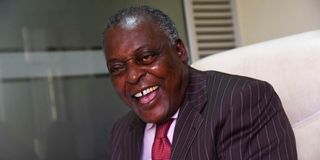
Former Lugari MP, Cyrus Jirongo, during the interview with the Sunday Nation at his Mayfair Suites offices in Nairobi on October 28, 2021.
Photo credit: Evans Habil | Nation Media Group
When bankruptcy threatened his Lugari parliamentary seat, friends urged him to reach out to President Moi. A meeting was arranged through National Security Intelligence Service boss Wilson Boinett. Though by then a Kanu rebel leaning towards the opposition, Jirongo attended Moi’s rally in Bomet on May 21, 2001 — arriving without a car, driven by a friend named Titus. Moi acknowledged him from the podium, quipping: “Nasikia Jirongo ako hapa ametorokea baridi .” Days later, Jirongo was appointed Cabinet Minister for Rural Development.
He continued to dream big. He targeted military land in Embakasi for a housing project and was allocated 1,000 acres of Ruai sewerage land, which he handed to Post Bank under Chahonyo. The loan was never repaid, leaving the bank holding public land it could not sell.
Despite failed plots, mounting debts and political fallout, Jirongo remained relentlessly optimistic. He believed the YK ’92 saga — which he felt unfairly scapegoated him for wrecking the economy — would one day be properly shared with the intelligence services, State House and KANU mandarins. At the time of his death, he was working on a manuscript — an attempt to pin down the story of a man who rarely stayed still long enough to be captured.
In political-science terms, Jirongo was a political entrepreneur operating in a deeply clientelist system, converting money and access into loyalty through personalised exchange rather than programme or ideology.
As he lived, Jirongo spoke in the language of billions, moved in the currency of connections, and travelled through Kenya’s political decades convinced the next door would open — because, so often, it did. Either for public coffers, or for business.