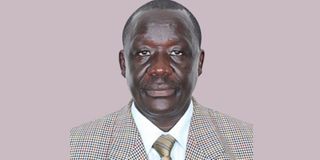
To encounter Mr Luke Kangogo Kittony is to enter a world in which aeroplanes are x-rayed to detect invisible broken parts.
It is a world where people study the manuals that come with aeroplanes like their lives depend on it. Wait, their lives depend on those manuals. Not just theirs, but the lives of those who use the planes.
“I was like a doctor whose job was to ensure aircraft were always sound and ready for the next mission,” he says in a book to be launched this week.
Mr Kangogo is the man who booked a place in the history of the Kenya Air Force by leading repairs that saw a fighter jet that had been grounded for seven years back in the air.
As the Kenya Air Force marked its 50th anniversary in 2014, it listed the restoration of the F-5E jet as the most outstanding engineering feat in its history. It may still be.
In the book, titled Aviator Par Excellence: An Autobiography, Mr Kangogo says the jet is still operational.
The repairs – which came after its manufacturer had recommended cutting up the jet and shipping it to the US for fixing – made Mr Kangogo a hot commodity in Kenya’s aviation circles.
Apart from earning him a medal from President Daniel arap Moi, it secured him promotion to the rank of Warrant Officer.
Months after the completion of the repairs (December 1987), Kenya Airways (KQ) approached him with a mouth-watering pay offer. He accepted it, and after 12 years in the military, he shifted to KQ as a senior aircraft technician, starting his duties in June 1988. It is at KQ that Mr Kangogo repaired a plane after a X-ray scan.
He would later be poached at an even higher salary – 10 times what KQ was paying. It wasn’t the last time he was given a tempting pay package to change jobs.
Mr Kangogo says he would have left the Air Force by 1984 as he had job offers in the US. He had been there for training and impressed his teachers by topping his class, which had learners from all over the world. Many job offers came.
An autobiography book by Eng. Luke Kangogo Kittony pictured on August 30, 2025.
Photo credit: Francis Nderitu | Nation Media Group
“While they were lucrative and enticing offers, I turned them down for two main reasons,” he writes.
The first was the provision in his Kenya Air Force contract that he had to serve for at least 12 years before leaving.
“I had been nominated for the aircraft structural technology course so as to learn then return and use the knowledge and expertise to benefit my country. It would be a betrayal of this great trust to accept the offers to remain in the US,” he writes.
“In addition, I had a strong connection with my roots, having been trained from a young age to value my people, my land and my heritage. I would be turning my back on everything and everyone that invested in my upbringing. This did not augur well with me.”
The book is a testament to the power of the tongue. When he was about three years old, growing up in Kaimuchuk village of Arror location in Elgeyo Marakwet District, his mother prophesied that he would be on an aeroplane one day.
“I had been crying, and she held me in her lap, trying to console me. She then said her lastborn son would fly in ‘that thing up there’ while pointing at an aircraft. There was no vocabulary to describe it. She was happy to repeat this to anyone who cared to listen whenever she spotted one in the skies. Her words came to pass,” he writes.
“The countries I have not visited are fewer than those I have been to,” he writes, attributing this to his time at the Kenya Civil Aviation Authority.
As a boy, he easily grasped concepts in the classroom, especially in mathematics and science. He did so well in mathematics in the East African Certificate of Education examination in 1975 that his paper was retained for a while.
It was eventually cleared, and a straight A in mathematics was confirmed.
However, the delay affected his progression to Form Five as he had to wait for another year. During that period, he gave a shot at military recruitment and was taken by the Kenya Air Force.
He had to pass 12 examinations that saw thousands of hopefuls eliminated and only two picked from his home area.
He joined the Air Force in a group of 100 that also had Corporal Hezekiah Ochuka, who would later be hanged for leading a botched military coup.
Senior Private Hezekiah Ochuka, who had assumed the title of chairman of the People's Redemption Council, which planned to replace President Moi.
Photo credit: File | Nation Media Group
Mr Kangogo writes that August 1, 1982, the day of the attempted coup, was his first day of annual leave. He had travelled upcountry when he got the news.
“All those who had proceeded on leave were recalled and vetted in Lanet,” he writes.
“During the vetting, some people were given green cards; some yellow cards and others red cards. Those with red cards were taken to Kamiti Maximum Security Prison; those with yellow cards were taken for further interrogation, and those with green cards were taken to the Air Force Base in Eastleigh for deployment,” he writes.
He got a green card, but adds that the general attitude towards Air Force personnel changed.
“The whole lot of us were not deemed trustworthy,” he says.
“When the tension that came with the attempted coup subsided, I was allowed to continue working as an aircraft technician on the F-5 Squadron.”
Just two weeks after he wedded on February 26, 1983, Mr Kangogo received news that he was to fly to the United States for training.
In April of that year as he departed, his family gathered at Jomo Kenyatta International Airport, and his mother reminded them of her prophecy.
He remained in the US until January 1984, returning after he turned down the many offers to work there.
After his superiors in Kenya heard of his prowess while training in the US – where he had shown a unique ability in reading manuals and implementing repairs based on them – they tasked him with breathing life into the abandoned F-5E.
It had rained one afternoon in 1980 while the jet was airborne. The pilot braked too hard while landing. The jet had aquaplaned and swerved off to the mud, on the side of the runway at high speed. On realising what had happened, the pilot ejected.
“By the time it came to a stop, part of one wing, the belly and the landing gear had been extensively damaged. All that the maintenance crew could do with the aircraft in this state was to take its good parts and use them as spare parts for others, effectively rendering it even more unserviceable,” he writes.
Before the Chief of General Staff and the Air Force Commander tasked Mr Kangogo with repairing the jet, efforts had been made to do so.
“At one point, Northrop Corporation, the manufacturers of the aircraft based in the United States, had been invited to come and give an assessment of the aircraft. They were requested to give an informed quotation on how much it would cost to bring the aircraft back to service,” he continues.
“Northrop’s quotation was high. Further, the aircraft was also going to be disassembled, crated and shipped back to the factory for restoration. The requirements were too steep, and there was a stall on a decision for the way forward.”
Tasked with the restoration, which began in January 1986, Mr Kangogo made a list of the needed parts and ordered them from the manufacturer. Then the work began.
“One of the interesting encounters I had during the repairs involved two men who would later become national figures. These were General Francis Ogolla, who went on to become Kenya’s Chief of Defence Forces (CDF), and Major-General Michael Gichangi, who later served as the Director of the National Intelligence Service,” he writes.
The late Chief of Defence Forces, General Francis Omondi Ogolla.
Photo credit: File
He adds that Gen Ogolla, who was a second lieutenant in the Air Force, kept wondering what he was doing in the hangar all day while Major-General Gichangi “was also quite interested in what I was doing”.
The repairs ended in December 1987, and the result surprised everyone.
The achievement saw Mr Kangogo climb the ladder, rung after rung, finally switching to the Kenya Civil Aviation Authority and then to regional aviation agencies.
Aircraft Technician, Sheet Metal Engineer, Principal Engineer for Quality Systems and Civil Aviation Airworthiness Manager are some of the titles Mr Kangogo has held over the years.
Now in retirement, Mr Kangogo is regularly called up as a consultant in one aviation project or another. He is also a part-time lecturer at Moi University in Eldoret.
The book, which renders itself in a friendly relatable tone, is a hybrid of inspiration and vivid recollection.