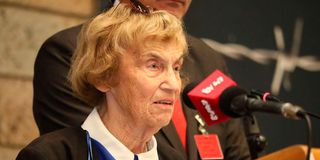
When Wanda Helena Albińska, 90, rose to speak at the United Nations Office in Nairobi on Tuesday, the room fell into a quiet stillness.
Diplomats, students, civil society leaders and human rights advocates gathered for the International Day of Commemoration of the Holocaust listened keenly as a woman whose life had been shaped by one of history’s darkest crimes began her testimony- not with anger or accusation, but with gratitude.
“I am not here because I was brave. I am here because others were,” Ms Albińska recalled the horror events of 1939-1942. She was three years old when the German Nazi invasion of Poland began.
Ms Albińska is a Holocaust survivor, one of the Jewish children smuggled out of the Warsaw Ghetto during Nazi occupation and hidden on the so-called “Aryan” side by Catholic rescuers who risked execution to save a child they barely knew.
Speaking in Nairobi, thousands of kilometres from Europe, she traced a life marked by loss, survival and the quiet courage of ordinary people who refused to surrender their humanity. She identifies as a Jew, a Polish and a catholic.
Born in Warsaw three years before the start of the Second World War, Ms Albińska spent her earliest years inside the Warsaw Ghetto, where more than 400,000 Jews were confined behind walls and barbed wire. Overcrowding, hunger and disease were constant, and death was an ever-present reality.
“The ghetto was designed not only to imprison bodies, but to break the human spirit,” she said.
As a child, her understanding was fragmentary, shaped more by fear than by facts. But certain images never left her. The gaunt faces, whispered warnings, and a sense that life itself had become fragile.
At the centre of her story is her mother, Dr Halina Rotstein, a physician who worked in the ghetto treating patients despite the absence of basic medicines and equipment.
Holocaust survivor Wanda Helena Albińska speaks during the International Day of Commemoration in memory of the victims of the Holocaust at the United Nations Offices in Nairobi on January 27, 2026.
Photo credit: Bonface Bogita | Nation Media Group
Dr Rotstein was only 35 years old when she died, but to her daughter, she embodied strength and moral clarity.
“She was a doctor before she was anything else, and she believed her duty did not end because the world had lost its mind,” Ms Albińska said.
As Nazi deportations intensified- later revealed to be transports to extermination camps - some professionals were offered chances to escape. Dr Rotstein was among those given such an opportunity. She refused.
It was a choice that would cost her life. Dr Rotstein was eventually deported to Treblinka, where she was murdered. Ms Albińska never saw her mother again. But before her death, Dr Rotsein made one final decision that would shape her daughter’s fate, to ensure that the child lived, even if she herself could not.
As a young girl, Ms Albińska was smuggled out of the Warsaw Ghetto. The details, she said, remain blurred by time. What she remembers are fragments: being carried through danger, being warned not to speak, the constant terror of discovery.
On the other side of the ghetto wall, she was hidden by Catholic rescuers who concealed her identity, taught her new prayers and shielded her from Nazi patrols.
“They did not know if the war would end. They only knew that a child should live,” she said.
Ms Albińska learned a new name and new habits. She learned how to disappear into the background, how to listen more than she spoke. Even as a child, she understood the stakes. One mistake would not only cost her life, but also that of her protectors.
When the war ended, liberation did not bring instant peace. Like many survivors, Ms Albińska found that freedom came with grief.
Orphaned and displaced, she grew up in Europe struggling to rebuild from devastation. Families had been wiped out, communities erased, and familiar landmarks reduced to rubble. For survivors, the task was not only physical reconstruction, but emotional survival.
From left: Israel’s Ambassador to Kenya Gideon Behar, Holocaust survivor Ms Wanda Helena Albiński, and Germany’s Ambassador to Kenya Sebastian Groth during the International Day of Commemoration in Memory of the Victims of the Holocaust at the United Nations Offices in Nairobi on January 27, 2026.
Photo credit: Bonface Bogita | Nation Media Group
Ms Albińska later studied chemistry, drawn to what she described as the order and predictability of science after years defined by chaos. She married Wojciech Wacław Albiński, and together they lived in several countries, including South Africa, building a life that extended far beyond the ruins of wartime Warsaw.
For decades, she rarely spoke publicly about her experiences. Like many survivors, she focused on living, on building a future rather than revisiting a past filled with pain. But as time passed and the number of survivors dwindled, she felt a growing responsibility to speak.
“When survivors are silent, denial becomes loud,” she said.
Through documentaries and interviews, Ms Albińska has shared her family’s story, determined to counter Holocaust denial, distortion and historical amnesia.
Her address in Nairobi came at a time when the United Nations and its partners have raised alarm over rising antisemitism, hate speech and the erosion of historical truth worldwide.
She urged listeners to reflect not only on perpetrators, but also on bystanders — and on those who chose to resist, often at great personal risk.
“My rescuers were ordinary people. They did not see themselves as heroes. They simply refused to cooperate with evil,” she said.
She also spoke of her mother not only as a victim but as a moral example whose choices continue to resonate across generations.
Addressing people in the room, she stressed that the Holocaust must be understood not only as a historical tragedy, but as a warning.
“Genocide is never an accident. It is built step by step, when hatred is normalised, and indifference becomes acceptable,” she said.
Reflecting on her life, she turned to one simple truth that has defined her existence.
“I am here today because someone chose to care. Because someone chose humanity,” she said.
Her testimony was echoed by diplomats who spoke during the event, urging the world to always remember the Holocaust.
EU Ambassador to Kenya Henriette Geiger said the world must continue to honour the six million men, women and children murdered during the Holocaust, warning that remembrance must be matched with action.
“If the six million victims of Nazi atrocities could speak to us today, they would tell us to stand up for dignity and human rights and to learn from the unimaginable crimes of the past,” Ms Geiger said, cautioning that “silence in the face of evil is evil itself”.
German Ambassador to Kenya Sebastian Groth said Germany carries a special responsibility to ensure that the Holocaust is never forgotten and that Jewish people can live freely and safely, even as antisemitism continues to rise globally.
“Even in 2026, we continue to witness rising antisemitism, which in many cases has led to physical attacks,” Mr Groth said, urging the international community to defend human rights and protect minorities.
Israeli Ambassador to Kenya Gideon Behar said the commemoration was not only about remembering history, but confronting the present, noting that recent years have seen a sharp rise in antisemitic incidents worldwide.
“The Holocaust did not begin with gas chambers. It began with words, exclusion and silence. If we do nothing, it can happen again,” he cautioned.