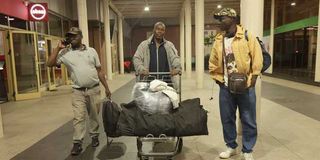
The scene at the Jomo Kenyatta International Airport (JKIA) on Thursday, as a cohort of Kenyans landed after fleeing South Africa can be described as “light”.
Light because many of those who came did not bear the luggage you would expect.
For people who were returning home from a foreign country, with no hope of going back, one would have expected mountains of luggage to come out of the Kenya Airways aircraft belly. But no, some of them had barely a bag in their hands.
Their manner of arrival itself was enough to communicate that these were people returning after losing all they had.
When we interviewed some, another aspect of light emerged: they were feeling less burdened now.
They did not have to fear for their lives. They did not have to live like fugitives. Sixty more Kenyans were evacuated from South Africa and arrived at JKIA last night
The Foreign Affairs ministry said on Thursday that 240 Kenyans have so far sought assistance from the Kenyan High Commission in Pretoria, with dozens more expected to return home in the coming days.
Some of those who returned to Kenya on Thursday are Joseph Gichini, Jim Onyango and Mike Mwita.
151 Kenyans return home after emergency evacuation from South Africa
Speaking with Nation at the airport, the three said they are done with South Africa. The Nation also interviewed Bernard Mwita, the chairman of the Kenya Diaspora in South Africa (Kedasa), and his secretary-general William Thageya.
What emerged is a commendable level of coordination between the organisation of about 12,000 Kenyans in South Africa with the government to bring afflicted Kenyans back home, a journey that started on June 30.
The Kenyan government estimates that there are a total of 27,000 Kenyans in the rainbow nation.
The evacuees’ experiences highlight how the immigration crisis in South Africa is affecting Kenyans.
Joseph Gichini, one of the Kenyans repatriated from South Africa following escalating anti-migrant protests speaking at JKIA after landing on July 2,2026.
Photo credit: Evans Habil | Nation Media Group
Mr Gichini had lived in South Africa for 20 years, long enough to train in insurance, build a career, start his own business and raise children.
Yet when the 49-year-old arrived back in Kenya on Thursday evening, the life he had spent two decades building had been reduced to one bag.
He had travelled to South Africa, a city called East London, to see his children when calls began coming in: Mount Frere town, where he lived and kept his belongings, had become a no-go zone. Friends warned him not to return. His landlord told him to stay away. Going back, he said, meant choosing between property and life.
“I lost my car. I lost my property,” he said. “If I ever step in there, then I have to choose two things: the property I have, or my own life.”
He chose his life, and that is why he came to Kenya with just a bag, and now he will be calculating how to rebuild his life from his native Murang’a County.
“I came with a single bag. These [with me] are the clothes I carried when I visited East London to see my children,” he said.
Mr Gichini’s fear was not only of police or immigration officials. He said pressure in South Africa came from landlords, vigilante groups and ordinary residents who would demand to see his papers and permits.
“But it no longer matters whether you got documents or not. You have to leave by force,” he said.
His bank account, he said, had also been frozen after “suspicious” delays in renewing immigration papers, leaving him unable to access money he had earned.
Without the support of the Kenyan government, he could not have afforded the ticket home.
Reuters reports that although South African authorities have condemned violence, vigilantes have often failed to distinguish between documented and undocumented migrants.
Asked whether he can return after the tension eases, he says: “I will never go back there.”
One of his reasons is that he has lost a close friend in the crisis. He was a truck driver from Zambia.
“They never understood why he was transporting goods from Zambia to KwaZulu-Natal and back. They killed him,” he said. “So how can you dare to go there?”
Nelly Ochieng' Onyango, one of the Kenyans repatriated from South Africa following escalating anti-migrant protests speaking at JKIA after landing on July 2,2026.
Photo credit: Evans Habil | Nation Media Group
Mr Nelly Ochieng' Onyango went to South Africa in 2013 and has been working as an electronics technician, a trade that allowed him to repair televisions and other appliances and build a modest livelihood.
He returned to Kenya on Thursday with many lessons, among them that Kenyans abroad, in the long-term, should return home.
Mr Onyango described repeated encounters with groups he associated with the anti-immigrant campaigns, including the “Dudula” vigilantes.
In one incident, he said, trucks arrived near his shop in the Eastern Cape, and men took customers’ television sets, loaded them into vehicles and drove away.
He went to the police, but the response, he said, was to wait. Three days later, he had to flee. “They told me, ‘You must go,’” he recalled.
His wife, who is Congolese, has remained in South Africa with their children, and he plans to bring them to Kenya.
In Mr Onyango’s view, migrants like him have helped open local people’s eyes to business possibilities. But he rejects the claim that foreigners simply took jobs.
“My business was doing okay,” he said. “We have not taken their jobs; we’ve just shown them how to do it.”
His advice to Kenyans still in South Africa? “Be careful, avoid accumulating bulky possessions, keep only essentials and be ready to move.”
Mike Mwita, one of the Kenyans repatriated from South Africa following escalating anti-migrant protests speaking at JKIA after landing on July 2,2026.
Photo credit: Evans Habil | Nation Media Group
At 22, Mr Mwita should have been at the beginning of an ambitious migrant story. He left his home in Migori County after Form Four and went to South Africa to learn, work, gather capital and someday return to Kenya with ideas.
He first worked in a salon, then in an internet café where he edited photos, printed canvases and typed documents. The pay was modest, about 1,000 rand (Sh7, 670) a week, but it was a start.
Then the anti-immigrant marches reached his neighbourhood and the routine of work was replaced by hiding.
Mr Mwita said he worked in a Nigerian-owned shop, which made him more vulnerable because Nigerian businesses were among those singled out by protesters. The shop had to close.
At his house, he was always scared. Some nights, he paid to sleep in a hotel. He stopped going to church because foreigners gathered there and could be targeted together.
The police, he alleged, could also exploit migrants, demanding money in exchange for protection. When the danger grew, Mr Mwita and others turned to the Kenyan embassy and Kedasa.
“The moment you go back, that is all. You are finished. They took everything from my house,” he said.
Now, back in Kenya, he likens himself to someone freshly out of high school, except with trauma rather than optimism.
He also described witnessing an attack on a Pakistani man during the early days of the unrest, saying he survived partly because, as a black African who could speak some local language, he could blend in.
“The Pakistanis are coloured so it’s very easy to identify them,” he said. “He was trying to run for his life. He left the shop. As others were trying to take things from the shop, others were hitting him.”
She went to South Africa in 2013 as a visitor, then saw an opportunity and stayed.
Over time, she regularised her stay, built a beauty business, created work spaces for others and raised two children who are South African citizens with her Kenyan husband.
Speaking with NTV on Thursday, Ms Wambui said the danger had been cyclical for years, but the past year became harsher, with vigilantes going to houses and shops, ordering foreigners out and sometimes stealing, leaving them with nothing.
Last year, while she was at work, she received a call saying her house was on fire. She rushed back to find everything burnt to ashes, including her documents.
From then on, she was rebuilding. When the latest threats intensified, she knew she could not hide. Neighbours know her. With the threat of door-to-door night visits, she resolved to leave.
“They come knocking at your door at night. They know who is who. They knock and ask, ‘What are you doing? We gave you till June 30. What are you still doing here?’” she said.
“When you’re leaving, you leave with nothing. If you were in a night dress, that is the one you’ll leave with.”
Through Kedasa, she registered for evacuation. The government-supported journey took her from Durban to Pretoria, then to a hotel, food and eventually a flight home.
Her husband, a nurse, remains in South Africa, taking care of some of those forced into camps.
Mr Thageya, the Kedasa’s secretary-general, remains in South Africa because, as he put it, someone had to be “the last man standing” while others were being evacuated.
He told NTV on Thursday that he has lived there since July 1996, and he has seen previous cycles of anti-immigrant hostility.
This one, he said, feels broader and more dangerous. He prefers the term Afrophobic because the violence, in his view, mostly affects African migrants.
Those most exposed are Africans in smaller businesses like barbers, mechanics, tailors, salon owners, domestic workers, street vendors and shoe repairers.
Mr Thageya said Kedasa has about 12,000 registered members, though many more Kenyans live in South Africa outside its network.
The association collected names of people who felt threatened, forwarded lists to the Kenyan embassy, helped coordinate calls, transport and humanitarian support, and urged those without papers not to hide.
He said Kenyan officials negotiated so undocumented Kenyans without criminal records could be processed for repatriation without being taken through court or detention camps.
He also described the logistical challenge of a vast country: Kenyans in KwaZulu-Natal, Eastern Cape, Western Cape and other regions often needed help to travel hundreds of kilometres to reach the embassy in Pretoria.
Kenyan Diaspora in South Africa chairperson Bernard Maina speaking at JKIA in Nairobi on July 2, 2026.
Photo credit: Evans Habil | Nation Media Group
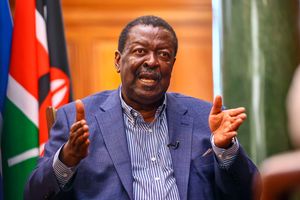
Mr Maina, the national chairman of Kedasa, told Nation that the crisis is both a humanitarian emergency and the latest expression of a deeper South African contradiction.
He was in Kenya for a family burial when some of the returnees arrived, and he returned to South Africa on Thursday.
Kedasa had been involved in identifying Kenyans in distress, linking them to regional Kedasa leaders, channelling cases to national officials and coordinating with the Kenyan High Commission and the State Department for Diaspora Affairs.
“The official number of Kenyans in South Africa, the registered ones, is about 27,000. But I’ll put the numbers at about 200,000. A lot of them are doing serious stuff. They’re building that nation, and they’re creating wealth for Kenya too,” he said.
His assessment is that the most exposed Kenyans are those working closest to the struggling townships.
He argues that South Africa’s black townships remain shaped by apartheid-era exclusion, with many local residents competing fiercely over small opportunities while immigrants, including Kenyans, have filled gaps in retail, services and informal enterprise.
That competition, he said, has been turned into political anger, especially around election seasons, with foreigners portrayed as the source of unemployment and crime.
Despite the anti-immigrant upheavals, Mr Maina, who runs a distillery in South Africa, insisted that the country remains open for business.
“People who want to do business there, they shouldn’t shy off,” he said, adding that new entrants need to consult Kedasa. “We can’t run away. We can’t be cowards and say we won’t work.”
A Kedasa coordinator spoke with Nation on the phone from Johannesburg but did not want to be named. He has lived there for 20 years, first as a student and later as a businessman.
Not all South Africans, he said, support what is happening.
“Not all support what is going on. Remember, this country has 11 tribes,” he said.
“But this needs to be addressed by the South African government because it affects their image in the entire world.”
But fear, he added, changes every calculation.
“If you’re fearful, even if it’s honey you leave it alone,” he said.
He is one of the people who help the beleaguered seek help. On Thursday morning, when he spoke with Nation, he had received many calls from worried Kenyans and had been sending guidance on which papers to carry and show police when stopped.
In his view, the returning diaspora represents both a wound and an opportunity.
“The government can look into their database and see how it can place them in the industries or the sectors that they have studied here or what they were working in,” he said.