The government’s response to flood-related humanitarian emergencies aimed at minimising loss of lives, livelihoods, property and critical national infrastructure could have been significantly improved had recommendations by Auditor-General Nancy Gathungu been acted upon.
A performance audit on the government’s response to floods released on March 24, 2024 and later presented to Parliament recommended the development of a national disaster risk management policy and the enactment of a corresponding law.
Auditor-General Nancy Gathungu.
Photo credit: Alex Odhiambo | Nation Media Group
Ms Gathungu made the recommendations after establishing that the government, through the State Department for Internal Security and National Administration (SDISNA), now under the Interior and Coordination of National Government, failed to act on flood early warning information issued by the Kenya Meteorological Department (KMD) and the Water Resources Authority (WRA).
Also criticised in the audit over glaring inefficiencies and deficiencies that have contributed to loss of lives and widespread destruction of property and infrastructure was the State Department for Arid and Semi-Arid Lands (ASALs) and Regional Development.
“The State Department for Internal Security and National Administration should coordinate with the State Department for Arid and Semi-Arid Lands and Regional Development to ensure the national disaster risk management policy and law are enacted,” the audit recommended.
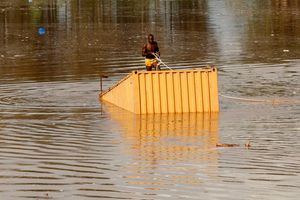
A man swims in flood water after heavy rains flooded a quarry within Kamulu area of Nairobi County on March 6, 2026.
Photo credit: Monicah Mwangi | Reuters
According to the report, such a framework would address institutional capacity challenges affecting flood response operations while also resolving coordination and mandate conflicts among agencies.
Floods exacerbate poverty
The audit was conducted in light of increasing flood incidents in the country, largely attributed to climate change, which have caused significant loss of life, property and livelihoods.
According to a 2019 World Bank report on Kenya’s Natural Disaster Risk Profile, floods affect an average of 150,000 people annually.
Ms Gathungu noted that recurring floods exacerbate poverty and food insecurity by compromising sanitation and water quality, thereby triggering humanitarian crises.
“Floods not only disrupt the provision of healthcare but also erode the gains made on housing or shelter, manufacturing and agriculture,” the audit says as it calls for lasting intervention measures, adding; “despite the destruction, floods also present an opportunity for improvements in food security.”
The report further notes that despite their destructive nature, floods can present opportunities to improve food security if excess water is properly managed and utilised for irrigation.
“Proper response to floods is therefore not only necessary for the achievement of the government’s development agenda but also critical to ending poverty in all its forms,” the audit states.
The audit covered a five-year period from July 2017 to June 2022 and focused on SDISNA and the Directorate of Special Programmes. It sought to establish the measures put in place by the government to respond to flood-related disasters and ensure minimal losses, as well as effective recovery after flooding.
Six counties across four flood-prone catchment areas were sampled: Baringo and Narok in the Rift Valley catchment, Busia in the Lake Victoria North catchment, Garissa and Tana River in the Tana catchment and Kisumu in the Lake Victoria catchment.
The audit revealed that most government interventions focused on repairing damaged roads and bridges, “leaving out community livelihoods and critical infrastructure such as schools, hospitals and marketplaces.”
Vehicles remain partially submerged in floodwaters after heavy rainfall caused severe water accumulation on streets in Nairobi, on March 06, 2026.
Photo credit: Edwin Nyamasyo | Reuters
To improve the response to early flood warnings, the audit recommended that the State Department for ASALs and Regional Development finalise the national relief response policy and ensure enactment of the relevant legislation.
“This will resolve inefficiencies observed in the relief process by providing clear and legally binding guidance,” the audit states.
SDISNA, through the National Disaster Operations Centre (NDOC), was also tasked with working closely with the Office of the Deputy President and the Council of Governors to fast-track the clarification and gazettement of disaster risk management functions between national and county governments.
The move was intended to ensure clarity of responsibilities in evacuation, relief and recovery operations for affected communities.
However, three years after the audit was released, the situation appears largely unchanged.
The report continues to gather dust on the shelves of the National Assembly, which is yet to act on it through the relevant parliamentary committees.
Before the heavy rains that pounded Nairobi on March 6, 2026, causing deaths and widespread destruction, the Kenya Meteorological Department had already issued advance warnings.
On March 3, 2026, the met department warned of heavy rainfall in Nairobi between March 3 and March 9, with peak intensity expected between March 4 and March 7.
Members of the Kenya Red Cross search for bodies trapped in the wreckages of vehicles destroyed following heavy rainfall in the Grogan area, popular for automotive workshops and secondhand spare parts in downtown Nairobi, Kenya, March 7, 2026.
Photo credit: Thomas Mukoya | Reuters
A day later, the department issued another advisory specifically for Nairobi, warning of showers and thunderstorms expected to deliver between 30mm and 50mm of rainfall.
Police were not deployed in many affected areas to guide motorists, leaving drivers, many of whom were unaware of the danger, to enter flooded roads where vehicles became stuck or were swept away by raging waters.
Subsequently, Nairobi recorded extreme rainfall levels, including 160mm at Wilson Airport and 145mm at Moi Airbase in Eastleigh.
The intense rainfall resulted in severe flooding in several residential areas and contributed to the 25 reported fatalities.
Despite repeated alerts from KMD, the Nairobi City County Government failed to clear the city’s drainage systems in anticipation of the heavy rains, leaving residents wading through waist-high floodwaters.
Many motorists also found their vehicles marooned in parking lots and flooded streets, raising concerns about potential engine and interior damage.
To help mitigate flooding risks, the audit recommended that the State Department for ASALs and Regional Development implement an integrated relief records management system to improve monitoring of relief efforts.
The report notes that flood early warning information is routinely generated by both KMD and WRA, similar to the alerts issued before the March 6 rains.
Learn from past disasters
This information is disseminated through multiple channels, including the National Government Administration Officers (NGAO) chain of command, radio broadcasts and SMS alerts issued by the Kenya Red Cross Society.
However, the audit found a consistent lack of early action from both government agencies and communities.
A member of the Kenya Red Cross searches for bodies trapped in the wreckages of vehicles destroyed following heavy rainfall in the Grogan area, popular for automotive workshops and secondhand spare parts in downtown Nairobi, Kenya, March 7, 2026.
Photo credit: Thomas Mukoya | Reuters
“It was evident from the audit findings that the government, through the State Departments for Administration and Internal Security and the Directorate of Special Programmes, had not put in place adequate measures to respond to humanitarian emergencies during flooding,” the report states.
The audit concluded that the government must learn from past disasters to better prepare for future ones.
“Consequently, floods led to loss of lives and property in the affected areas, which would have been avoided if action had been taken following early warnings,” the report states.
It further notes that the lack of early action may be attributed to the absence of a clear framework linking early warnings to early response.
The State Department for Administration and Internal Security and the Directorate of Special Programmes, recently elevated to a State Department, are tasked with ensuring flooding does not escalate into humanitarian crises.
According to the audit, SDISNA had structures in place to disseminate flood warnings and coordinate response efforts, while the State Department for Special Programmes had systems for providing relief assistance to victims.
However, the report identified several weaknesses in flood response and recovery, including lack of early action, evacuation challenges, weaknesses in relief processes, limited recovery interventions and poor coordination among agencies.
The audit also identified broader disaster preparedness challenges, including unclear institutional mandates, absence of critical laws and policies, inadequate institutional capacity and lack of contingency planning.
“Where good practice is in place, flood early warning information should be communicated to county commissioners or deputy county commissioners in flood-prone areas,” the report states.
Kenya Red Cross officials conduct an assessment in Rachuonyo North, Homa Bay County, on March 8, 2026, following floods that have displaced families in the region
Photo credit: George Odiwuor | Nation Media Group
Local administrators are then expected to convene stakeholder coordination meetings to evaluate preparedness levels and plan appropriate responses.
The audit further notes that effective evacuation requires the State Department for Administration and Internal Security to work closely with county governments to map evacuation routes, establish evacuation centres and provide the necessary equipment such as boats and vehicles.
However, the audit revealed that none of the sampled counties had mapped evacuation routes.
“Except Kisumu, which had six centres, none of the other sampled counties had designated evacuation centres,” the report states.
The audit emphasised that relief provided to victims must be sufficient, timely and based on actual needs, while procurement and distribution of supplies should also be cost-effective.
However, incomplete data provided by the Directorate of Special Programmes prevented auditors from determining whether relief operations met these standards.
Due to limited recovery interventions, many flood victims were unable to rebuild their livelihoods after disasters, leaving them more vulnerable to future flooding.
“The limited recovery efforts after floods were attributed to the lack of a clear mandate among government agencies dealing with floods, institutional capacity challenges and lack of contingency planning,” the audit concludes.