When boda boda riders wheeled a frail, trembling man into the emergency wing of Kenyatta National Hospital on Sunday night, they had no idea they had brought to safety one of the most sought-after missing persons.
The men who found him reportedly said he had been lying by the roadside on Ngong Road, disoriented, unable to speak and visibly traumatised.
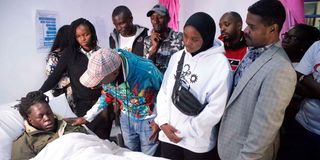
Activist Davis Lichuma at Nairobi Women's Hospital on June 29,2026. He went missing during the June 25 protests aand was found sickly along Ngong Road on Sunday night.
Photo credit: Evans Habil | Nation Media Group
For nearly four days, the family of human rights activist Davis Lichuma had searched desperately in police stations, hospitals and mortuaries after he vanished moments after his arrest during demonstrations in Nairobi on June 25.
At about 9.30pm, Mr Lichuma’s elder brother, Benson Shikala, acting on what he described as instinct, decided to make one last stop at KNH. He had already spent the better part of Sunday moving from one hospital to another, combing through mortuaries across Nairobi and Kiambu counties without success.
At the hospital gate, security officers initially turned him away because visiting hours had ended. After explaining that he was searching for his missing brother, he was directed to the emergency wing.
“I was told many people had arrived there, and when I checked, I saw someone without clothes, but he had rastas [dreadlocks] like my brother. I moved closer and positively identified him,” Mr Shikala recalled.
“He was very hungry, was not hearing anything, and if you touched him, he wanted to escape. He was fearful, very afraid and did not know anyone. He was disoriented,” Mr Shikala said.
Benson Shikala, brother of activist Davis Lichuma: We looked everywhere for him
Mr Shikala and fellow activists later transferred Mr Lichuma to Nairobi Women’s Hospital for specialised treatment. By yesterday morning, family members said he remained unable to speak, could barely eat and was undergoing scans to determine whether he had sustained head injuries or broken bones.
Mr Lichuma was the last of seven activists to be found after they disappeared following their arrests during demonstrations marking the second anniversary of the June 25, 2024, anti-Finance Bill protests.
Activist Davis Lichuma still traumatised, cannot speak yet
His reappearance opened a disturbing chapter, as survivors began recounting allegations of torture, secret detention and threats during their captivity. Just like Mr Lichuma, the other six were dumped along Ngong Road.
The seven had gathered in Nairobi to commemorate the Gen Z protests that transformed Kenya’s political landscape. Some had laid wreaths outside Parliament Buildings before police moved in to disperse them.
Frederick Ojiro Odhiambo recalled that plainclothes officers arrested them outside Parliament Buildings before bundling them into a police truck at around 11am. The truck sped towards Nairobi Central Police Station.
“We thought we were being taken there,” he said.
Instead, two officers briefly alighted, entered the station and returned before the vehicle drove away again. The vehicle later stopped outside Parklands Police Station, where another officer stepped out, made several phone calls and then returned. From there, the vehicle headed past Limuru towards the Naivasha-Nakuru highway. For the activists inside the truck, confusion gradually turned into fear.
Christine Lubanga remembered travelling alongside eight police officers for about half an hour before the lorry stopped at an undisclosed location along the highway. Before any of them could contact relatives or lawyers, a convoy of vehicles arrived.
“Three Subaru Outbacks arrived, and we were bundled into the boots in pairs,” she said.
Collins Otieno said they were ordered out of the lorry before armed men forced them into waiting vehicles.
“They pointed their guns at us, telling us not to dare run. I was taken while being beaten and forced into a car boot. Our mobile phones were confiscated, and we have not seen them again,” he said.
The journey, the survivors said, eventually ended at what appeared to be an abandoned house deep inside a forest. Mr Odhiambo remembers recognising the terrain not by sight but by sound.
“I knew it was a forest because when we entered, you could hear sticks breaking under the car’s wheels, then the sound of planes, and birds chirping,” he recalled. “The room is so dusty, the first thing you do is sneeze badly when you get there, and you are welcomed with kicks and blows before everyone is taken to their own room for further beating.”
The activists allege that over the following days, they endured repeated assaults while blindfolded and held in isolation. They were beaten, kicked and subjected to physical humiliation.
Human rights defenders who met them after their release said several sustained injuries requiring medical attention.
Michael Ngige, popularly known as Jomo Kenyatta Junior, underwent a CT scan after complaining of severe pain all over his body.
“I am pained everywhere ... my head, waist, back and the rest of my body. I cannot talk much at the moment. What I need now is proper medical attention and treatment,” he said.
Mr Lichuma’s condition yesterday appeared far worse. When fellow activist Boniface Mwangi visited him, he said the activist was unable to speak and appeared severely traumatised.
“Every single person who was arrested on Thursday and disappeared was tortured. Lichuma looks like he went through the worst torture of all. He cannot speak, but we can tell from how he looks,” he said.
According to Mr Mwangi, the other six also talked of being beaten, physically humiliated and confined inside small, dark rooms.
“It is clear the government has ungazetted police stations, dungeons, so to speak,” he alleged.
Drawing from his own previous experience in detention, Mr Mwangi said prolonged isolation leaves deep psychological scars. He recalled experiencing similar trauma after his detention in Tanzania, saying he struggled to tolerate ordinary conversations after days of being blindfolded.
From left: Michael Oloo, Abdulaziz Duba, Davies Lichuma and Macmillan Kiarie.
Photo credit: Nation Media Group
“What you are seeing with Lichuma is shock, and hopefully, after treatment, he is going to be able to speak,” he said.
According to Hussein Khalid, Executive Director of Vocal Africa, the activists said interrogators wanted to know who had financed them.
“They were beaten, and their private parts were injured. They were being asked who was funding them, where they got their bodycams from because they had the cameras to cover police excesses,” Mr Khalid said.
“Lichuma cannot speak. Only tears come out of his eyes. He is one of the strongest among us, and for him to be in this state, it must have been a very terrifying experience,” he added.
Boniface Mwangi: If you think activists are funded by the West, freeze their bank accounts
Mr Odhiambo also recalled receiving what he described as chilling warnings shortly before being released.
“They came around 1pm with further beatings and an ominous warning: ‘Do not ever say what has happened to you. Be silent or continue with stories of William Ruto and there will be no forgiveness,” he said.
Mr Shikala said his brother had spent years defending constitutional rights and participating in peaceful demonstrations.
“My brother is a fighter for the democracy of Kenya. He is always armed with a copy of the Constitution. Everywhere he goes, he has it,” he said.
He explained that previous arrests had always ended predictably, with relatives locating detainees at Nairobi Central Police Station and securing their release.
“This time round, we were shocked. All CCTV cameras were not even showing where he was taken. Our youth are disappearing every now and then. If someone has done something wrong, arrest and charge them in court,” Mr Shikala said.
Human rights organisations said the finding of the seven activists does not signal the end of the crisis. Mr Khalid said other individuals reported missing in the days leading up to last week’s protests remain unaccounted for, including Macmillan Kiarie and Abdulaziz Duba.
Abdulaziz Duba Molu who went missing on June 23,2026.
Photo credit: Pool
“If anyone had any doubt that abductions in Kenya are alive and back in full force, this confirms it,” he said.
He maintained that while the seven had now been found, their treatment pointed to serious violations of constitutional protections, particularly the requirement that arrested persons be presented before court within 24 hours.
“There will be lawsuits. We have been in touch with our legal teams,” he said.
He also criticised the Independent Policing Oversight Authority, saying the agency had failed to adequately investigate allegations of police abuses despite hundreds of complaints arising from the 2024 Gen Z protests.
Mr Mwangi also demanded accountability, insisting that if criminal offences had been committed, suspects should have been lawfully charged.
“It is very disappointing because last year, President William Ruto said the abductions are over, but it is clear they are back,” he said.
As the seven begin the long process of physical and psychological recovery, many questions remain unanswered. Who authorised their removal from lawful police custody? Where were they held? Who interrogated them?
For Mr Lichuma, those answers may take longer to emerge. Yesterday, as relatives stood by his bedside, the activist who had marched carrying nothing but a copy of the Constitution still could not speak. Only tears answered the questions everyone was asking.