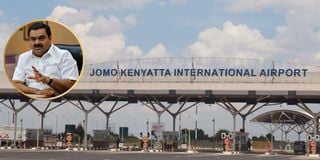
Kenya Airports Authority (KAA) on Tuesday confirmed that the Sh258 billion Adani deal for the renovation and expansion of the Jomo Kenyatta International Airport (JKIA) was officially cancelled.
Appearing before the High Court for the mention of the case, the authority tabled a letter stating the cancellation of the multi-billion shilling deal with India’s Adani Group.
But even confirming the cancellation of the deal, the court declined to lift a conservatory order issued in September 2024.
The court instead directed the case filed by activist Tony Gachoka and Mount Kenya Jurists to be heard on April 17.
The Indian firm had proposed to upgrade the airport, including the construction of a second runway and a new passenger terminal under a 30-year-build-operate-transfer (BOT) contract, in the deal.
The deal was, however, cancelled following an uproar by Kenyans.
Other than the upgrade of JKIA, Adani Group had also bagged an energy transmission deal with the Kenya Electricity Transmission Company (Ketraco).
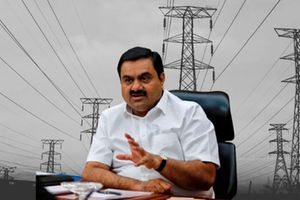
Indian billionaire Gautam Adani speaks during an inauguration ceremony after the Adani Group completed the purchase of Haifa Port earlier in January 2023, in Haifa port, Israel January 31, 2023.
Photo credit: Amir Cohen | Reuters
Mr Gachoka and the lobby group challenged the leasing plan, arguing that the entire process was done in secrecy.
The petitioners stated in the case that Section 3 of the Public Private Partnership Act does not contemplate a scenario where the government would alienate the already existing projects in favour of a private citizen, especially where the citizens have invested public funds into the project.
Adani Group had defended the deal, arguing that it intended to upgrade JKIA into a world-class airport.
Court documents showed that the Indian company sent the proposal for a privately-initiated proposal (PIP) to KAA on March 1, 2024 and 17 days later, the application was cleared and Adani Airports Holdings ltd given the greenlight to proceed with the feasibility study.
Another case had been filed by the Law Society of Kenya (LSK), Katiba Institute and Kenya Human Rights Commission (KHRC) challenging the deals.
The LSK had challenged the project, arguing that it was reached in an opaque manner, with no meaningful public participation, and the government deliberately concealed crucial information about the project.
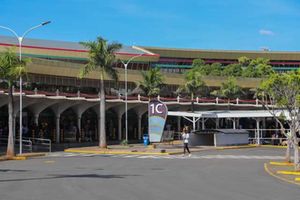
Travelers at Jomo Kenyatta International Airport in Nairobi.
Photo credit: Wilfred Nyangaresi | Nation Media Group
The organisations argued that JKIA is a strategic and profitable national asset and the deal is, therefore, irrational and violates the principles of good governance, accountability, transparency, and prudent and responsible use of public money.
Other than quashing the deals, the lobby groups have also challenged the constitutionality of some sections of the Public Private Partnerships Act, arguing that they are in violation of the constitution.
The organisations argued that some sections of the Act undermine the constitutional framework for checks and balances by excluding parliamentary approval for Privately Initiated Proposals (PIPs).
Katiba Institute further said that by making discretionary the decision whether PIPs should be subjected to open competitive tendering, section 44(5) and (6) of the PPPA violates Article 227 of the Constitution, hence unconstitutional.
“The handling of the JKIA deal raises substantial doubts about the capacity of any subsequent processes related to the project guaranteeing fairness under Article 227 of the constitution,” Katiba Institute said.
The organisation said in the 2024 Budget Policy Statement, the PPP directorate revealed that a total of 31 projects were in the pipeline and at various stages, with most of them at the procurement stage.