‘A right without a budget is just a slogan’: Ruto’s wake-up call to Africa
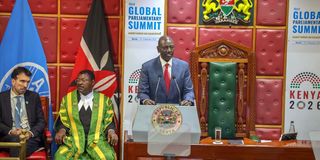
President William Ruto addresses delegates during the Third Global Parliamentary Summit Against Hunger and Malnutrition at the National Assembly Chambers on Monday, November 16, 2026.

“Today, a mother in Africa is deciding which of her children eats first,” President William Ruto said as he challenged African parliaments to abandon decades of diplomatic rhetoric, demolish trade barriers, and put real domestic money behind the continent’s right to food.
Addressing over 250 lawmakers from more than 100 national parliaments gathered in the Kenya National Assembly’s debating chamber for the third Global Parliamentary Summit on Hunger and Malnutrition. President Ruto delivered a stark wake-up call.
The summit marks a historic milestone, the first time the global assembly has been hosted on African soil, following previous editions in Spain in 2018 and Chile in 2023.


With one in five Africans facing malnourishment, the Kenyan president argued that hunger is no longer a technical problem, but a failure of legislative will and financial architecture.
"As a continent, we must not look for solutions elsewhere when we have solutions here, in our continent," said President Ruto as he challenged the delegates.
This even as the Head of State revealed that Africa holds $4 trillion of its own money locked in pensions and savings while questioning the financial wisdom of keeping these funds in foreign banks for meager returns.
"Why do we save our money in banks where we get 1 percent, when we can save it in our African financial institutions?"
Yet, beneath the ceremonial pomp of parliamentary diplomacy lay a stark and uncomfortable reality of corruption.
As the lawmakers convened under the summit theme, “legislating for resilient agrifood systems and zero hunger in a changing climate,” the human cost of legislative inaction hung heavy over the room.
Data from the World Bank and the Ethics and Anti-Corruption Commission (EACC) show that Kenya is estimated to have lost between Sh1.48 trillion and Sh2.43 trillion to corruption and governance-related leakages over the past four years- 2022 to 2026.
The World Bank’s economic update for November 2026 shows that Kenya lost $2.8 billion, about Sh370 billion annually and Sh1.5 trillion in the last four years in direct fiscal drain from governance weaknesses, inflated project costs and lost public revenue.
The EACC, on the other hand, shows that Sh608 billion is lost annually, culminating in Sh2.43 trillion in the last four years, an official benchmark that has previously been cited by the government leadership, in systemic graft.
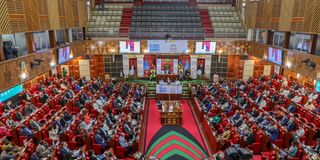
Delegates follow the proceedings as President William Ruto addresses the Third Global Parliamentary Summit Against Hunger and Malnutrition at the National Assembly Chambers on November 16, 2026.
Data also shows that broad procurement and mismanagement estimate up to Sh1.1 trillion and Sh4.4 trillion lost through procurement leakages, illicit financial flows and county-level audit queries.
Kenya’s entire population is roughly 56 million and according to 2026 Integrated Food Security Phase Classification (IPC) assessments, between 2.7 million and 3.7 million Kenyans face crisis-level hunger, while approximately 883,000 children under five require treatment for acute malnutrition.
Therefore, depending on the type of life-saving intervention, the Sh1.48 trillion to Sh2.43 trillion lost to corruption over the last four years could have funded emergency food relief for 101 million to 167 million people for a full year.
The amount is also enough to cure 75 million to 124 million severely malnourished children in the country.
According to UNICEF and medical relief benchmarks, a full six-to-eight-week course of Ready-to-Use Therapeutic Food (RUTF) to pull a child back from severe acute malnutrition costs roughly $50, about Sh6,500.
The lost funds could have treated 227.7 million to 374.2 million children and enough to cure Kenya’s current annual caseload of 883,000 malnourished children 250 to 420 times over.
During the 2026 drought response, the Kenyan government budgeted about Sh4 billion per month to provide emergency food and cash transfers to 3.3 million hunger-stricken citizens, working out to approximately Sh1,212 per person per month or Sh14,545 per year.
Food vs corruption
At that rate, the money lost to corruption could have fed 101.7 million to 167.2 million people for an entire year.
Beyond the direct cash stolen, the World Bank’s November 2026 economic update notes that corruption widens Kenya’s fiscal deficit by approximately 2 percent of GDP and doubles the cost of basic infrastructure, power and logistics compared to global peers.
By comparison, in its 2024/2025 operational cycle, the EACC recovered Sh3.4 billion in corruptly acquired assets and averted Sh16.5 billion in potential losses, a fraction of the hundreds of billions lost each year.
Globally, about 700 million people suffer from malnutrition and across Africa, one in every five citizens goes to bed malnourished.
The Eastern Africa region, despite accounting for less than a quarter of Sub-Saharan Africa’s population, shoulders more than half of the continent’s food insecurity burden.
For President Ruto, these numbers represent not an act of nature, but an indictment of governance.
For decades, global discussions on African food security have followed a familiar script; climate shocks strike, harvests fail and leaders appeal to international donors for emergency relief.
But during the summit, President Ruto systematically dismantled that story, challenging the lawmakers to reject a posture of perpetual dependency.
"The responsibility is ours. We must solve this hunger problem," declared President Ruto while tying the continent's agricultural future directly to the implementation of the Kampala Declaration.
The Kampala Declaration is a 10-year African Union roadmap, 2026–2035, adopted in January 2025 to end hunger, boost agricultural output by 45 percent, mobilize $100 billion in investment and transform Africa’s entire food value chain.
Building on the earlier Maputo 2003 and Malabo 2014 declarations, the Kampala Declaration shifts Africa from focusing solely on farming to building resilient, end-to-end agrifood systems, covering production, local processing, trade, climate resilience and nutrition.
Warning that continental frameworks will succeed or fail based on the laws National Assemblies, including Kenya’s, enact, President Ruto left the lawmakers with an ear-splitting legislative test.
"A right without a law waits; a law without a budget waits even longer. Legislate the right and give practical effect to the right to food. A right without a budget line is a slogan," the President challenged the lawmakers.
While acknowledging that erratic weather patterns, prolonged droughts and shifting climate realities severely batter African farmers, the President ‘refused’ to let climate change become a convenient excuse for policy paralysis.
“We must build an Africa that feeds itself, creates wealth from its agricultural resources and makes its full contribution to feeding the world,” the President said, adding; “and together, we must build a world in which no child goes hungry.”
He noted that the continent possesses the land, water, human capital and scientific capacity to become the world’s breadbasket if it sets out its collective ambition.
At the same time, President Ruto aimed sharp criticism at an international financial regime “that routinely punishes developing nations with punitive borrowing costs when they seek capital for climate adaptation and agricultural infrastructure.”
The rules of global finance, Dr Ruto insisted, cannot remain a unilateral command imposed on the Global South; “they must be renegotiated internationally so that African economies can access fair, long-term development financing.”
However, his sharpest rebuke was reserved for Africa’s own self-inflicted wounds specifically Kenya that has an insatiable appetite to pile up its debt stocks with expensive commercial loans sourced both locally and internationally.
Across the continent, intra-African agricultural trade remains stifled by bureaucratic red tape, non-tariff barriers, punitive border levies and fragmented customs regimes.
It is often easier and cheaper to import grain from outside the continent than to move surplus harvest across a neighboring African border.
With this, President Ruto challenged the national parliaments to use their legislative authority “to sweep away these unnecessary trade barriers,” warning that regional integration will remain an empty promise “so long as food cannot move freely from areas of surplus to areas of deficit.”
The president noted that for years, African governments have looked outward to Washington, Brussels, or Beijing to finance dams, irrigation schemes and rural roads, while allowing vast pools of domestic wealth to sit idle or flow abroad.
The President pointed out that Africa holds an estimated $4 trillion of its own money locked up in domestic pension funds, insurance pools and institutional savings.
“Rather than deploying that capital to build resilient food systems and agro-industrial value chains at home, much of it is parked in low-yield foreign instruments or conservative commercial banks.”
This, as he questioned the financial logic of this investment model.
To demonstrate that domestic resource mobilization is achievable, President Ruto pointed to Kenya’s own fiscal turnaround, noting that over the past few years, Kenya has grown its domestic savings kitty from $2.2 billion to $7 billion.
Mobilizing such internal capital forms the backbone of the Ruto administration’s strategy to fund large-scale infrastructure “without sinking deeper into unsustainable external debt.”
Anchored on the National Infrastructure Fund (NIF), a strategic financing vehicle designed to leverage national revenues, asset privatization proceeds and public-private partnerships, Kenya is pushing forward an ambitious plan to construct 50 mega dams, alongside 200 medium and small dams in a span of seven to 10 years.
The goal is to bring at least 2.5 million additional acres under irrigation and decisively break Kenya’s century-old dependence on unpredictable rain-fed agriculture, which currently forces the country to spend about Sh500 billion annually on food imports.
However, Kenya is still grappling with stalled, multibillion-shilling legacy dam projects, most notably the Arror, Kimwarer, Thwake and Itare, where taxpayers lost billions to inflated contracts, legal disputes and unresolved land compensation issues.
“He should complete the existing stalled dams before launching 50 new mega ones and others,” says Bumula MP Jack Wamboka.
Tetu MP Geoffrey Wandeto, notes that a single mega dam typically requires three to five years of feasibility studies, environmental impact assessments, land acquisition and engineering designs “before construction even begins.”
“Delivering 50 mega dams within a five-to-seven-year window is seen as physically and logistically implausible,” says Mr Wandeto.
But to counter skeptics who doubt whether state-backed agricultural reforms can yield rapid results, President Ruto turned the National Assembly chamber into a showcase of Kenya’s recent agricultural gains under his administration’s Bottom-Up Economic Transformation Agenda (BETA).
President Ruto announced that Kenya’s annual milk production has surged by one billion liters, climbing from roughly 4.5 billion liters to 5.6 billion liters.
Bolstered by subsidized sexed semen, expanded artificial insemination, livestock vaccination drives and higher farm-gate prices, Kenya has cemented its place as the highest producer of milk in Africa, overtaking traditional continental heavyweights.
But despite this claim, there is currently a milk shortage in the market, with State-operated New Kenya Cooperative Creameries (New KCC) suspending its production operations due to lack of milk.
This may have informed the absence of New KCC products on the shelves of retail outlets, including supermarkets.
Turning to a sector long plagued by mismanagement, crushing debts and delayed payments, President Ruto highlighted sweeping structural reforms across state-owned and private sugar mills.
With cane prices raised to Sh5,500 per tonne and mill operations streamlined, “sugarcane farmers are now receiving annual bonuses for the first time in Kenya’s history.”
The President projected that within the next two to three years, Kenya will eliminate its chronic sugar deficit and transition into a net exporter of sugar, even as manufacturers across all sectors of the economy complain about the high costs of production.
This, as the government stalls on the exploration of clean energy sources like wind and geothermal, as well as hydro.
Follow our WhatsApp channel for breaking news updates and more stories like this.