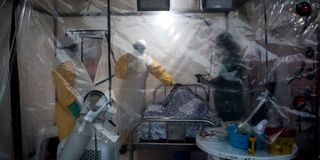
The Democratic Republic of Congo is once again facing an outbreak of the Ebola virus disease, the 16th time the country will be facing the scourge.
Officials said the disease had re-erupted in the health zones of Bulape and Mweka in Kasai Province, where health authorities had on Wednesday launched investigations following reports of cases and deaths exhibiting symptoms such as fever, vomiting, diarrhoea, and haemorrhaging. Samples analysed on September 3 at the National Institute for Biomedical Research in the capital, Kinshasa, confirmed the outbreak.
This marks the 16th Ebola outbreak in the country’s history. The last outbreak had been in April 2022 and it lasted three months. The deadliest epidemic took place between 2019 and 2020 in North Kivu, resulting in 2,232 deaths.
It means the DRC has been familiar with Ebola since 1976, when the virus was first identified in northwestern Congo by a team of Belgian, French, and Congolese virologists, including Dr Jean-Jacques Muyembe, now the Director-General of the National Institute for Biomedical Research. According to experts, the repeated resurgence of epidemics has enabled the country to develop a robust capacity to combat such diseases.
The Minister of Health has expressed concern over the current situation, citing the rising death toll. “As of now, the provisional count stands at 28 suspected cases and 16 deaths, including four health workers. The fatality rate, estimated at 57 percent, underscores the gravity of the situation. However, I must emphasize that these figures are provisional, as investigations are ongoing and further biological confirmations will provide a clearer picture,” said Minister of Public Health Samuel Roger Kamba on Thursday.
Provincial authorities, with support from partners, have initiated an emergency response. Measures include active case finding, contact tracing and monitoring, the establishment of treatment centres, and community awareness campaigns. The Ministry of Public Health, Hygiene and Social Welfare is urging community mobilisation to help curb the spread of the virus. Minister Kamba is calling on the public to adhere to preventive measures, particularly by avoiding contact with individuals who are ill or deceased and suspected of having Ebola.
A national rapid response team, composed of World Health Organization (WHO) experts in epidemiology, infection prevention and control, laboratory diagnostics, and case management, has been deployed to Kasai Province to reinforce surveillance, treatment, and infection control in health facilities. Provincial risk communication experts have also been dispatched to educate communities on how to protect themselves.
Mweka Territory, currently affected by the outbreak, has previously experienced Ebola epidemics in 2007, 2008, and 2011. The deadliest occurred in 2007, with over 260 cases and 187 deaths, according to health sources.
The DRC, already grappling with outbreaks of Mpox and cholera, must now confront the spread of Ebola. According to the WHO, “the number of cases is expected to increase with continued transmission.” The country remains among the most vulnerable to zoonotic diseases.
In response, the WHO has announced the delivery of two tonnes of supplies, including personal protective equipment, mobile laboratory tools, and medical provisions. “We are acting decisively to quickly stop the spread of the virus and protect communities,” said Dr Mohamed Janabi, WHO Regional Director for Africa.