At the France-Africa Summit, the organisers have arranged meetings focusing on seven key themes to ‘shape Africa’s future’. These include reforming the international financial system, energy, green industrialisation, the blue economy, peace and security, trade, sustainable agriculture and food systems, and AI.
On Saturday, Prime Cabinet Secretary Musalia Mudavadi said that Kenya is hosting the event because it believes in discussions that affect the future. He also said that this is part of recent efforts to establish Nairobi as a diplomatic hub in Africa.
But Mr Mudavadi acknowledged that the actual outcomes would depend on the priorities of the participating countries.
“The success of the Africa Forward Summit will be defined by the transformative outcomes we achieve together,” Mr Mudavadi, who is also the Foreign and Diaspora Affairs Cabinet Secretary, told a media briefing in Nairobi.
“We expect this historic gathering to deliver strong, actionable partnerships to drive meaningful and lasting progress for the people of Africa,” he said, adding that, besides creating realistic opportunities for African businesses and products, it should also rebuild ‘deeper trust and understanding between nations’.
However, the success of the summit will depend on what each country wants to achieve. It also depends on which countries each invited country sends to Nairobi. Kenya, in particular, is keen to build on growing business ties.
France has expanded its investment from traditional sectors into digital innovation, AI and green energy. Over the past decade, French foreign direct investment (FDI) in Kenya has tripled.
At this summit, Kenya is expecting to secure a deal to support the local production of vaccines for tropical diseases, as well as commitments from the World Health Organization and Gavi to guarantee markets for these vaccines.
“We will achieve an outcome that addresses the priorities of Africa as well as the interests of France,” said Korir Sing’oei, the PS for Foreign Affairs.
For France, this is an opportunity to improve its image in Africa.
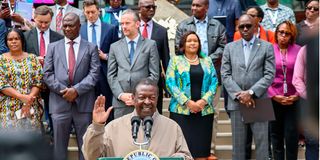
Cabinet Secretary for Tourism and Wildlife Rebecca Miano (left), Prime Cabinet Secretary and Cabinet Secretary for Foreign and Diaspora Affairs Musalia Mudavadi, French Ambassador to Kenya Arnaud Suquet and Principal Secretary for Foreign Affairs Dr Korir Sing’oei, hold a symbolic key at Kenyatta International Convention Centre, in Nairobi on May 9, 2026.
Photo credit: Wilfred Nyangaresi | Nation Media Group
Arnaud Suquet, the French ambassador to Kenya, said that Paris has ‘taken responsibility’ for its past actions in Africa. Now, he said, it wants a beneficial partnership. France is also keen to cooperate on maritime security to protect its overseas territories in the Indian Ocean. They want legitimate business, too.
“We are open to criticism, but we want to establish a new partnership that benefits both sides. A prosperous Africa is in France’s interest,” he said. As part of the European Union, France is attempting to reposition itself in Africa amid growing geopolitical competition from the US, China, Russia, the Gulf states, and emerging middle powers.
Some 39 African countries have confirmed they will be taking part in the Summit. Of these, 30 are sending heads of state or government. According to an official, but provisional, itinerary, two countries are sending vice presidents, six countries are sending ministers, and one country is sending a special envoy.
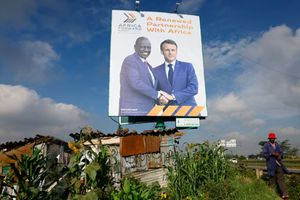
The summit is themed ‘Africa-France: Partnership for Innovation and Growth’. Hosted jointly by Kenya and France, it comes at a time when African countries are seeking new financing models, technology partnerships and industrialisation opportunities, as well as greater influence in global governance systems.
Participating countries are expected to use the summit to pursue sector-specific interests relating to green energy, digital technology, agriculture, health, manufacturing, maritime trade, infrastructure, and peace and security. Other East African countries attending the summit include Rwanda, Tanzania, Uganda, Somalia, Burundi and Djibouti. While the rest have confirmed sending their heads of state, Uganda is expected to send a ministerial representative.
Rwanda is expected to market itself as a regional innovation and services hub. Kigali has invested in digitisation, smart governance and green mobility; thus, it is likely to seek partnerships in AI, aviation, clean transport and technology incubation.
Somalia and Burundi may focus more on peace-building support, institutional financing and economic recovery initiatives. Somalia, in particular, is expected to lobby for stronger international support for stabilisation and maritime security.
Djibouti’s interests are likely to centre on logistics, ports and maritime trade given its strategic position along one of the world’s busiest shipping routes.
Uganda and Tanzania are expected to seek partnerships in agriculture, energy and mineral value addition. Tanzania may also pursue investments linked to maritime infrastructure and transport connectivity.
Countries from West Africa, including Nigeria, Senegal, Côte d’Ivoire, Sierra Leone, Togo and Benin, are expected to focus heavily on financing, industrialisation and security cooperation. They lie close to the Sahelian countries: Burkina Faso, Niger and Mali who are battling insurgencies. These three countries are expected to skip the meeting in Nairobi as they hadn’t confirmed participation by Saturday evening. They had previously accused France of interference.
Nigeria, one of Africa’s largest economies, is likely to pursue partnerships in artificial intelligence, digital infrastructure and energy transition. With its fast-growing technology ecosystem, Abuja may also seek French investment into start-ups, fintech and innovation hubs. Nigeria’s large population and manufacturing ambitions make it a key player in discussions on industrialisation and job creation.
Senegal and Côte d’Ivoire are expected to prioritise agricultural value chains, infrastructure financing and food security partnerships. Security discussions are likely to be particularly important for Chad given the instability in the Sahel region.
Togo and Sierra Leone may focus on maritime trade and the blue economy, especially around port development, shipping and fisheries management. The summit’s emphasis on maritime governance and decarbonisation of transport presents an opportunity for coastal West African states to attract investment into ports and logistics systems.
North African countries such as Egypt, Morocco, Tunisia, Algeria and Mauritania are expected to use the summit to deepen their industrial and diplomatic influence across Africa.
Morocco, which has aggressively expanded banking, fertiliser and renewable energy investments across Africa, is expected to focus on green industrialisation, agribusiness and trade integration.
Southern African nations attending include Zambia, Namibia, Mozambique, Malawi, Zimbabwe, South Africa, Lesotho, Botswana, Eswatini and Madagascar.
Zambia and the Democratic Republic of Congo are likely to advocate for value addition to critical minerals such as copper and cobalt rather than the continued export of raw materials. Both countries have increasingly pushed for local manufacturing and battery production partnerships.
South Africa is expected to pursue climate financing, industrial partnerships and technology transfer, especially around clean energy transition and manufacturing.
From Central Africa, the Republic of Congo and Chad are among the Central African countries that have confirmed attendance at the summit.
The Republic of Congo and Chad are expected to seek investments in infrastructure, oil and gas transition projects and agricultural development.